






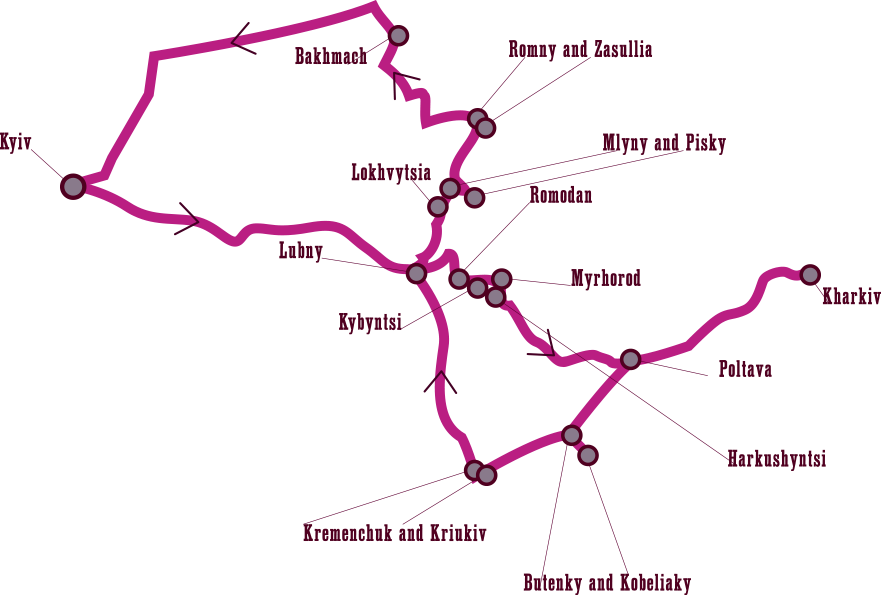















In 1920 huge travelling tour of group, that was named “The First Travelling Choral Capella of Dniprosoiuz” and in the future had become the basis of choir ”Dumka” (“National Ukrainian Travelling Capella”), took place around Left-bank Ukraine. Its aim was: the revival of Ukrainian folk song, its popularization, struggle “with very widespread in Ukraine hooligan-lackey songs”.
In 2003 a whole complex of unique materials from the personal archive of Hnat Yastrubetsky, Ukrainian cultural and musical figure of the 20s, came to Vinnytsia Regional Museum of Local History. Among the found documents was a handwritten "Diary of the first travelling choral capella of Dniprosoiuz" of the famous Ukrainian writer Stepan Vasylchenko, who accompanied the team on the journey in the summer of 1920. In May, 2019, work on the project of creating an interactive online map “The path of travelling capella. Executed voices”, where every stop has graphic sign with reference to authentic iconographic material and videos with elements of reconstructions of travel’s events, choral performances, locations, has started. Ukrainian Cultural Fund has supported the project within the competition program “Creating an innovative cultural product” – program of UCF. .

Lots of scientists agree that name “Darnytsia” come from phrase “give a present”.
The first mention about Darnytsia as a name of the river was in 1506. It is known that Mykilskyi and Pecherskyi abbeys of Kyiv were fighting for acres of Darnytsia during years, but the area was faintly inhabited. Only after Kyiv-Poltava railway construction in the end of XIX century (1899), settlement of railwaymen was formed around modern Prazka street (so-called Old Darnytsia). In 1896 near current Park of Partisan’s Honour came to life New Darnytsia village.
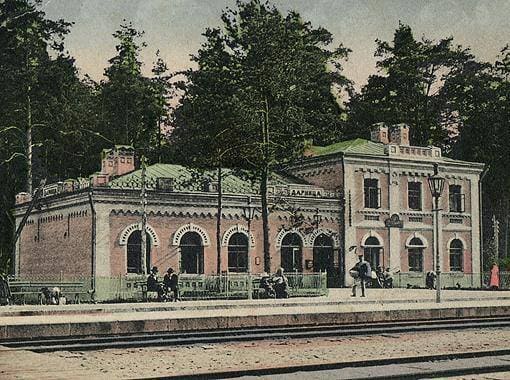
Railway station Darnytsia XX century. Public property
Darnytsia was famous as strategic railway knot, for which there were lots of battles at the beginning of XX century and during civil war.
The first travelling choral capella of “Dniprosoiuz” went to Left-bank Ukraine for “giving” Ukrainian song as a present on 12 th of July in 1920.
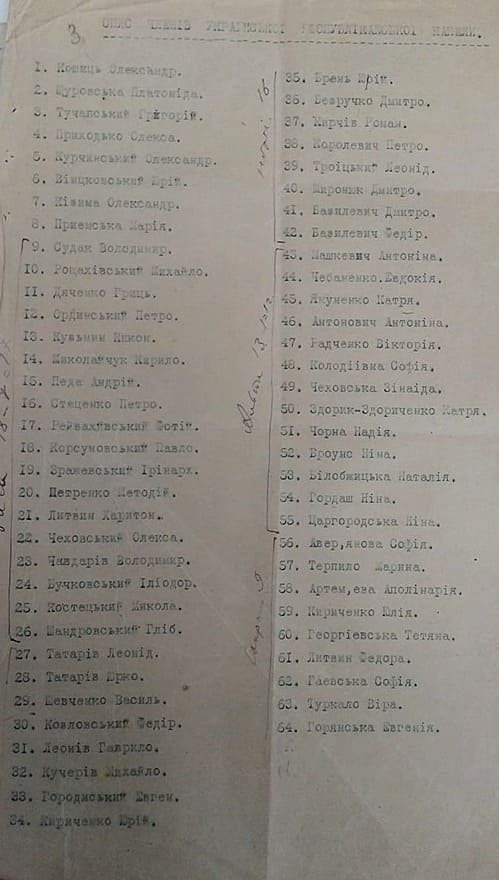
The list of The first travelling choral capella. 1920. Public property
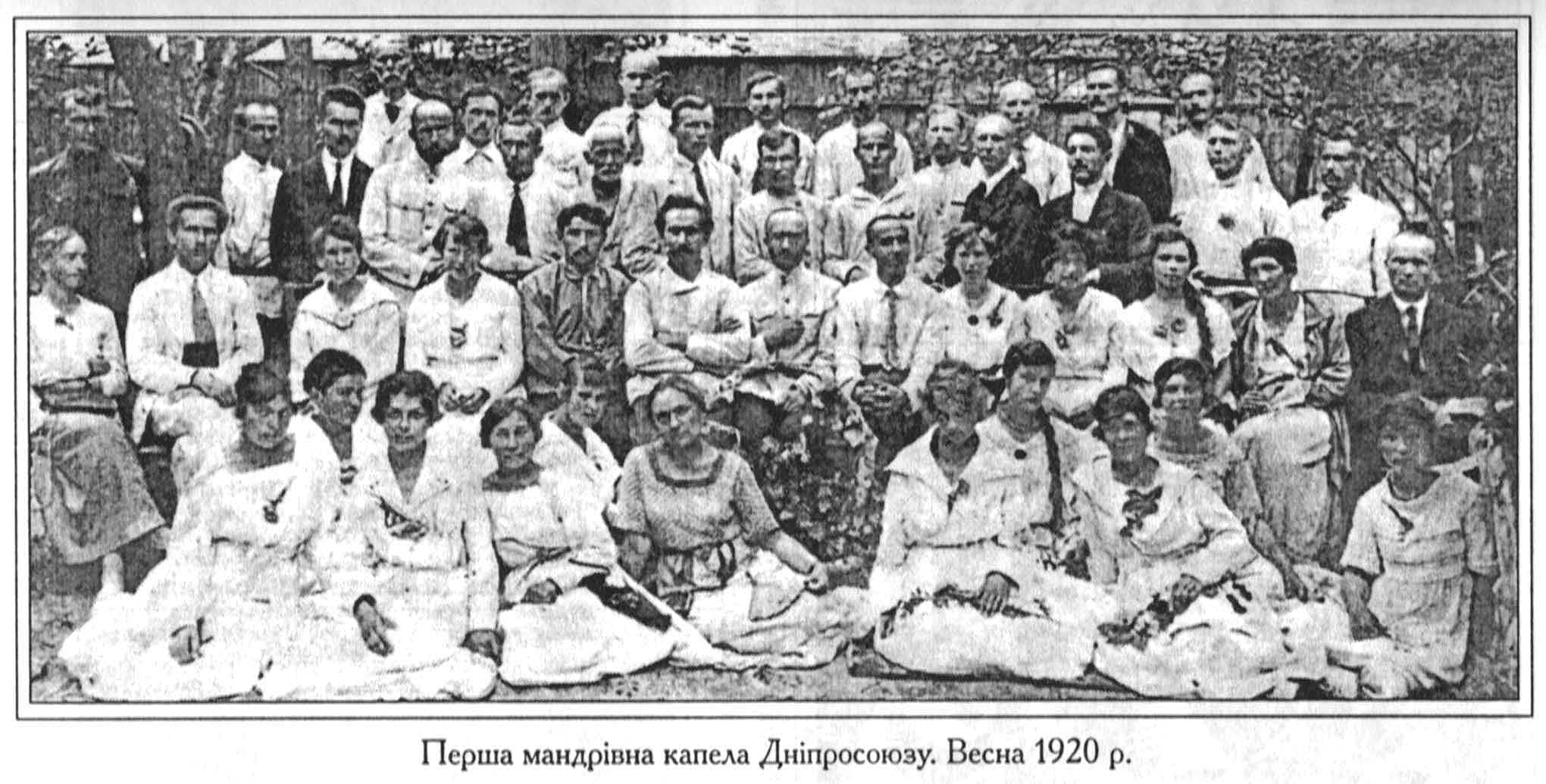
The first travelling choral capella of “Dniprosoiuz” 1920. Public property
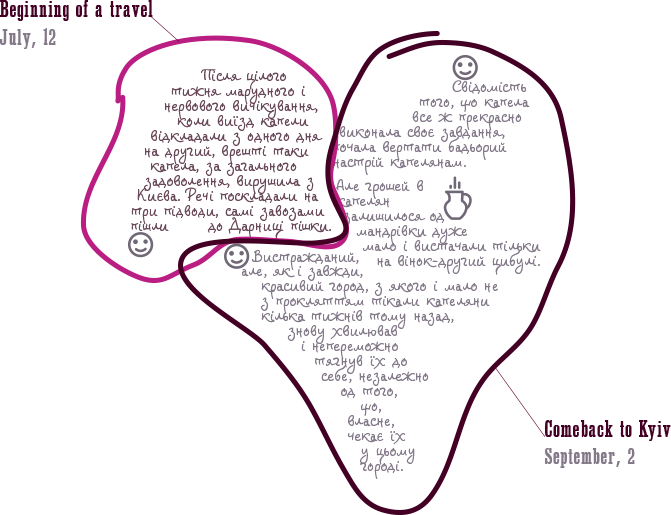



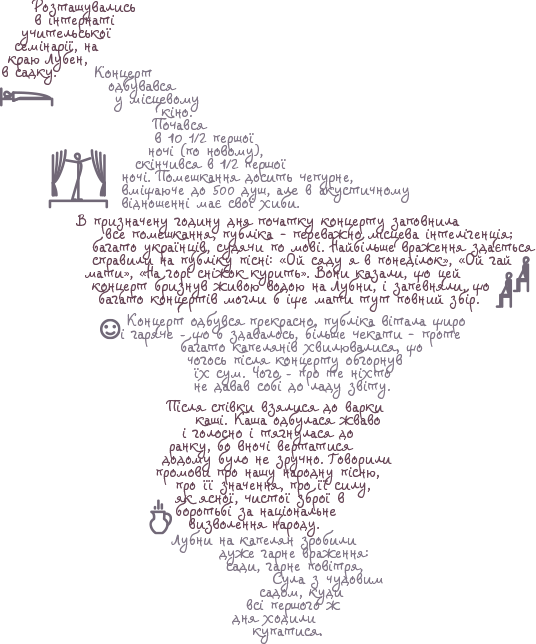
According to Stepan Vasylchenko’s diary, local choirs were acting in Lubny at the beginning of XX century. One of them was choir within Authocephalous Church under command of famous Ukrainian composer Hryhorii Davydovskyi. Choir had become glorious among locals and could play on tour by Ukraine.
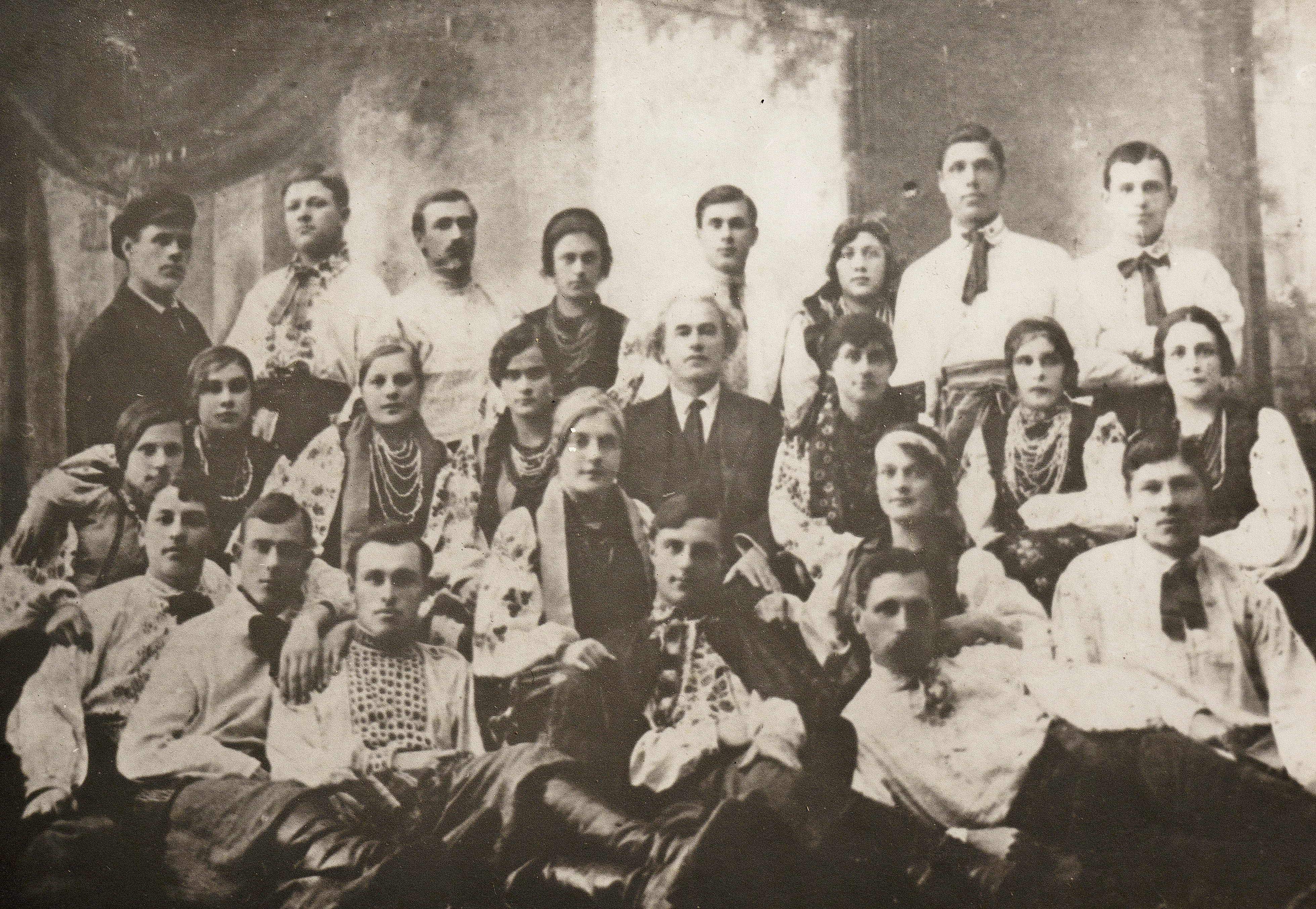
Choir in Lubny together with conductor Davydovskyi in 1920. From archive in Museum of local history in Lubny
Hryhorii Mytrofanovych Davydovskyi (1866-1952) was a choir conductor, composer, singer (tenor), teacher. Organiser and mentor of Ukrainian choral capellas (more than 35), especially in his native village Mel’na (1888), Saint Petersburg (1892-1902), Nice (1902-1903), Rostov-on-Don (1908; he played on tour by Russia until 1917), Moscow, Kyiv (1917-19, 1921), Vinnytsia (1923-26), Zhytomyr, Lubny, Kerch, Kharkiv (1944) and Poltava (1945-49). Thanks to choir-master’s skill of Davydovskyi, repertoire in his concerts got rich ton of voices, interpretations with elements of theatrics and effective choral imitations of instruments: technics of bandura, guitar, kobza. There were also Ukrainian folk songs. Suites “Bandura” (1896) and “Kobza” (1901) are famous till nowadays.
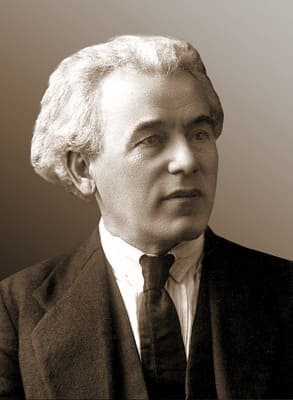
Hryhorii Davydovskyi. Public property
Contingency of meeting between choral capella of “Dniprosoiuz” with Davydovskyi’s choir is quite big. Because local national choir actively performed in Lubny in 20s of XX century.

The town Romodan was formed at the end of XIX century as a railway station, that was named after a neighbour village. Country’s name comes from old way of Romodan: romodan means “big road”. According to one recitation, the name of the way comes from surname of voyevoda Romodanovskyi. According to another, more truthful, it comes from chumak Romodan. The village started from Putyvl, went through Smile (village in Romny district of Sumy region nowadays), crossed Sula, then went through watershed between Sula and Chorol (tributary of Psel) through modern countries Semenivka, Globyne, and came to Dnipro near Kremenchuk. At the end of XVIII willows were planted around the Romodanivskyi way. This way held to be one of the most important roads, by which chumaks went to Crimea, until railways were routed in 60s-80s XIX century.
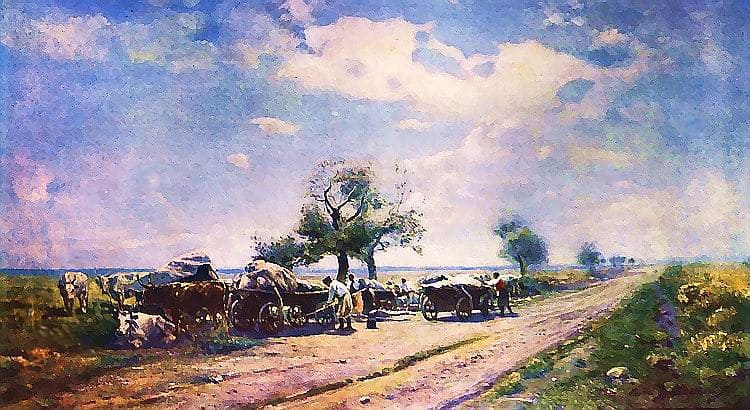
Sergiy Vasylkivskyi’s painting (near 1900). “Chumaks’ Romodanivskyi way”. Public property
Construction of railways started in 1880s and finished in 1896. Railway house was adapted not only for meetings of guests, but also functioned as a place for performances of local amateurs. Workers of railways met in the railway depot and conducted rehearsals of theatricals after hard day or week. It was collective of amateurs, that was making concerts for country-folks.
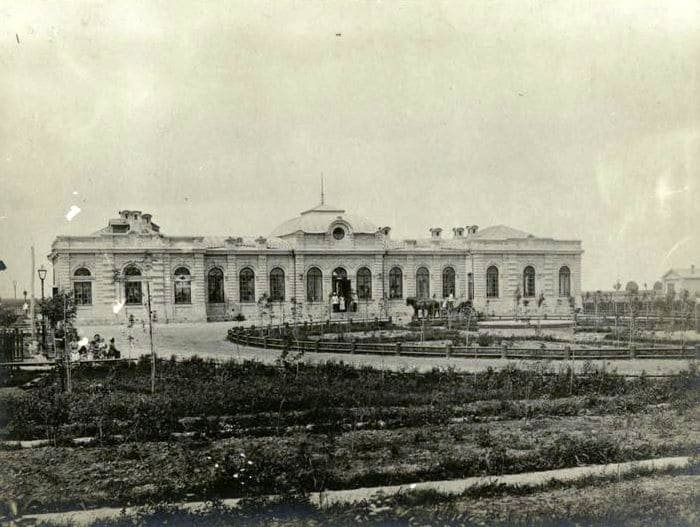
Railway station at the begging of XX century. Public property
At the end of XX century new railway station was build, because the previous hasn’t kept.
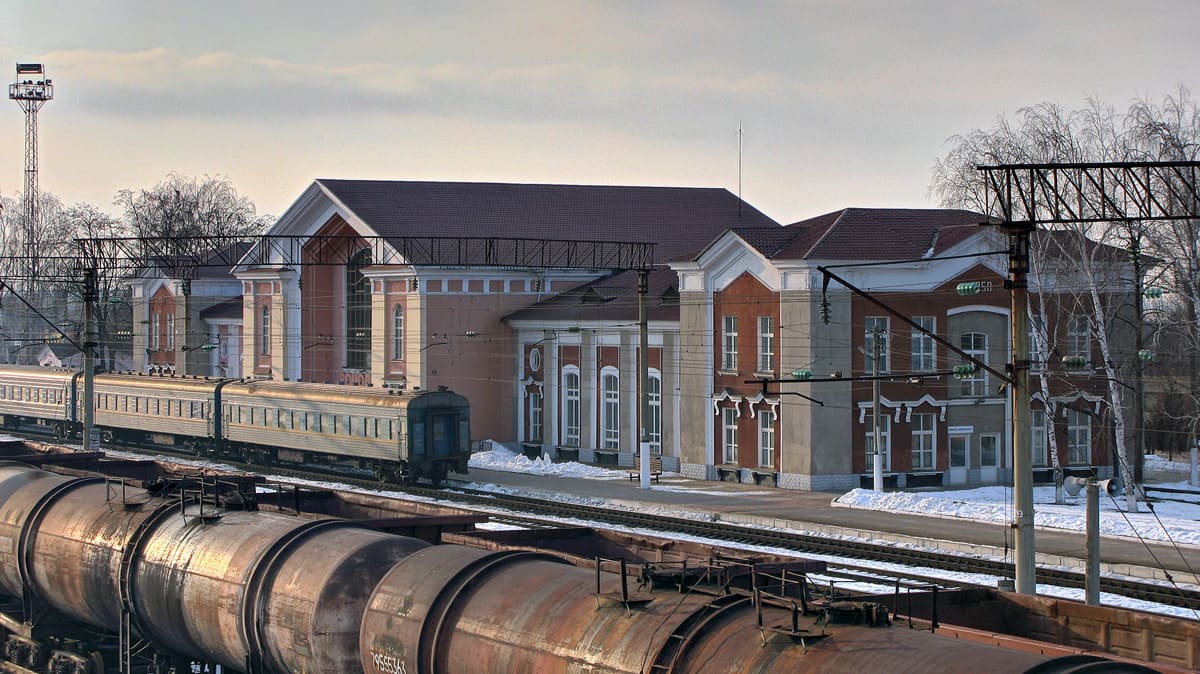
Modern view of station Romodan. Public property
Kybyntsi village is located in Myrhorod district within Poltava region, was founded in 1688.
In 1920 The first travelling choral capella performed for country folk in economical garden on the territory of previous Troshchynskyi’s county.
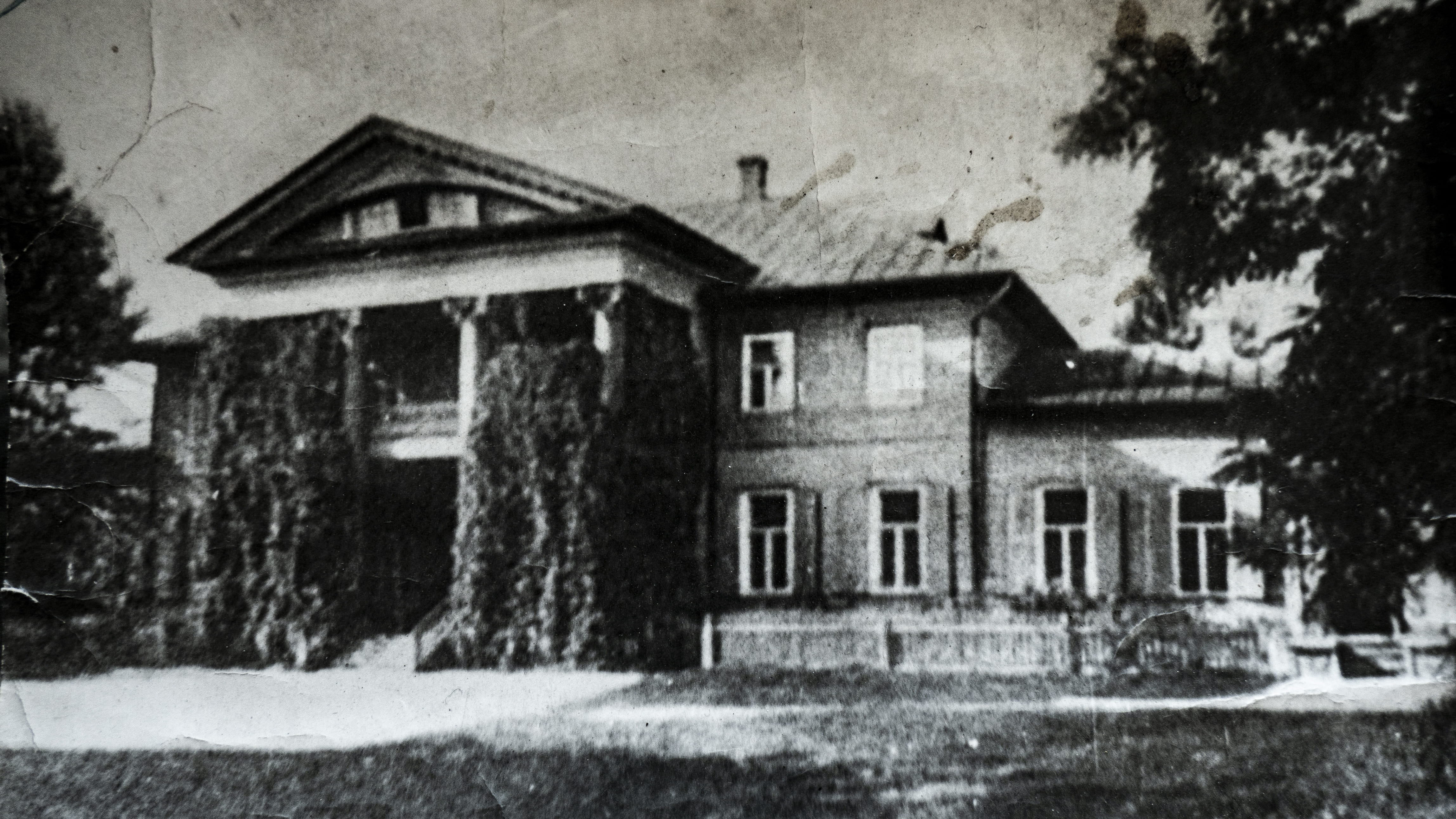
Troshchynskyi’s county XIX century. From school’s archive in Kybyntsi
Dmytro Troshchynskyi (1749-1829) is Ukrainian aristocrat of Cossacks chiefdom, statesman of Russian Empire. Patron of Ukrainian culture. In 1788 landlord bought a beautiful county with Italian sculptures, which was located on the hill near the picturesque pond. He lived there pretty long time (1806-1814, 1817-1829) and created “Little Rus’ Athens”. Library, art gallery, orchestra and theatre functioned here.
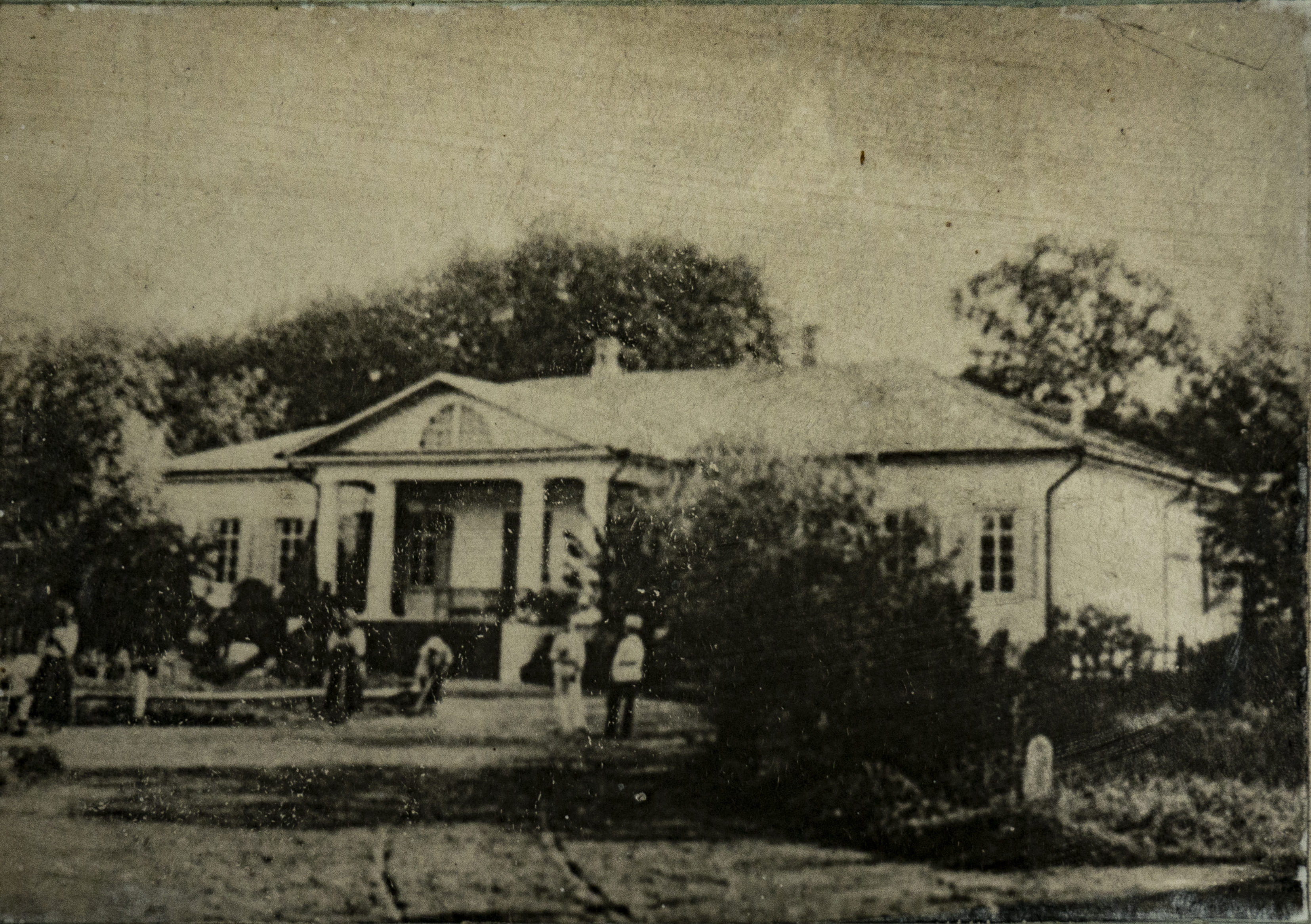
Troshchynskyi’s county XIX century. From school’s archive in Kybyntsi
Arena of the theatre has based just in the middle of the pond, where Mykola Hohol and his mother were playing, and father of the family, Vasyl Hohol-Yanovskyi, was creating stages of plays together with Vasyl Kapnist. A public figure I. Muraviov-Apostol often came to Kybyntsi. Troshchynskyi’s county was one of the heartbeat of Ukrainian culture at the first quarter of XIX c.
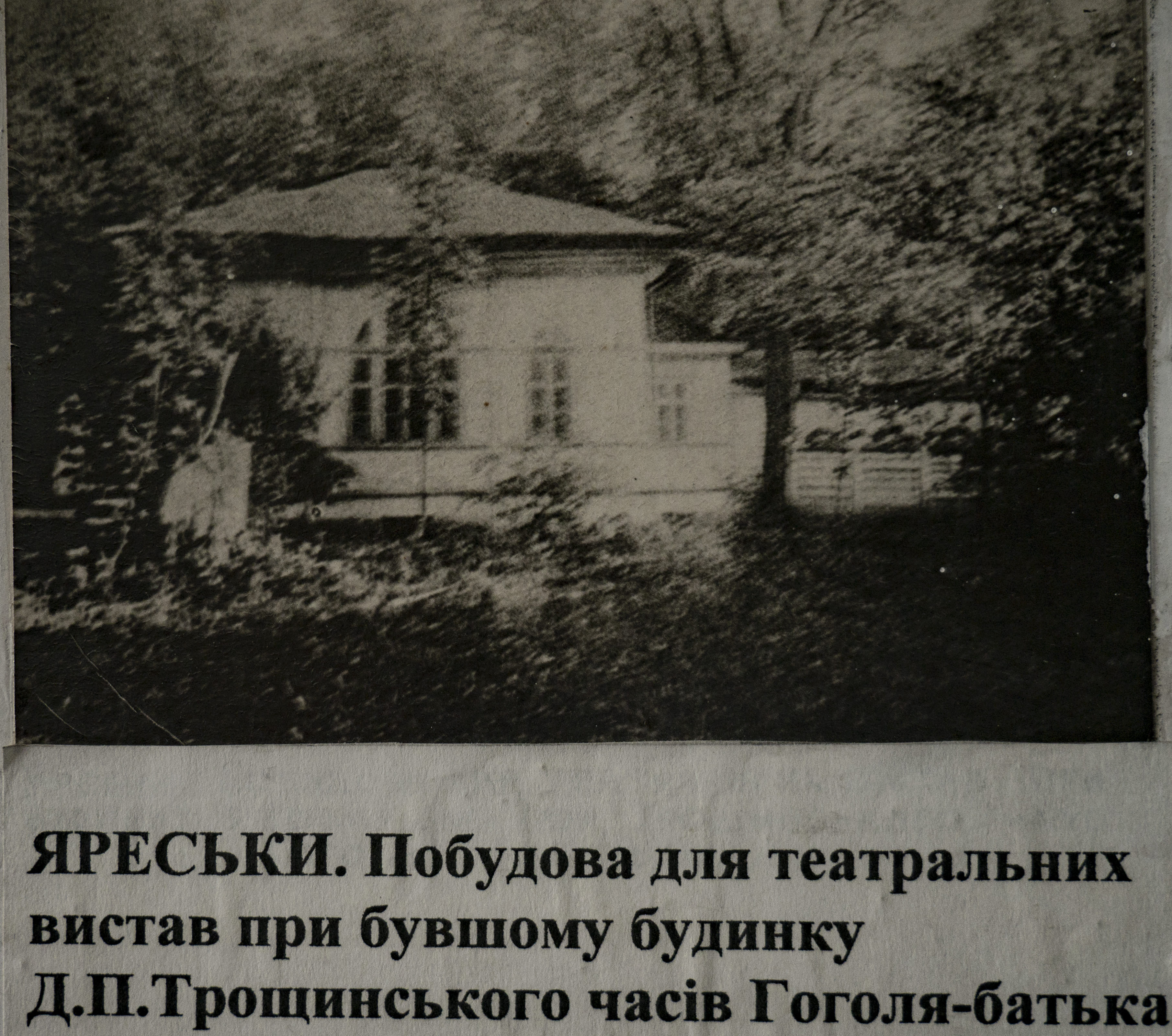
Troshchynskyi’s county. Annex of XIX c. From school’s archive in Kybyntsi
Landlord Shyshkin bought sir’s county (together with economy and horilka’s factory) after reform in 1861, and then he sold it to landlords Vulfert.
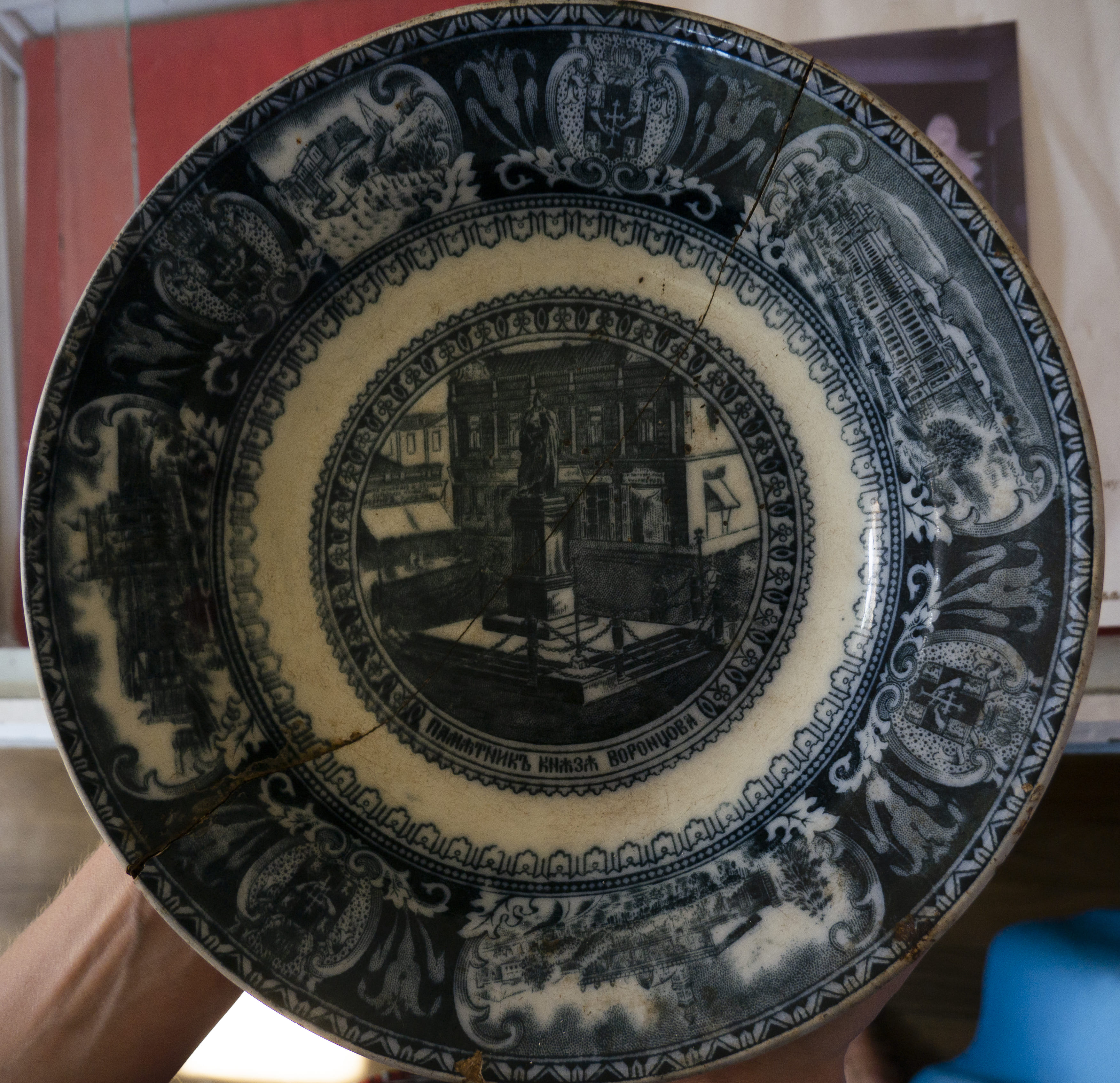
Dinnerware from Troshchynskyi’s county XIXc. From school’s archive in Kybyntsi
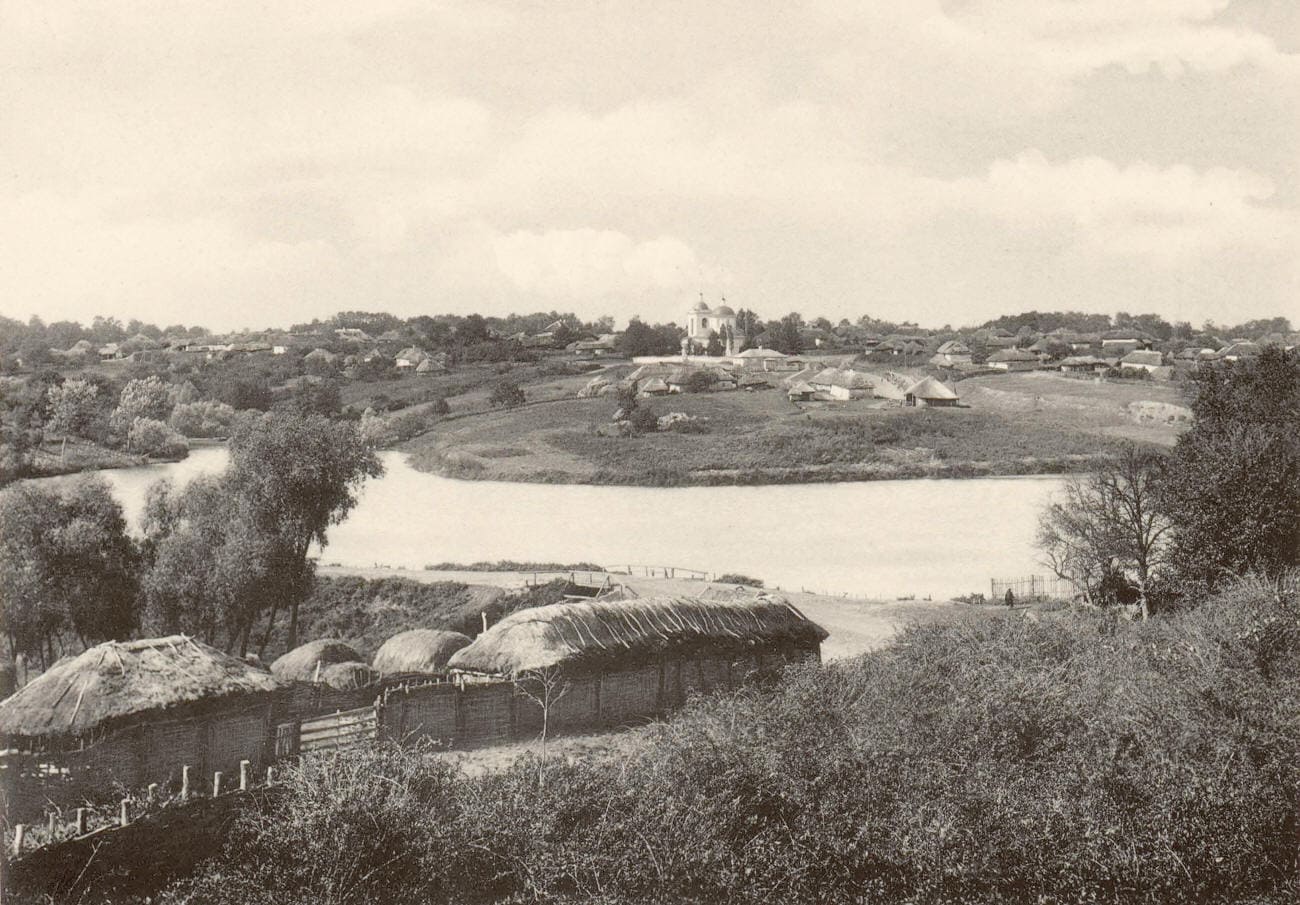
View from Troshchynskyi’s county XIXc. From school’s archive in Kybyntsi
Agricultural company was created in 1904. Pig farms, cylindrical flour-mill, two brickworks, horilka’s factory with annual alcohol production on price 10 000 karbovantsi existed at the beginning of XX c.
During wartime in 1918-20s governance was continually changing. During this time Troshchynskyi’s county was robbed and destroyed, only garden has left, where singers from capella had performed.
Nowadays there are only picturesque pond and unbelievably prodigal forest.
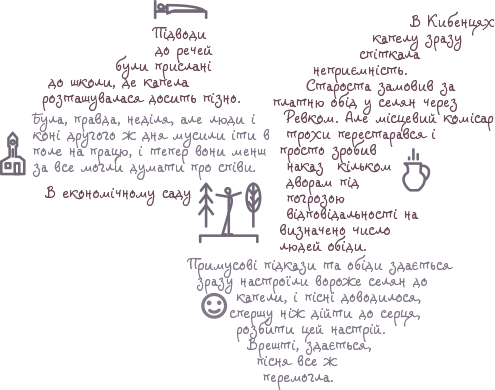
Myrhorod in Stepan Vasylchenko’s life
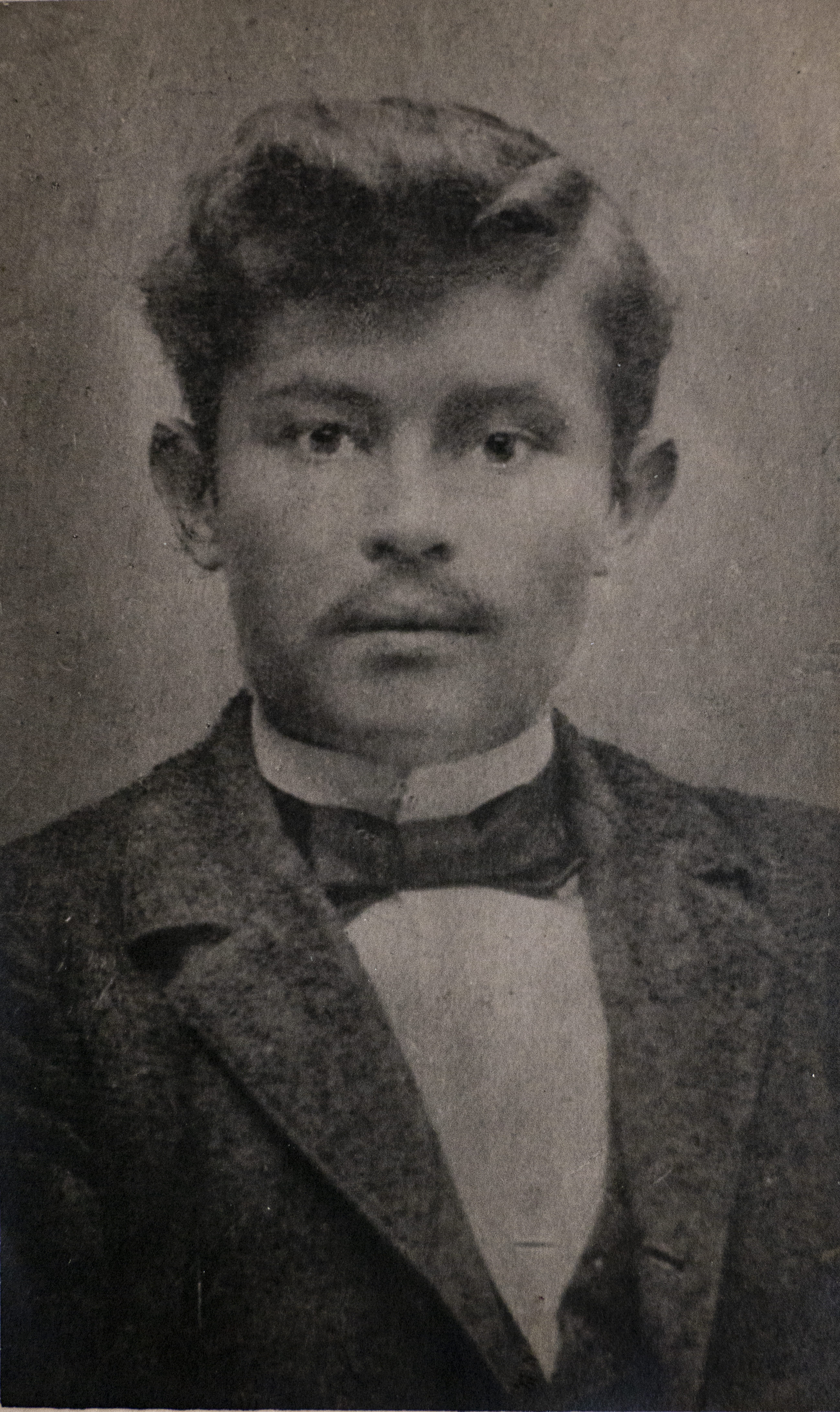
S. Vasylchenko 1920. From archive in Museum of local history in Myrhorod
From history of streets in Myrhorod
http://histpol.pl.ua/books/Rozsokha.L_Z_istoriyi_myrhorodskykh_%20vulyts.pdf
Lazorenka street
On the place of today’s building №18 at the beginning of XX century there was house of Cossack
Mykhailo Stepanovych Dubyna. His wife Paraskoviia Lukianivna was famous for weaving great “plakhta”
(part of a Ukrainian woman’s costume; piece of coarse hempen (linen) cloth) and had received many
prizes for it on provincial exhibitions. Their son Petro Mykhailovych and daughter Kylyna Mykhailivna
Dubyna (1893-1984), wife of the popular Ukrainian prosaist Stepan Vasylchenko (real surname
Panasenko; 1878-1932) were living there afterwards.
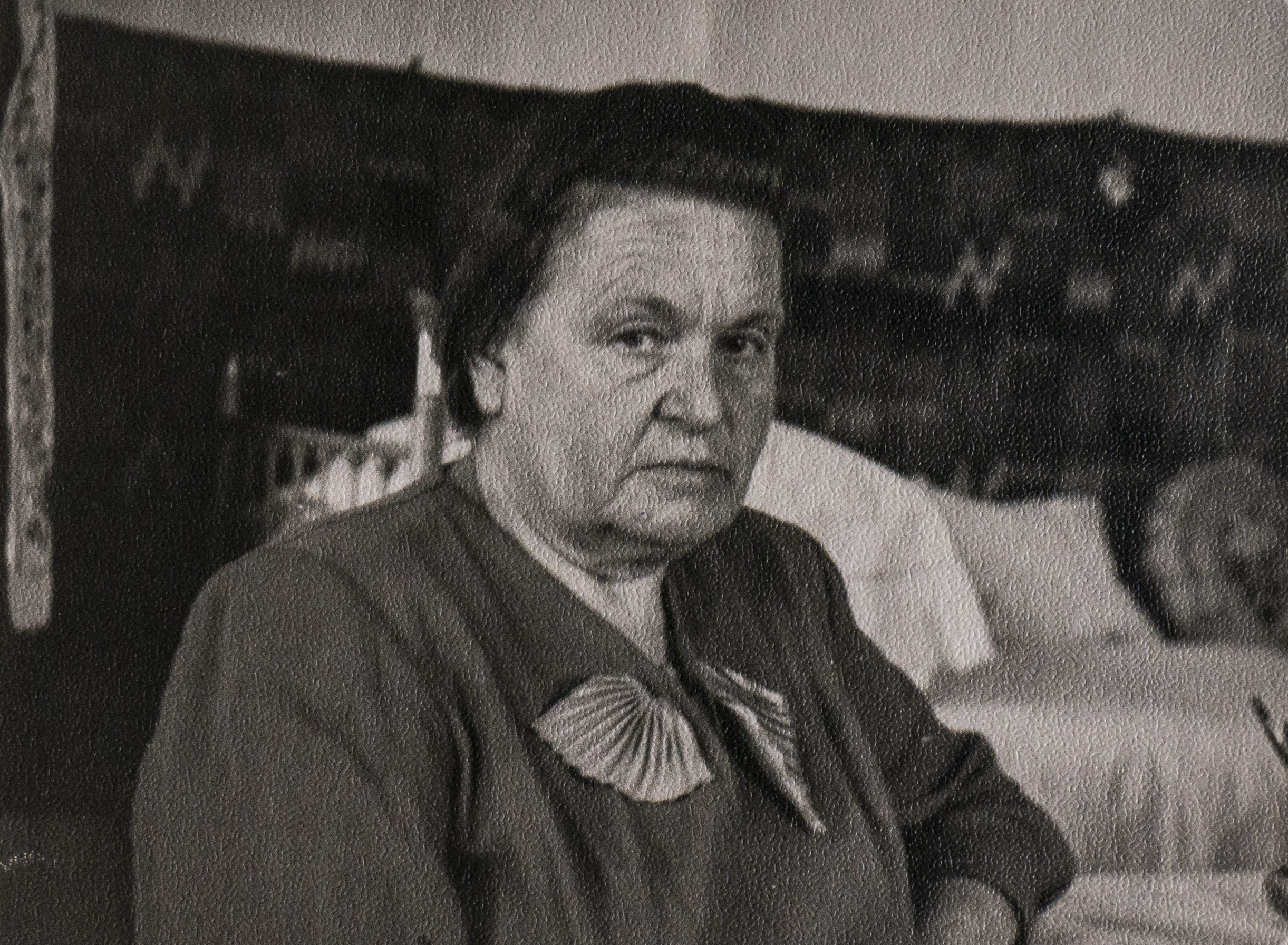
Wife Kylyna Dubyna. From archive in Museum of local history in Myrhorod
In 1914 writer came from front to Myrhorod on birthday of his son Yurii. He was there later too.
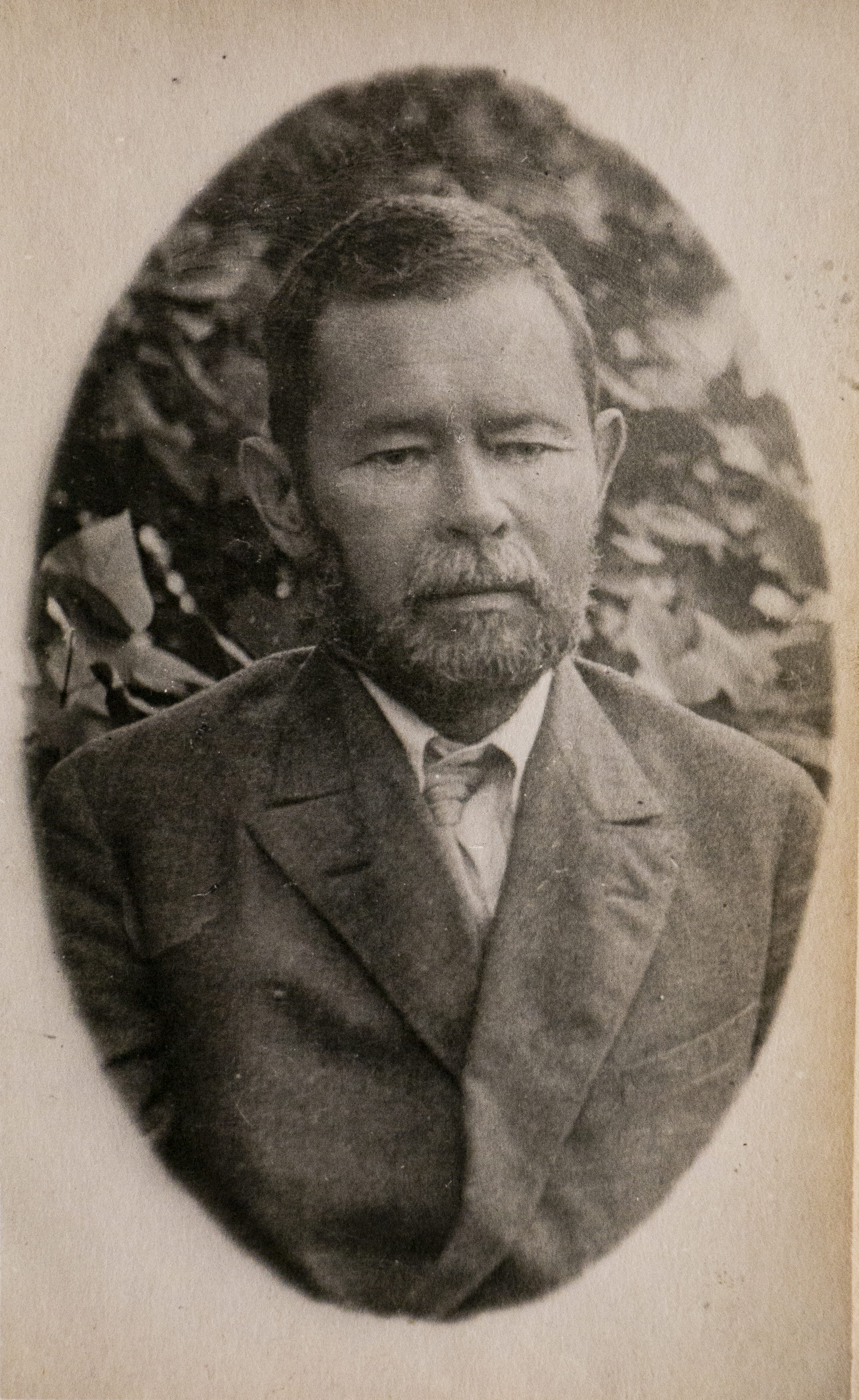
S. Vasylchenko 30s XX century. From photo archive in Museum of local history in Myrhorod
On July 1920 writer as correspondent has arrived to Myrhorod together with capella “Dumka”. On the street, where his wife had lived, in the garden of men gymnasium, famous capella gave few concerts.
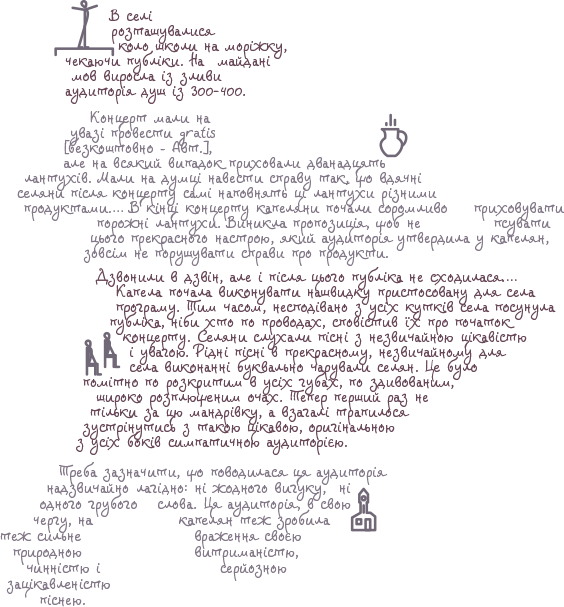
Recollection of Stepan Vasylchenko’s wife Kylyna about arrival of Travelling choir capella to Myrhorod: “Days when choristers were holding concerts in Myrhorod, for us with son, became genial: husband and father has visited us after long months of separation. Capella has performed in gymnasium’s garden, that was situated almost near the house of our parents. I have visited all concerts. Folks, workers, Red Army men were listening to the song with attention and passion. Our native, Ukrainian song, which people quite recently weren’t dare to sing for a big audience in such open manner, without concealment. Stepan Vasylchenko was also thrilled. He was gazing into people’s faces, was listening talks and thoughts of citizens, and when artists were chilling after the concert, he sat down somewhere in the corner, took his notebook in dark oilcloth envelope, put it on knee and with small prudent handwriting he noted his impressions about everything he had seen and had heard”. (citation from http://libgonchar.org/images/%D0%92%D0%B0%D1%81%D0%B8%D0%BB%D1%8C%D1%87%D0%B5%D0%BD%D0%BA%D0%BE.pdf In our town Myrhorod, S. Vasylchenko has written fragments of few novellas. Kylyna Mykhailivna was living with her husband in Kyiv, but after his death in 30s, she came back to native Myrhorod. She delegated handwritten archive of S. Vasylchenko to Institute of Ukrainian literature named after T. Shevchenko of Academy of Science of USSR. During the war, she was working in Myrhorod’s diary, then she was a teacher. After war she has received new house on the same street (now it’s called Lazorenka, № 49), where she was living until death. Kylyna Dubyna’s niece, Tamara Vasylivna Korol’, fan of folk art and creativity, was also living on that street; she has collected a huge collection of ancient Ukrainian folk needleworks, which she has gifted to Myrhorod’s museum of local history.
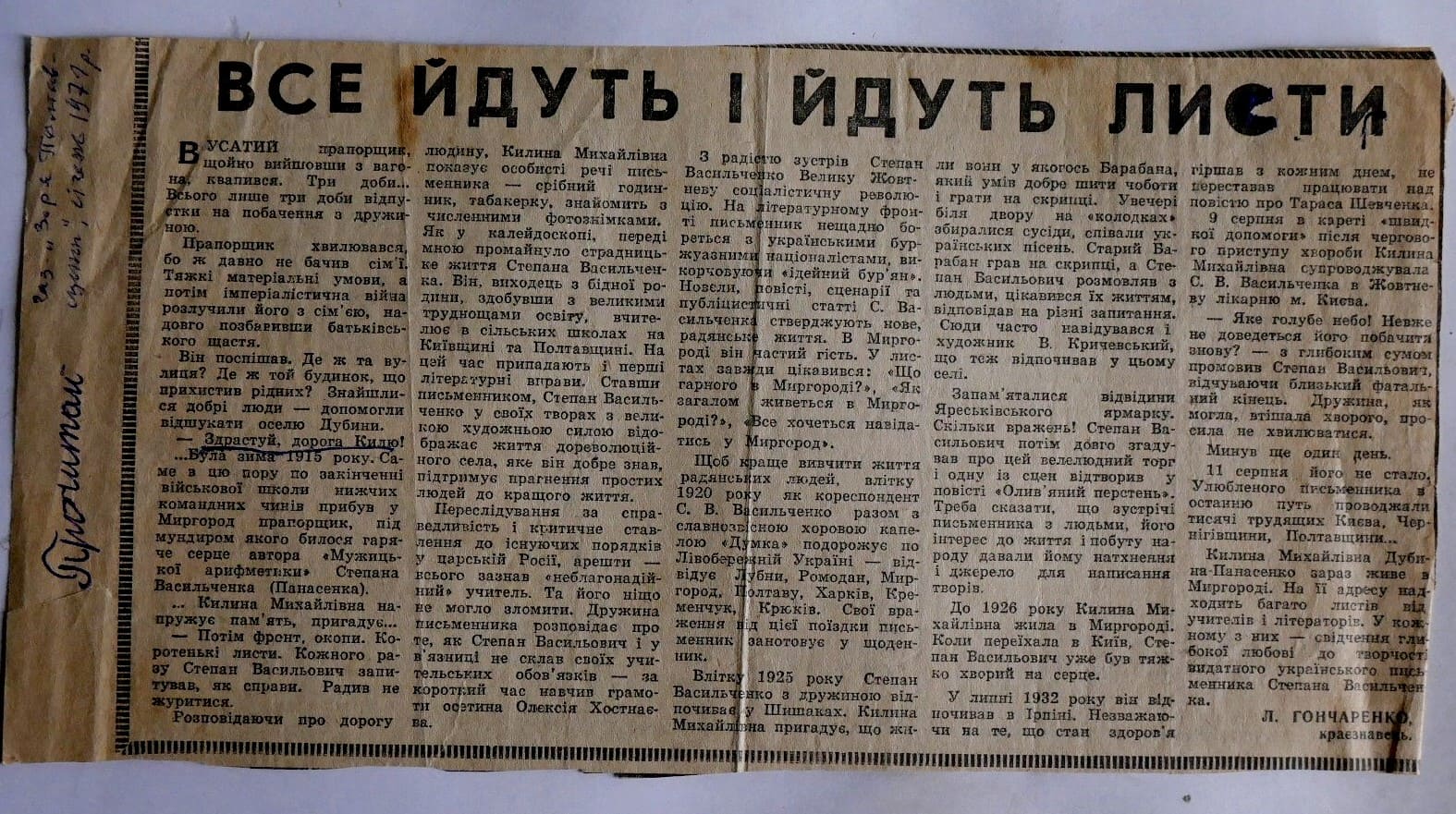
Clipping from newspaper. Memory about S. Vasylchenko. From archive in Myrhorod’s museum of local history
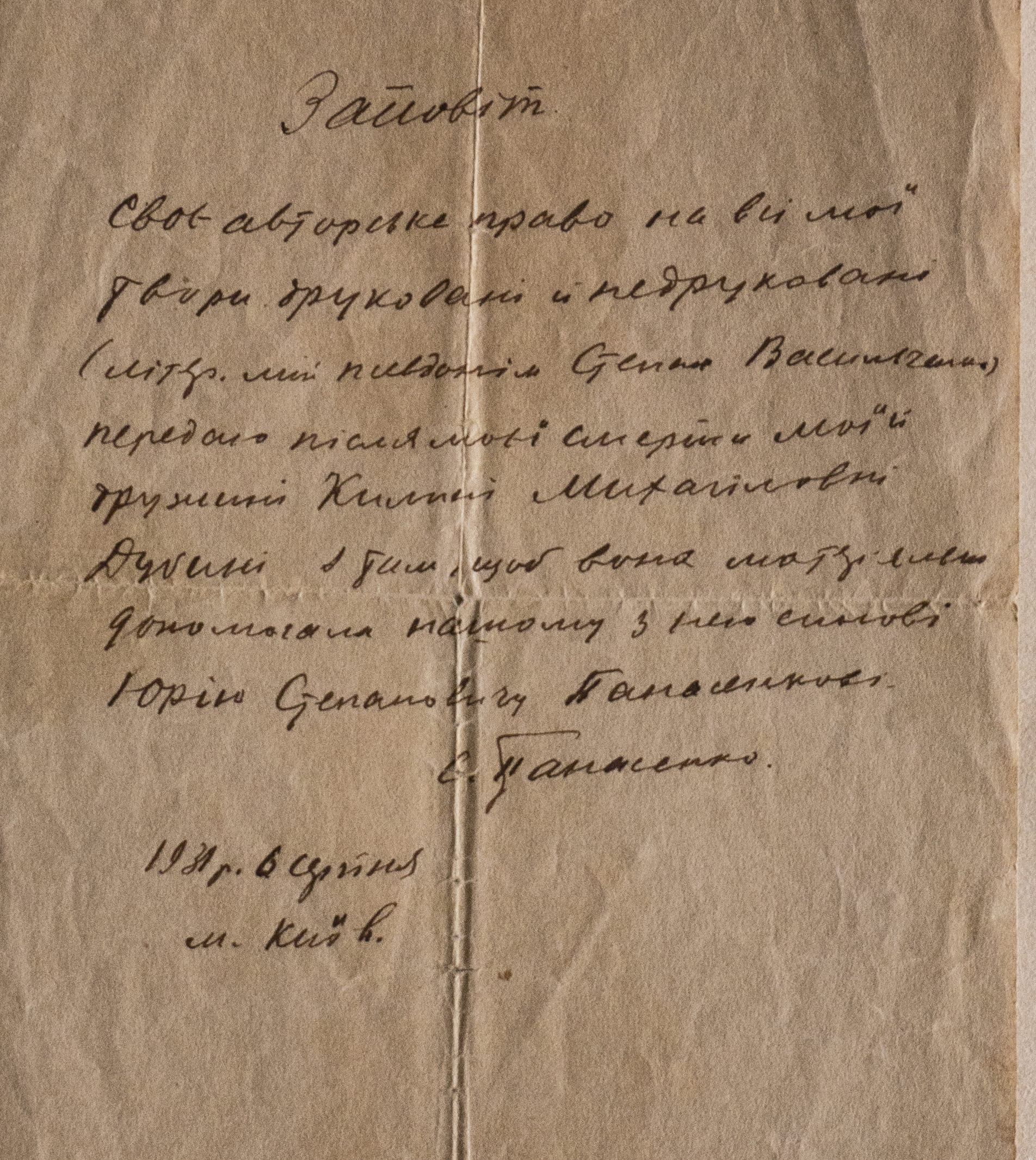
Will of S. Vasylchenko. From photo archive in Myrhorod’s museum of local history
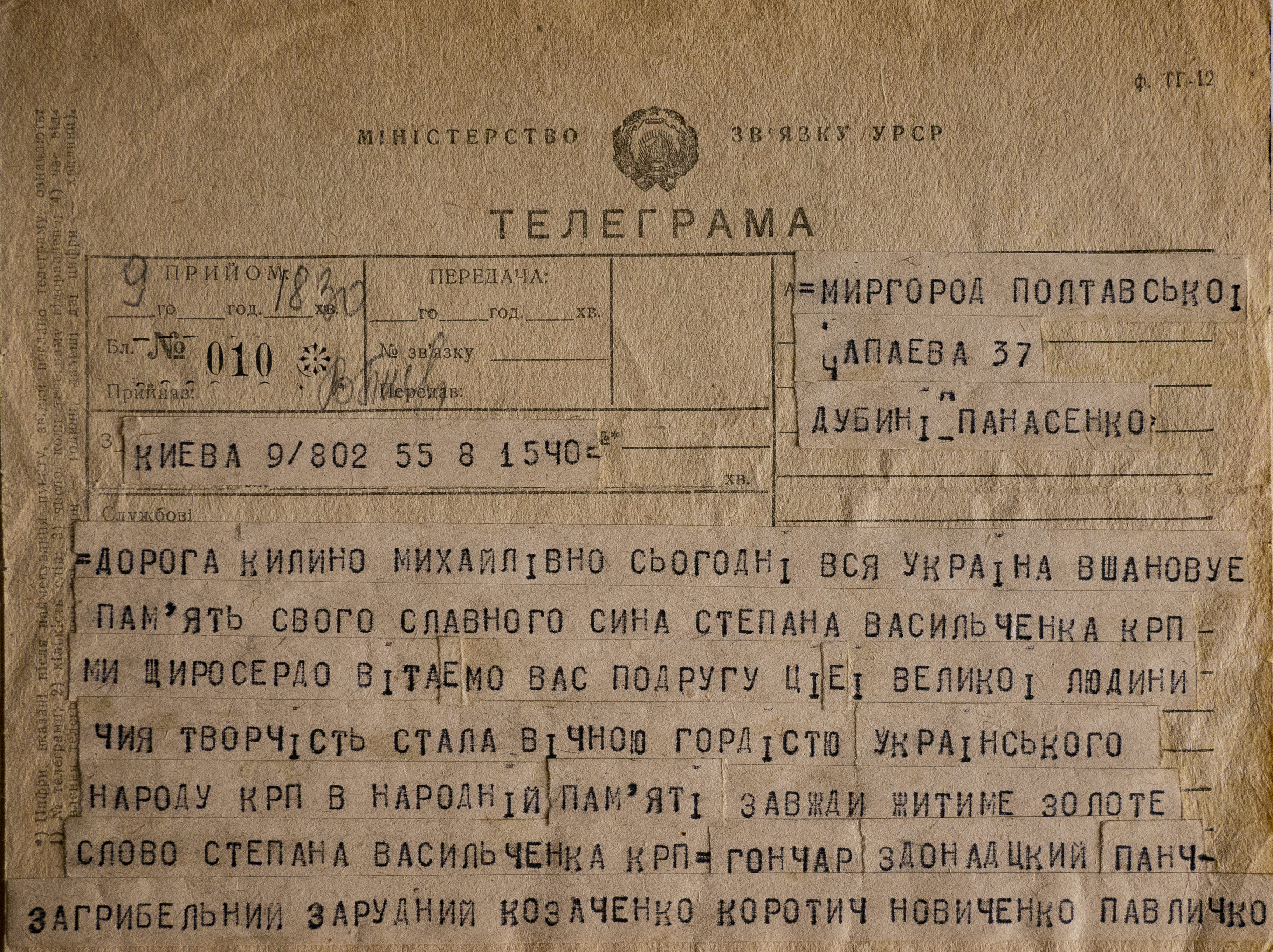
Letter. From photo archive in Myrhorod’s museum of local history
Yurii Panasenko (1914-1991), son of the writer Stepan Vasylchenko, famous as Yurii Kodak, has become a known Ukrainian architecture and has lived in Canada from 1949. He is an author of few churches, monuments, school projects in Canada and the USA. He liaised with Myrhorod. He died in Ottawa at the first year of Independence of Ukraine.
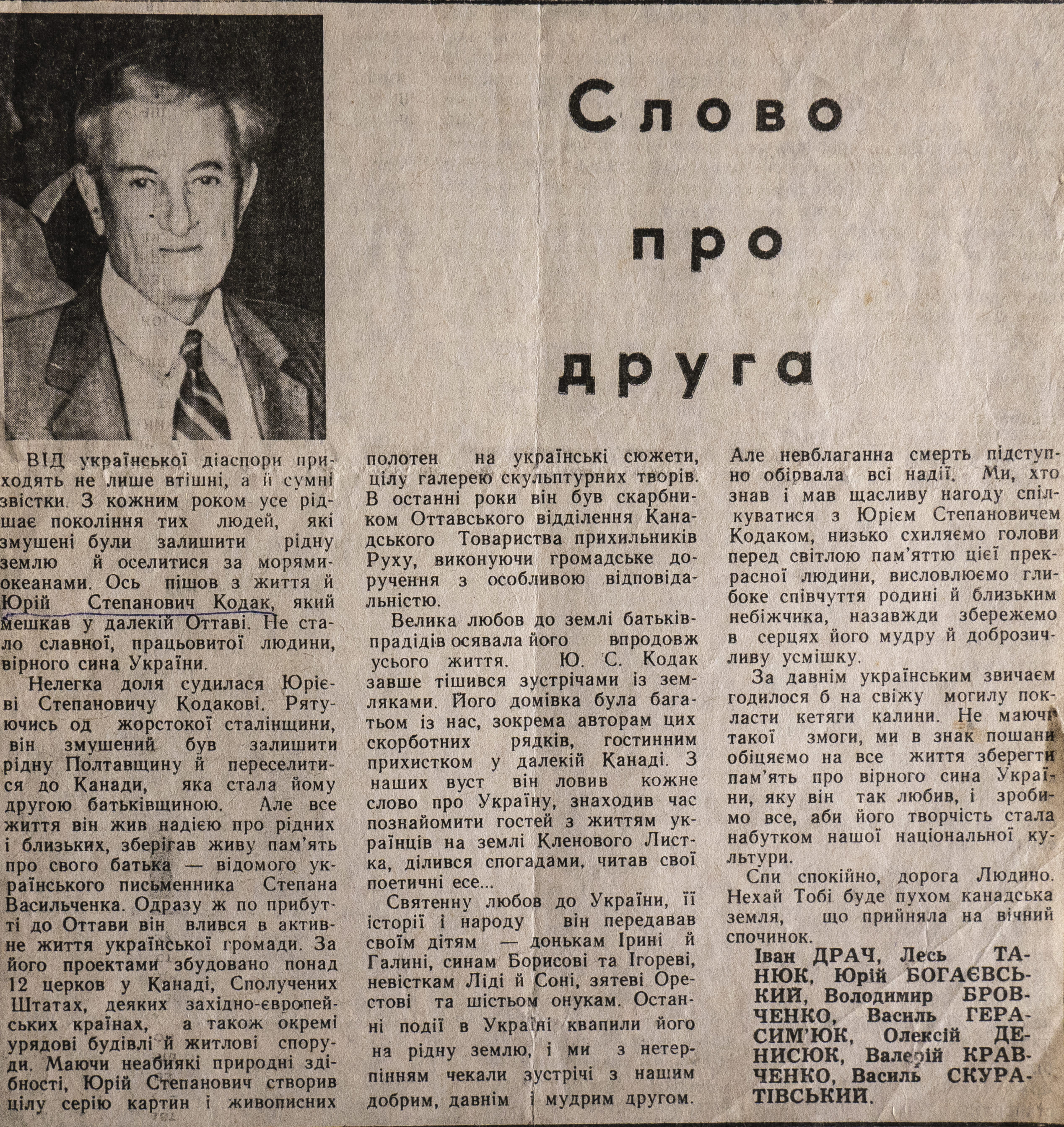
Clipping from newspaper. Memory about son Yurii Kodak. From photo archive in Myrhorod’s museum of local history
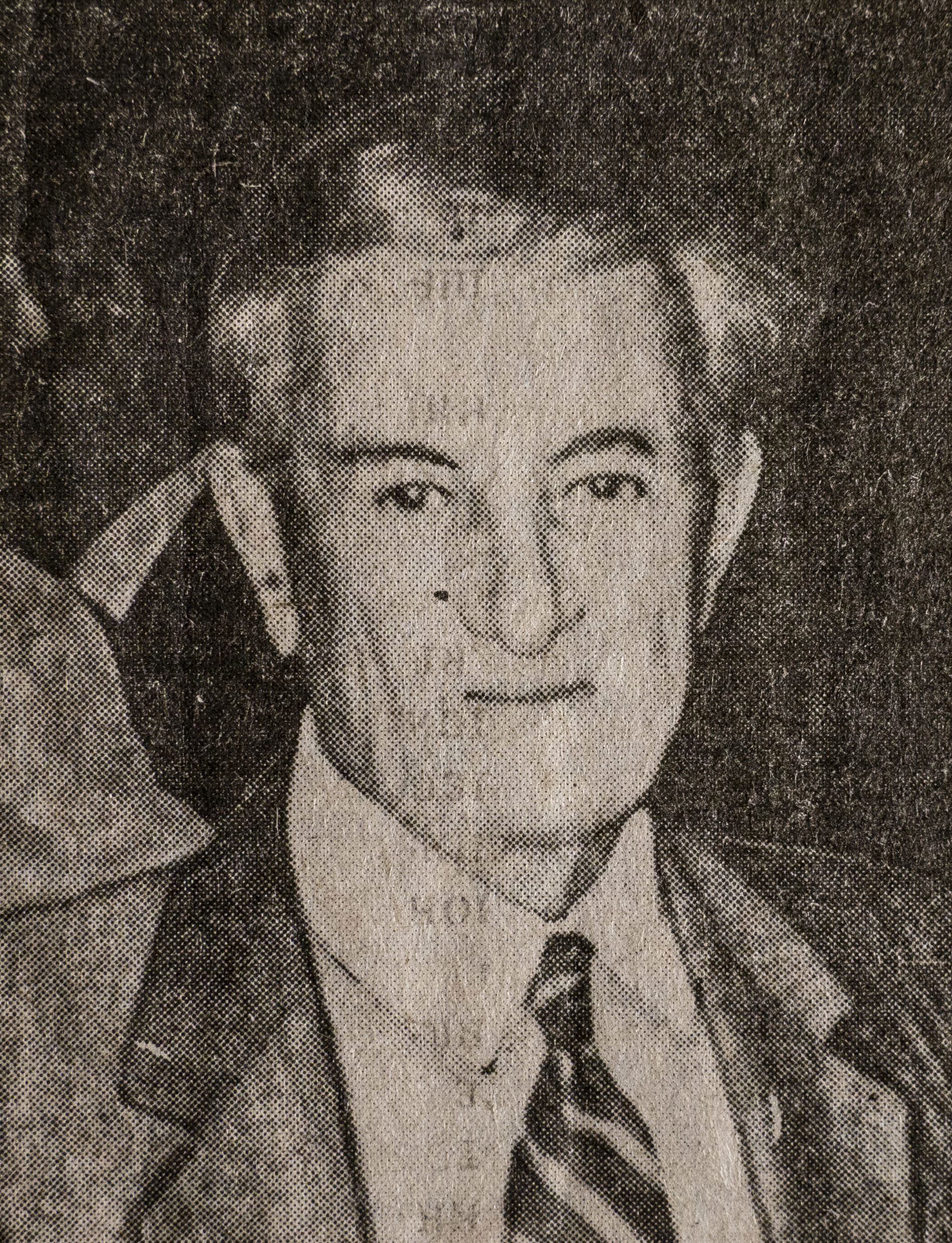
S. Vasylchenko’s son Yurii Kodak. From photo archive in Myrhorod’s museum of local history

Harkushyntsi village is in Myrhorod district and is located on the left side of Khorol river. For the first time the name Harkushyntsi appeared on the map of French engineer Guillaume Levasseur de Beauplan (1630-1648).
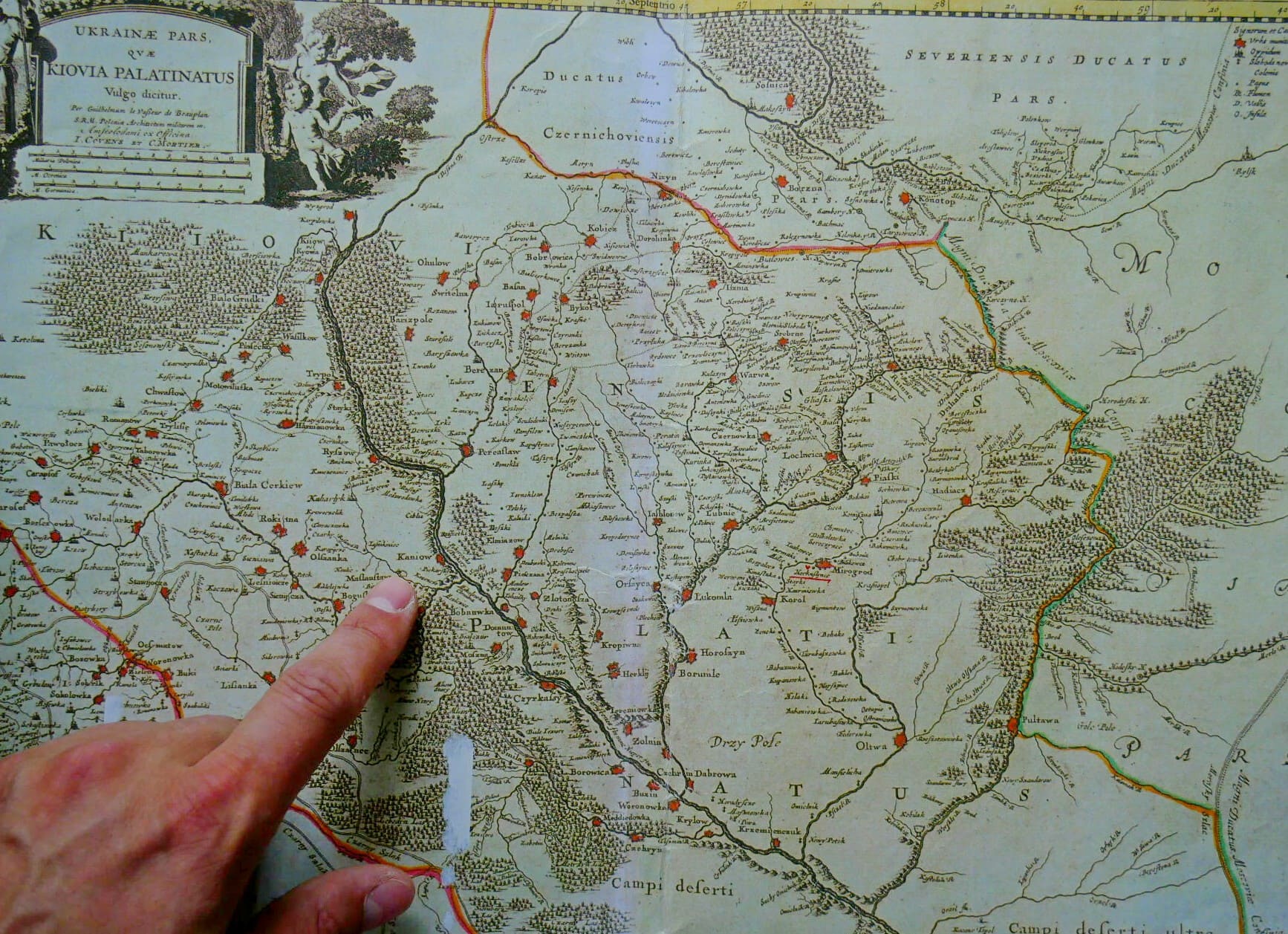
Map of the 17th century from Paraskoviia Syrbu’s private photo collection
The village come of Cossacks’ colonisation. It was a part of First Myrhorodska Sotnia of Regiment of Myrhorod.
“Is your soul crying?
When you will remember, Cossack,
How Poltava was burning,
Pushkarenko was punished,
And for ridicule, for destruction, we were given to the Tatars…”
The memory about 1st Cossacks Regiment in Myrhorod. This poetry was told by Paraskoviia Hryhorivna Syrbu, citizen of Harkushyntsi village.
In 1729 the village had 17 yards, in 1781 there were 73. Petro Horkushynskyi was an otaman of the country during 1737.
The church of Saint Great Martyr Varvara existed in the village (was built in 1753; new temple was built in 1873) and it was patronized by family of local big landowner Rud’.
According to local citizen Paraskoviia Hryhorivna Syrbu, church with bell-tower and school (previous “narodne uchylyshche” from 1897) were built due to landlord Rud’. First travelling choral capella of “Dniprosoiuz” has seen this places in 1920.
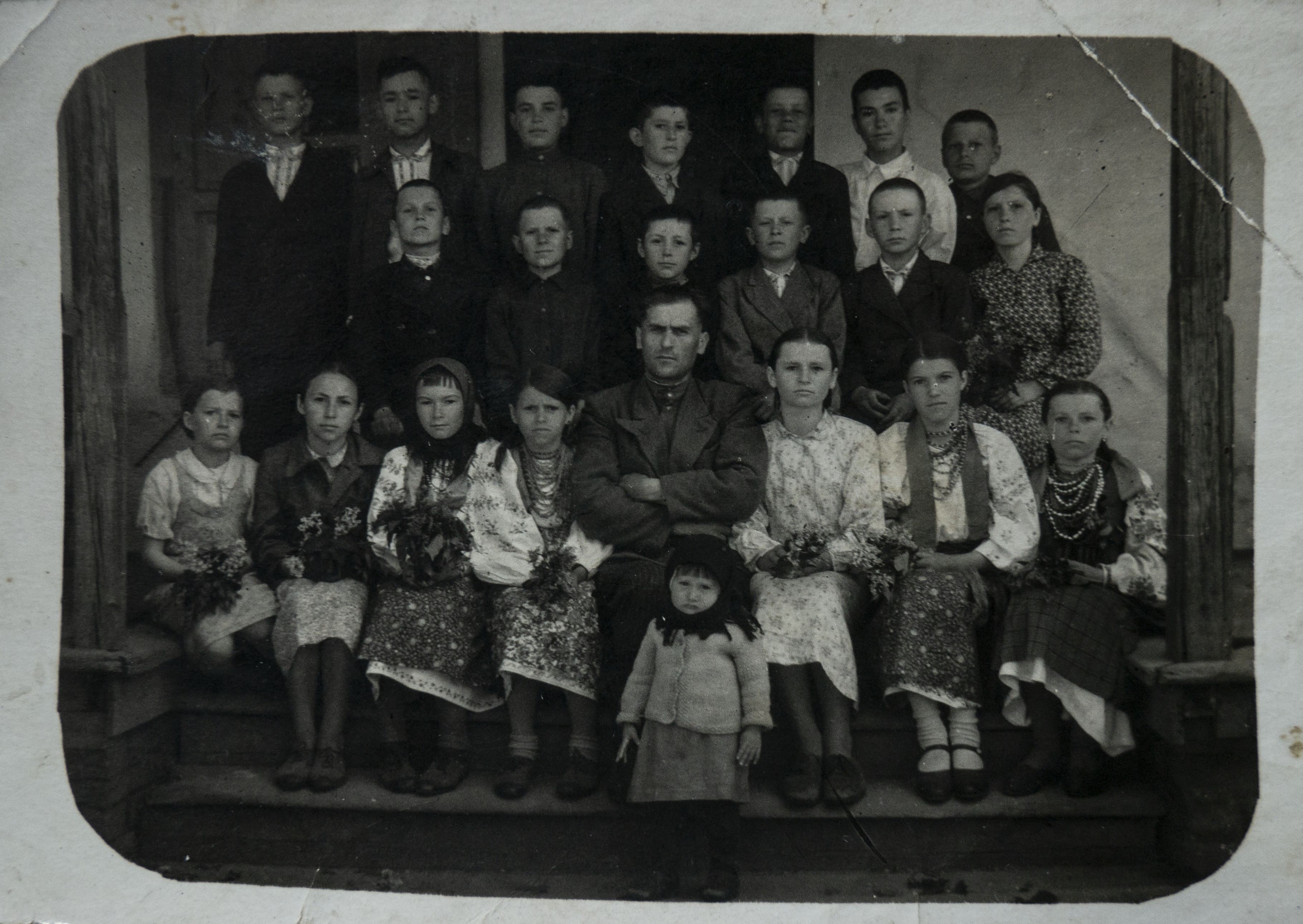
School XX century, from Paraskoviia Syrbu’s private archive
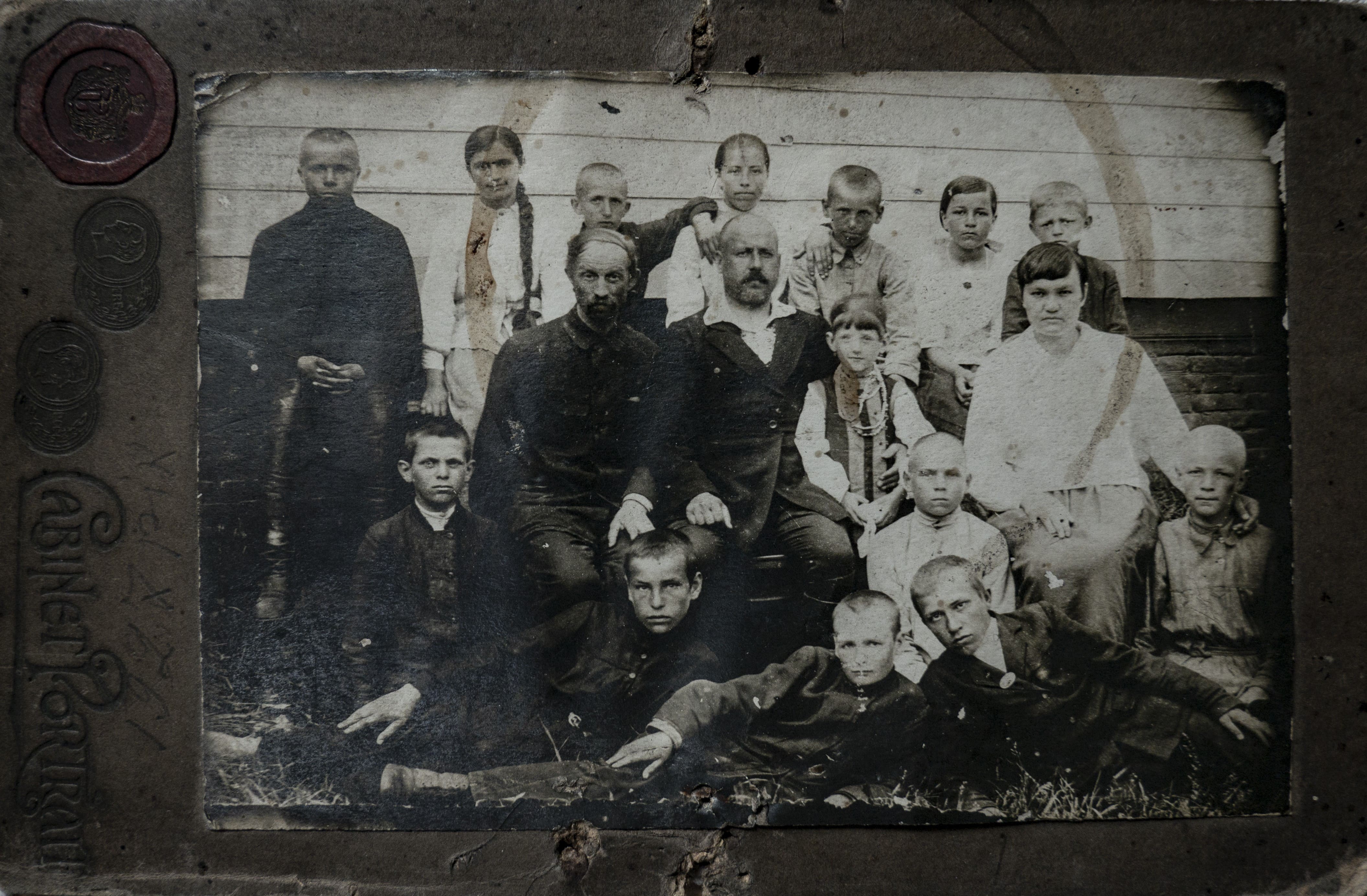
School XX century, from Paraskoviia Syrbu’s private archive
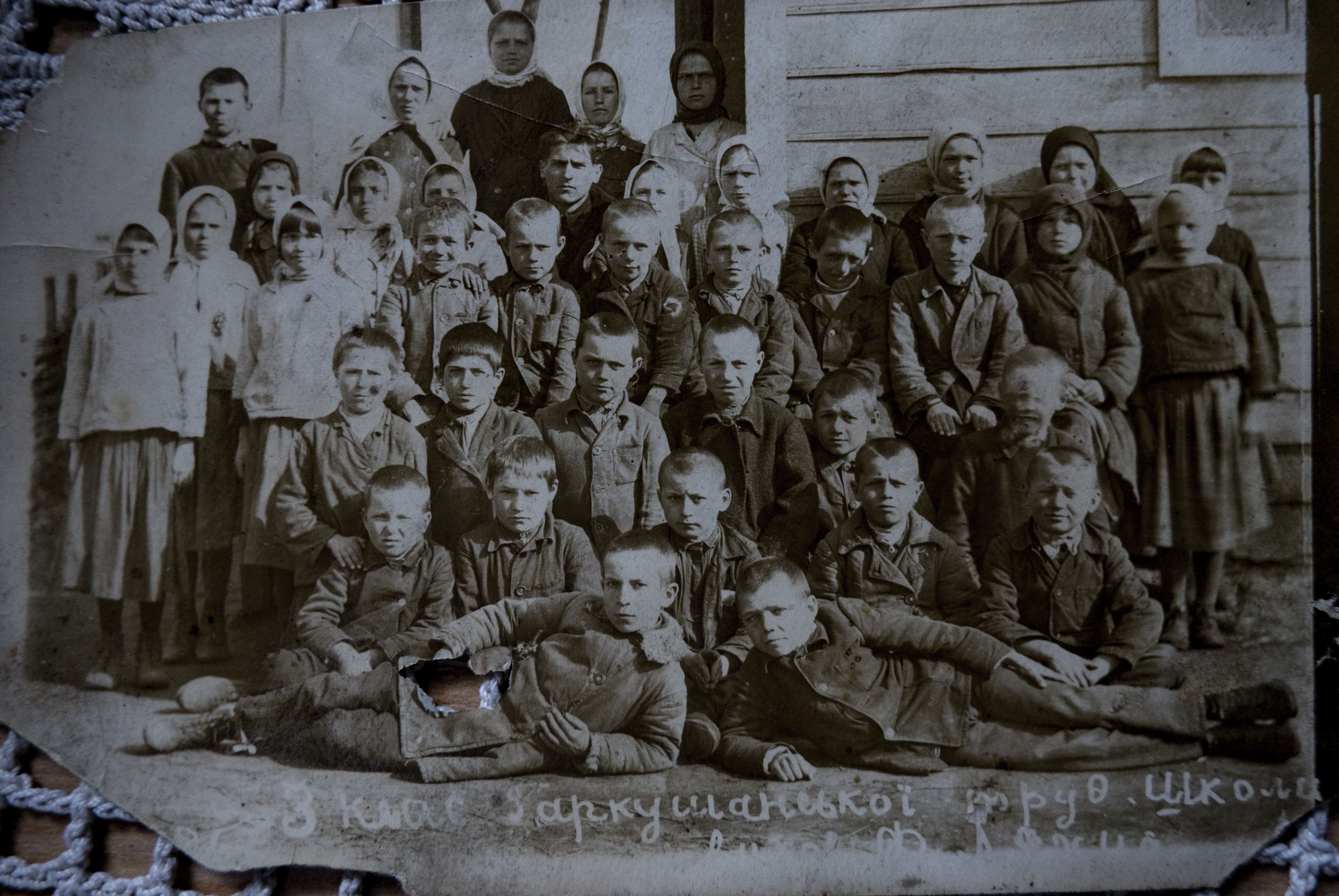
School XX century, from Paraskoviia Syrbu’s private archive
At the begging of XX c. there was brick-yard of landowner Markovskyi not so far away from the village, about 1911 brick factory of G. Ruban was working in Harkushyntsi. 284 households and 1491 citizens were in the village in 1926.
In 20s of XX c. there was rural choir, that was founded by local talented musician Stepan Pedorych. According to Paraskovia, travelling capella could listen to this choir, when it was visiting the village.
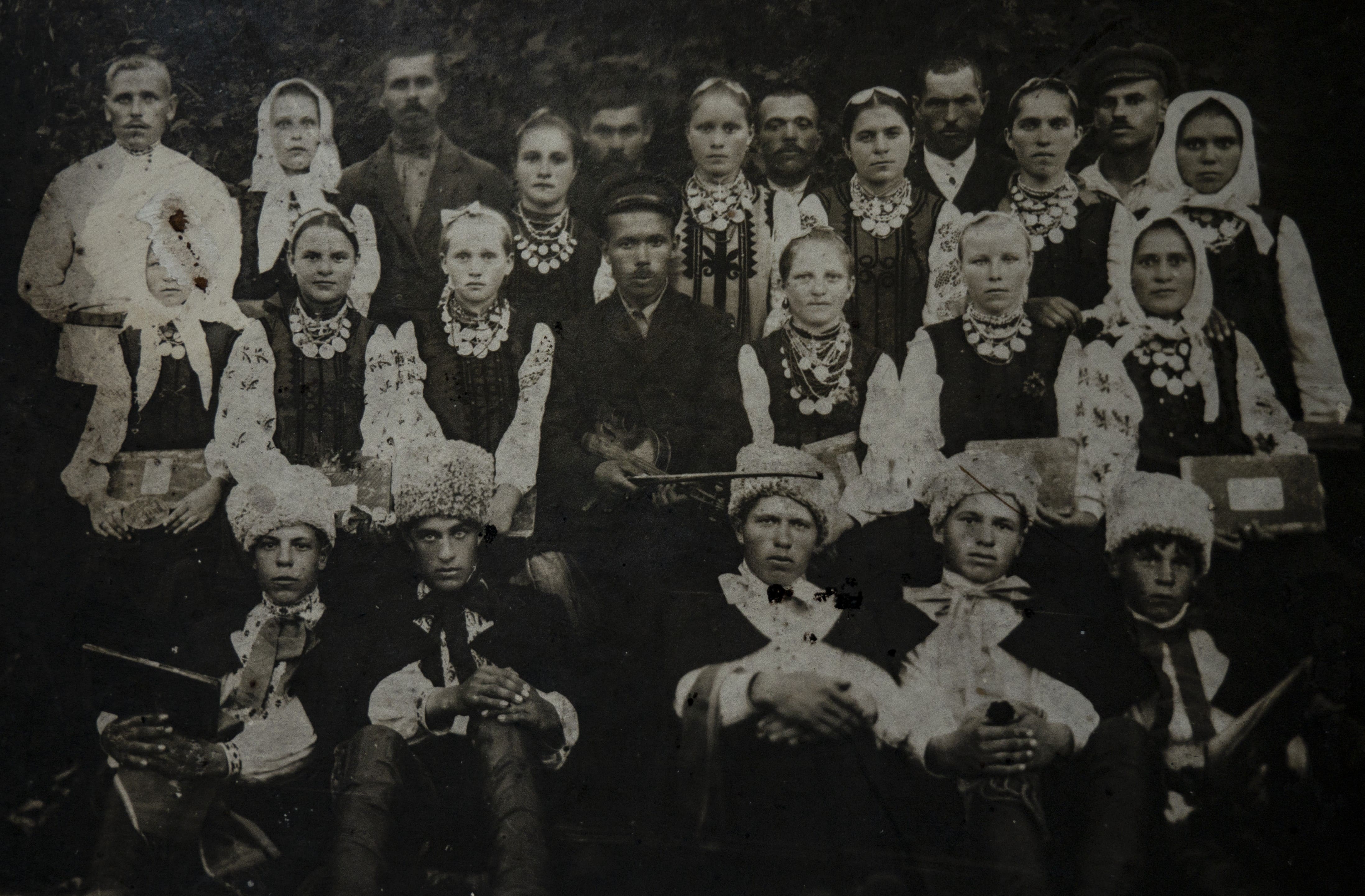
Choir in Harkushyntsi XX c. From private archive of Paraskovia Syrbu
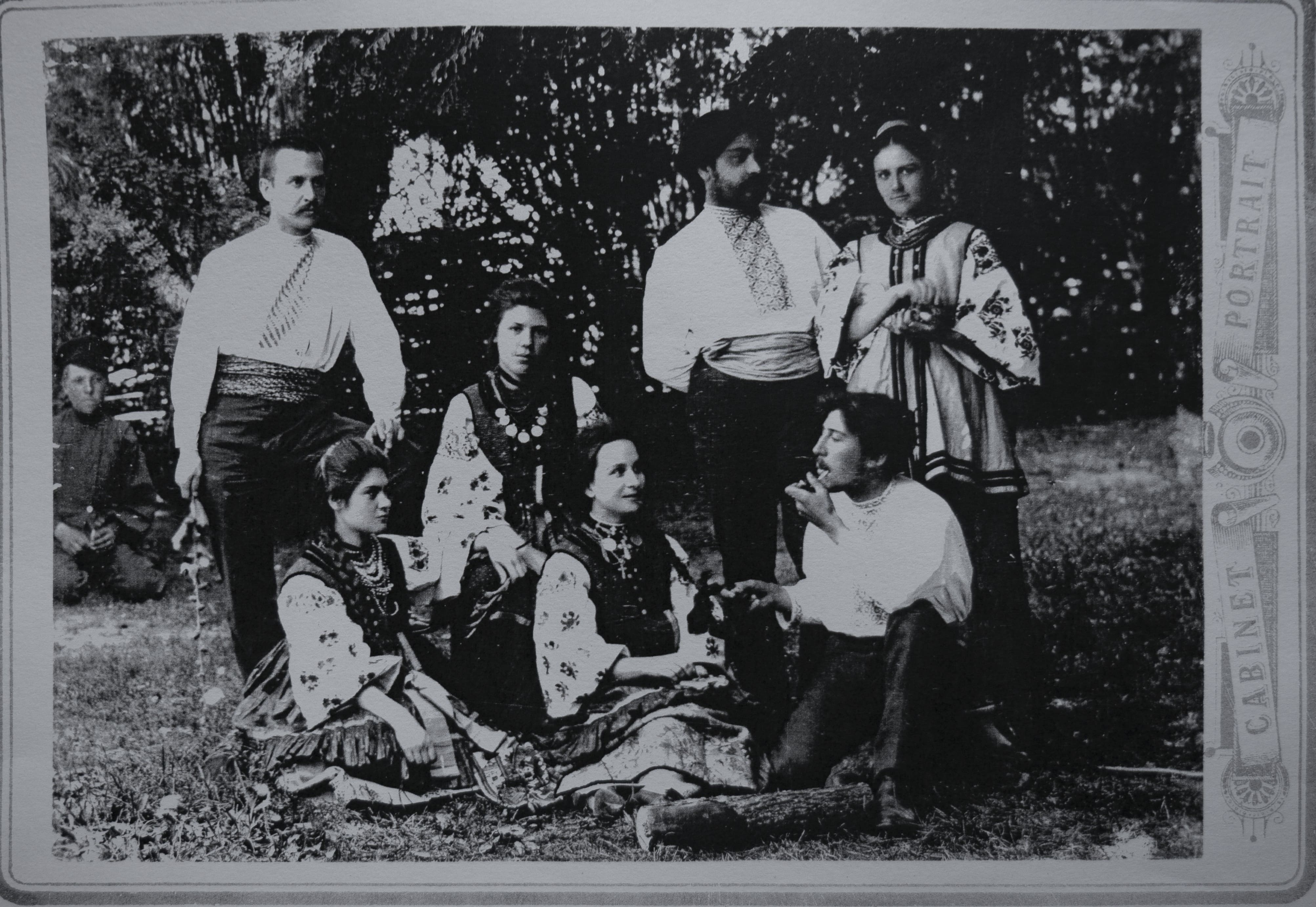
Choir in Harkushyntsi XX c. From private archive of Paraskovia Syrbu
On 15th March, 1931 collective property (kolhosp) named after State Political Management (Fedir Kozlenko was head of it) was created. In 40s kolhosp was named after Polyakov (named after first head of kolhosp, who was killed during violent collectivization in 1930). Kostiantyn Andriiovych Rogochyi was head of kolhosp in 1945. Members of Butenko’s, Pedorych’s, Stepur’s, Ustymenko’s, Shumeyko’s, Yakymenko’s families were repressed in 20s-30s.
In 1944, 247 yards and 720 citizens were in the village; in 1980 – 550 yards, 1518 citizens were there; in 1993 – 689 yards and 1603 citizens; in 2006 – 552 yards, 1400 citizens.
In 2019 demographic of the village is 1402 citizens.

Culture of Poltava at the beginning of XX century
Poltava is a Ukrainian city center of Poltava region. City was founded in 899. The first mention about the city was at old east Slavic Ipatiivskyi chronicle by the name “Ltava”. Modern Poltava comes from the name of the river Ltava, a right tributary of the Vorskla.
At the beginning of XX century the city was also called “Spiritual center of Ukraine”, because there were lots of outstanding spiritual, cultural and artistic activists; churches and historical monuments. Besides this, Poltava was the biggest center of Ukrainian cultural development and enlightenment of that time.
Musical cultural oasis was formed also in Poltava region. Writer Ivan Kotliarevskyi was working in Poltava as a theatre director, Petro Chaikovskyi’s pupil, pianist and kapellmeister, P. Shchurovskyi, conducted a synodal choir-master’s courses. Author of world-famous music for poem “Tastement” by Taras Schevchenko, Gordiy Gladkyi, was studying this courses by Shchurovskyi. Poltava region started to be famous thanks to her outstanding fellows: bandura players Ostap Veresai and Fedir Kushneryk, conductors Nestor Horodovenko and Hryhorii Kytastyi, Fedir Popadych and Volodymyr Kabachok; composers Isaak Dunaievskyi, Platon and Heorhii Maiboroda, Oleksandr Bilash, Hryhorii Chukhrai, Mykola Lysenko.
And as a matter of fact, first travelling choral capella of “Dniprosouiz” had in their repertoire compositions by Mykola Lysenko.
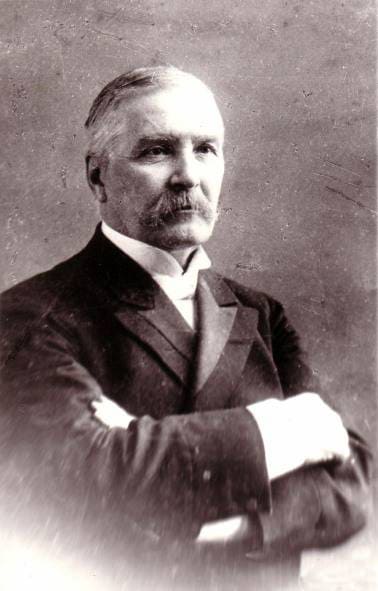
Mykola Lysenko (1842-1912). Public property
The main Lysenko’s endowment into national culture lies in two facts: 1) by collecting, exploring and polishing treasures of folk music, composer returns it to people in “posh artistic cover”; 2) he has developed professional musical language on a folk melos basis.
In 1920 travelling choral capella gave the concert in the city’s theatre.
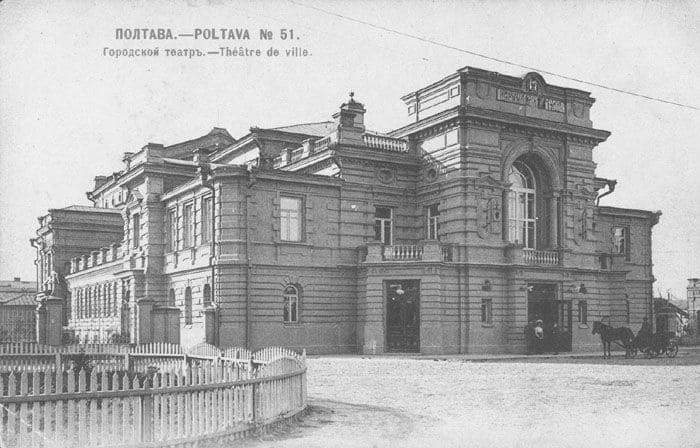
City’s theatre. Poltava in XX century, from Poltava’s archive
Now there are also large amount of creative groups. In particular, Honoured choir of song and dance of Ukraine “Ltava” named after V. Mishchenko. Collective was founded in 1957. Nowadays they continued to popularise Ukrainian folk song and to tour by Ukraine.
“Mussuri” was a building of theatre-circus in Kharkiv. At the beginning of XX c. the biggest theatre-circus in the world held 5750 viewers. Local architectural monument was in style modern.
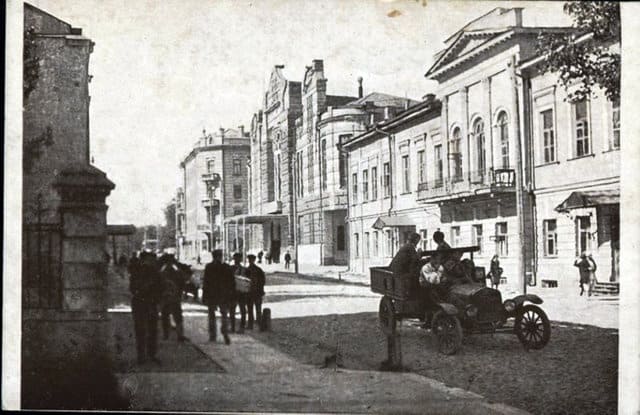
Theatre Mussuri. From archive in Museum of local history in Kharkiv
Building was constructed as building of circus in 1911. Author of the project was architecture Borys Korneenko.
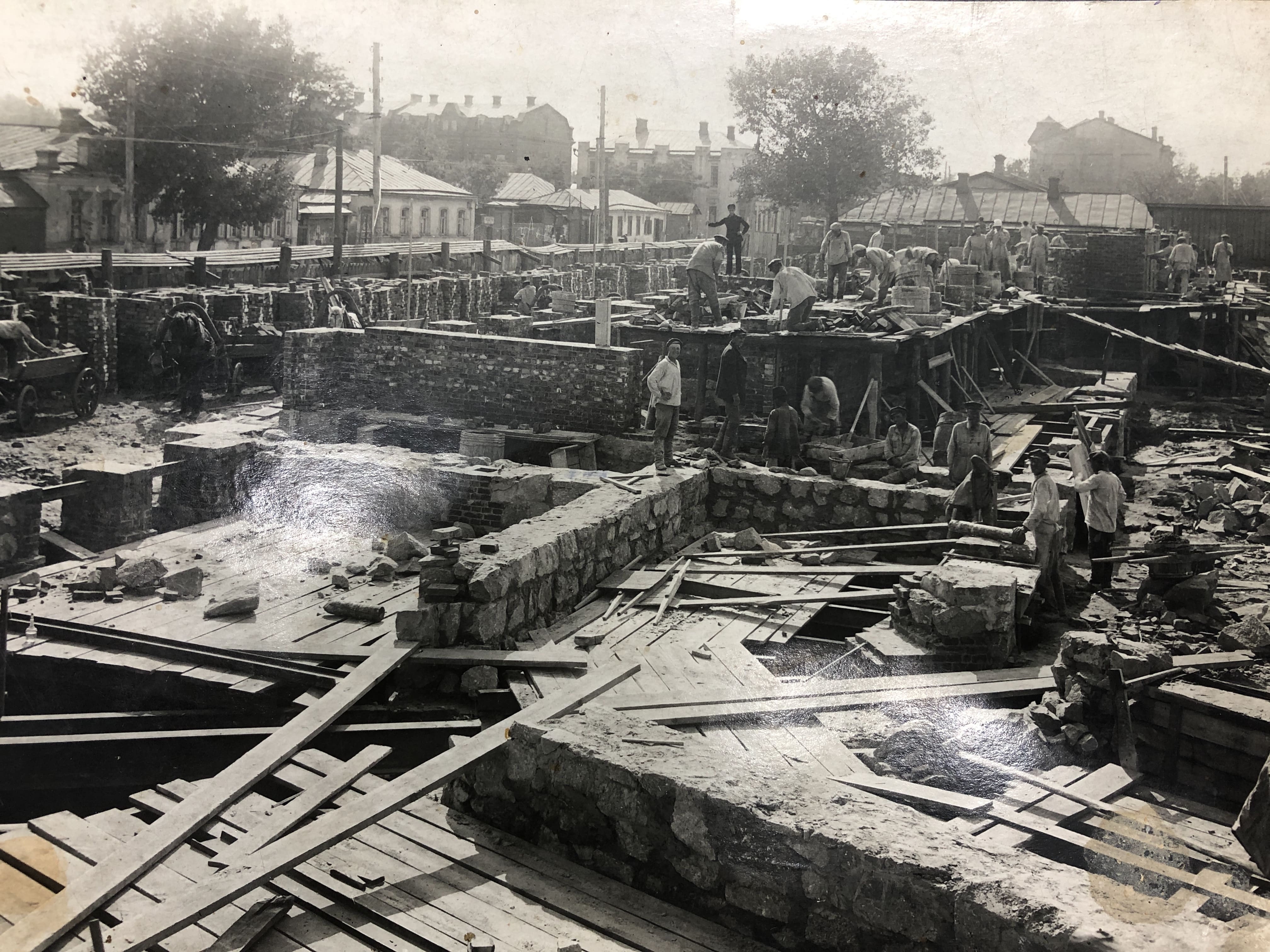
Theatre Mussuri. Laying the foundation. From archive in Museum of local history in Kharkiv
Was built from red bricks in style modern. Auditorium was without props; the height of the dome was 70 metres. Seats for viewers were placed in amphitheater, but arena was placed below ground level. At that time building was the biggest circus in the world and held near 6000 viewers.
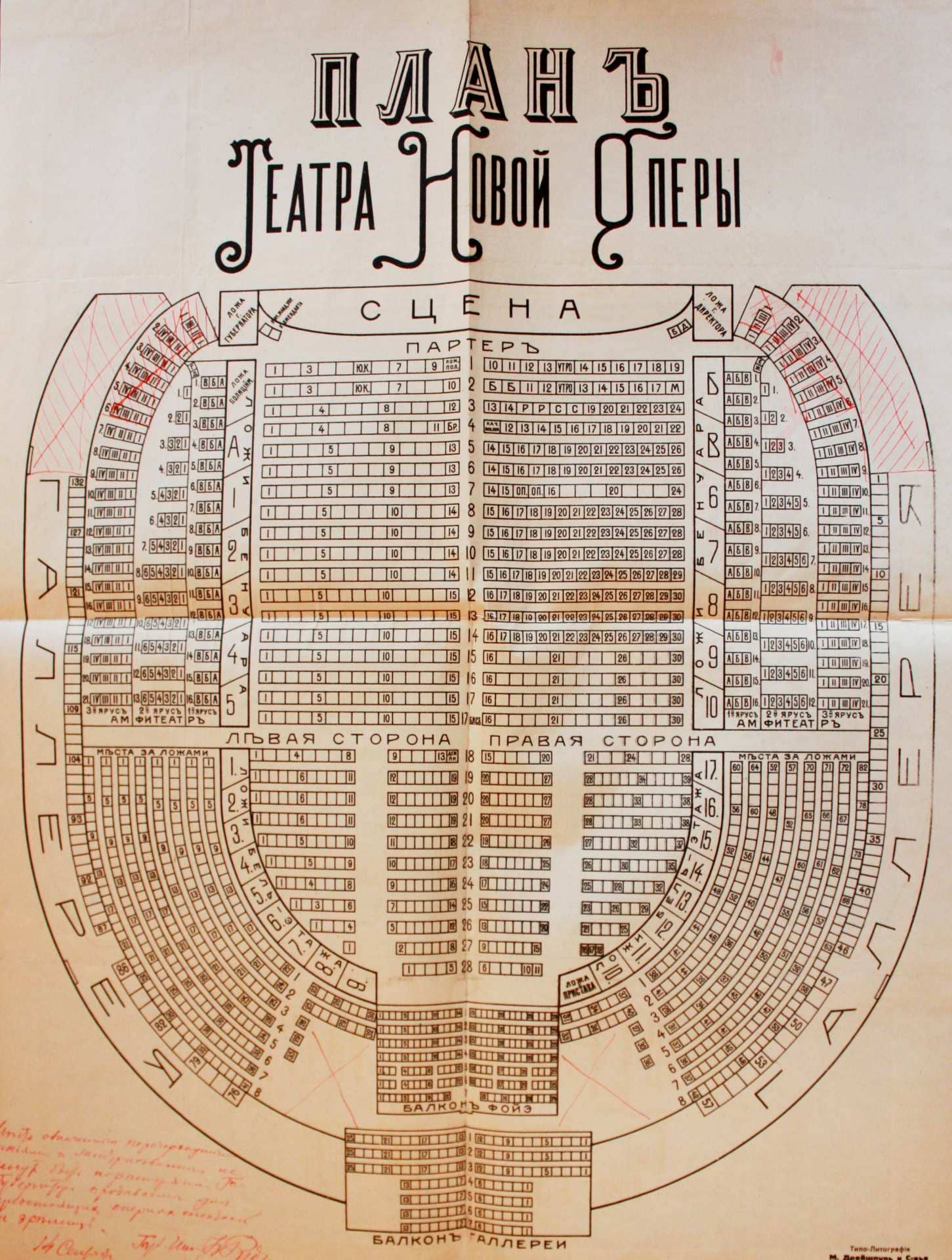
Theatre Mussuri. Plan. Public property
In 1912 building was transformed into opera theatre, which became called “Mussuri”, named after theater entrepreneur Herasim Mykhailovych Mussuri, who bought the building. Performance “Orpheus in Hell”, with the participation of Ostap Vyshnia, who created libretto for it, has opened the theatre. Ukrainian operas “Sorochynskyi fair” and “Wedding in Malynivka” were staged. Fedir Shaliapin, Volodymyr Maiakovskyi, Volodymyr Vysotskyi and others have performed on the stage of this theatre.
In 1911-1989 the building was the biggest theatrical building in Kharkiv.
But in archive’s documents about circus Mussuri were disappointing reviews. At the beginning of XX c. engineers have registered many violations in cases “About inspections of all theatres and cinemas in Kharkiv”.
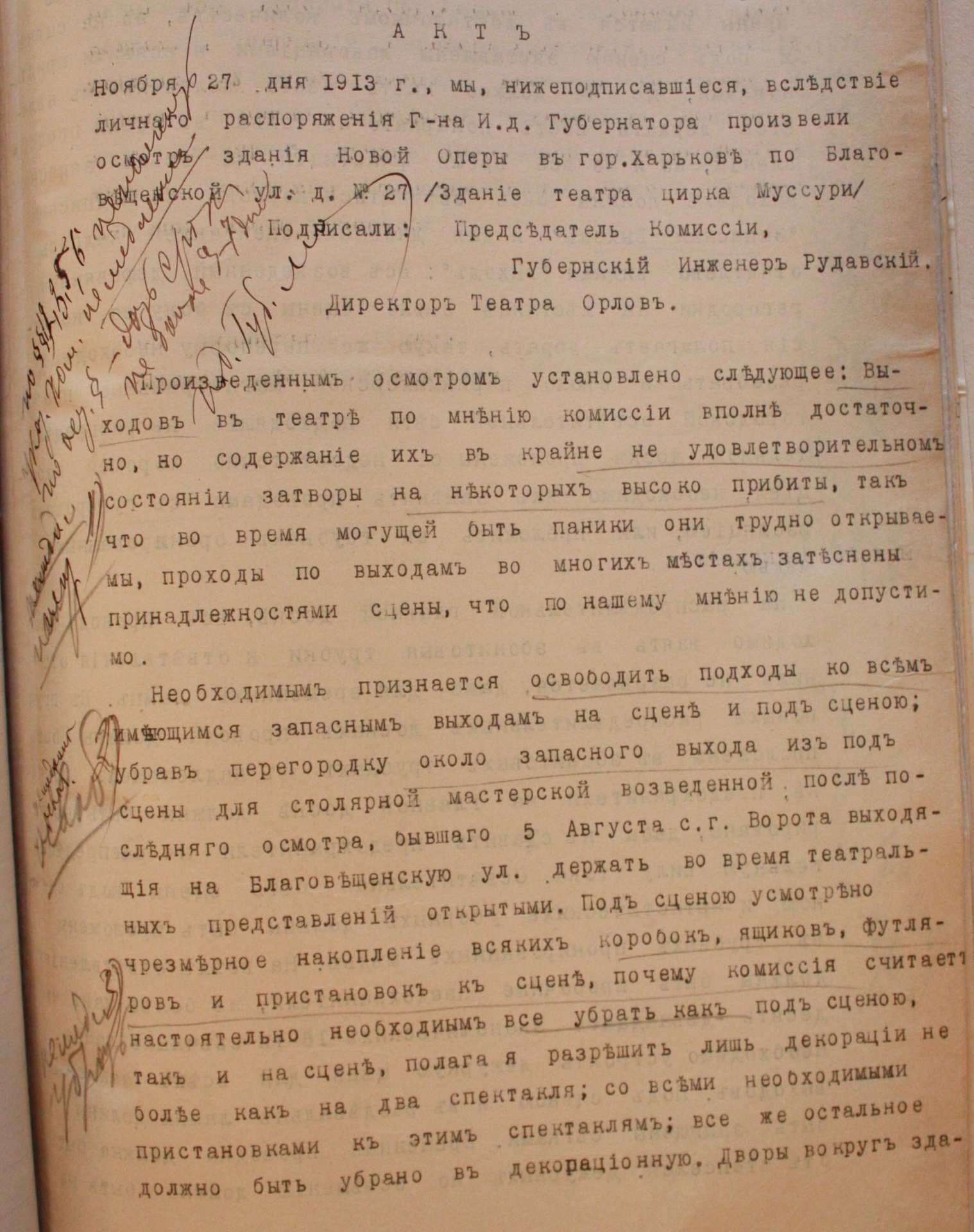
Act of violation. 1913. Public property
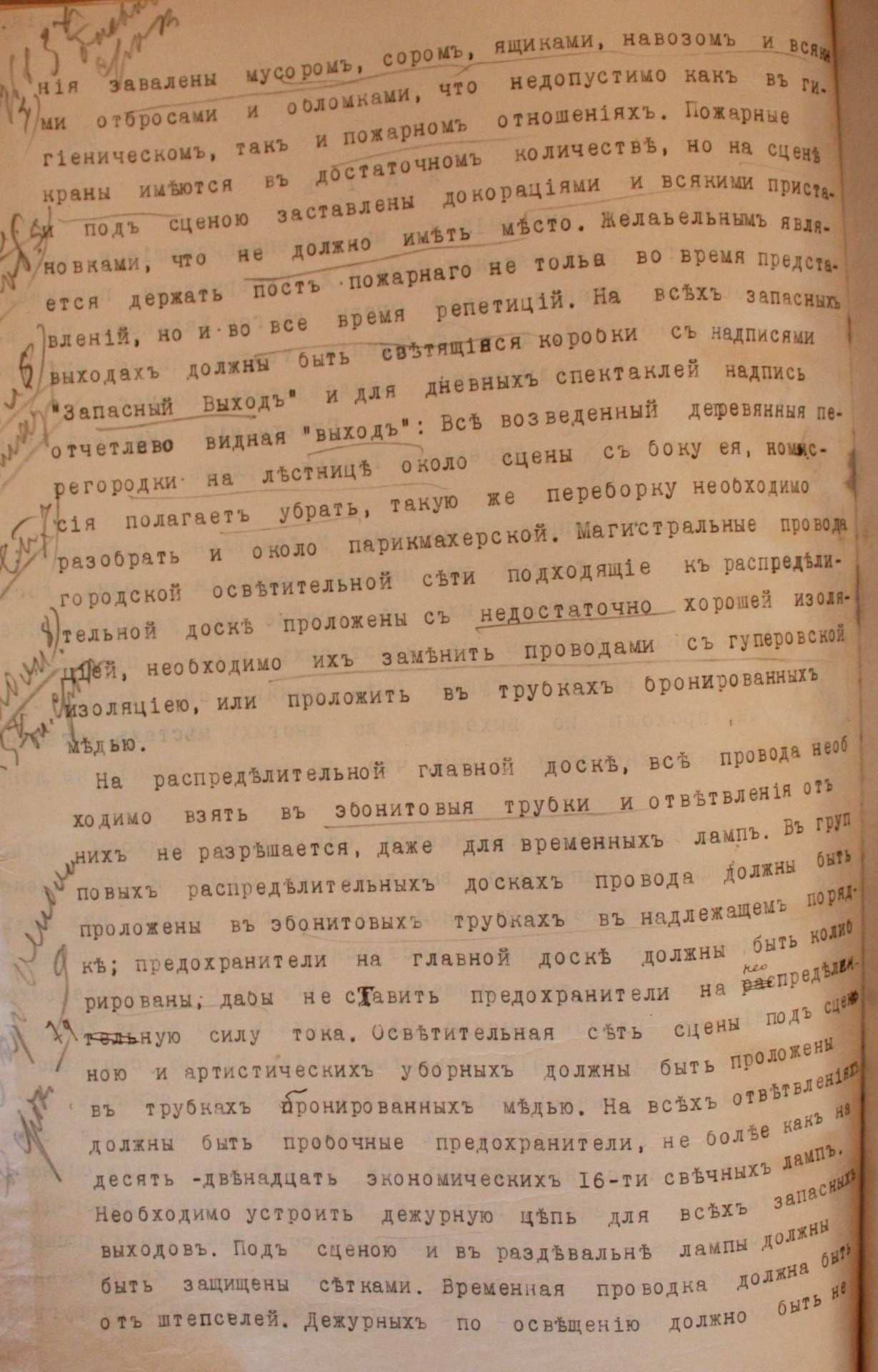
Act of violation. 1913. Public property
At this period, from 1919 to 1923, bilshovyky have used the building of previous circus to conduct social and political events. Their leaders such as Nadiya Krupska and Felix Dzerzhinsky have performed there. On 6-10th of March, 1919, there was the Third All-Ukrainian Congress of Soviets of Ukrainian Socialist Soviet Republic, fully controlled by the Bolsheviks. The first constitution of USSR was approved on this event, and also formal “independence” of USSR was acclaimed during this meeting.
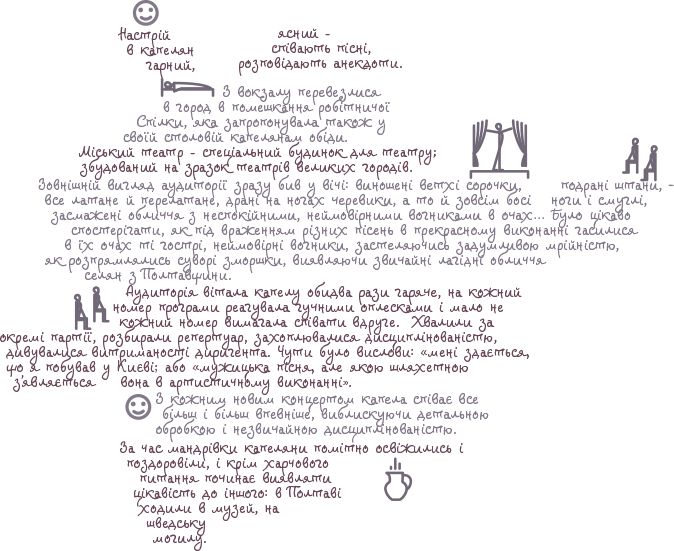
In 1920 capella of Dniprosoiuz “was waiting in the cue” for its concert, because before the performance there were political events and concerts were changed on the next day. In acoustic sense the building wasn’t suit for singers’ performances as it mentioned in the diary.
Musical comedy theater in Kharkiv was placed in this building almost 60 years at the soviet period. Now it is located in Palace of culture “Harchovyk” (Blagovishynska, 32, street), which is on the same side of the street, but through one building. Because of bad acoustic and inadaptability to holding performances, theatre was repeatedly rebuilt, gradually losing previous view: the facade was changing, details were lost, the building was lined with yellow tile.
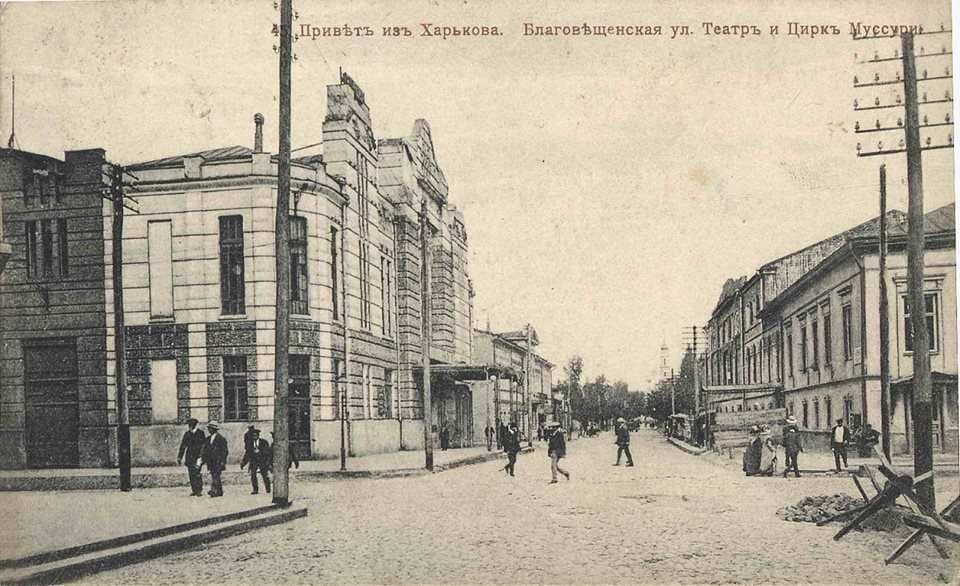
Theatre Mussuri. From archive in Museum of local history in Kharkiv
In 1987 the building was recognized as emergency. It was burning not once, because some of the constructions were wooden, and the overlap between the roof and the auditorium was made of pressed reed.
Theatre Mussuri. From archive in Museum of local history in Kharkiv
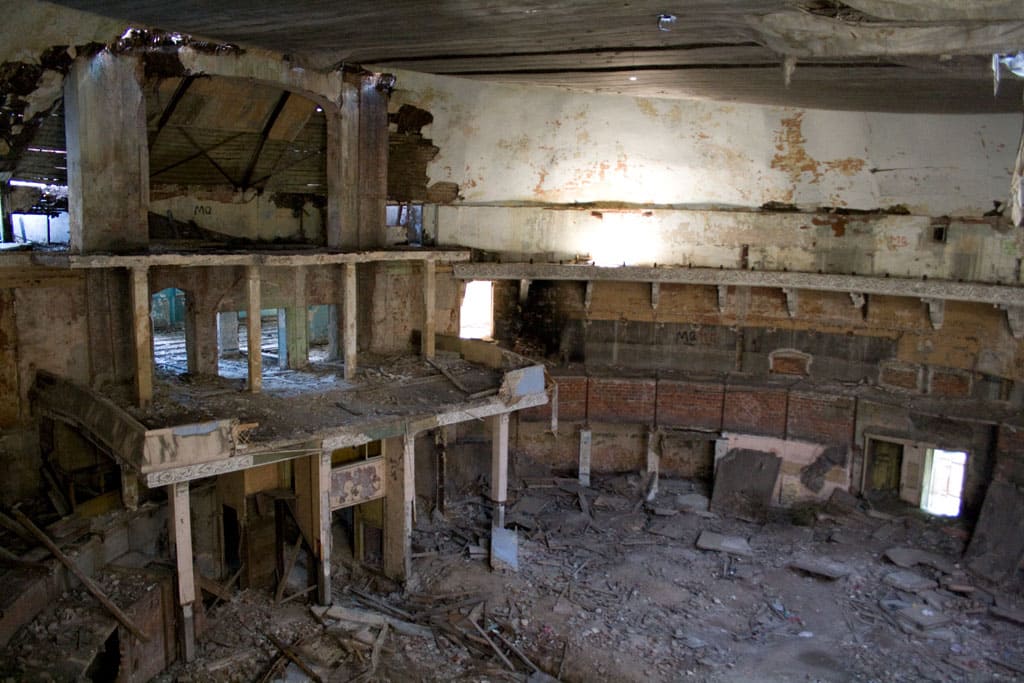
Theatre Mussuri. 2009. https://kharkov.livejournal.com/766934.html
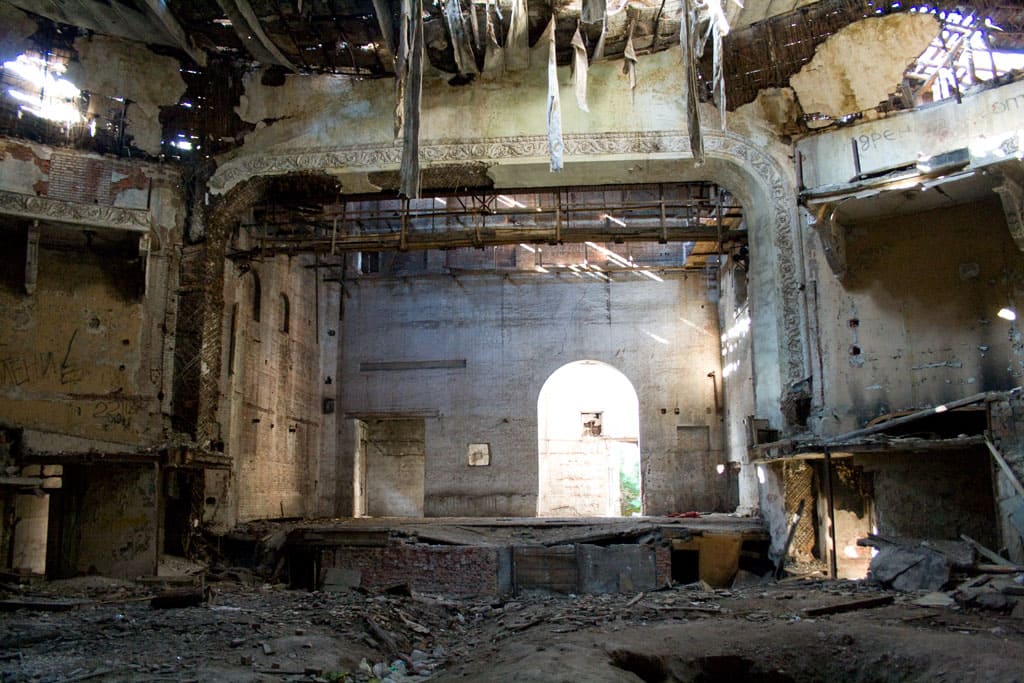
Theatre Mussuri. 2009. https://kharkov.livejournal.com/766934.html

Butenky is a Ukrainian village, that was founded in the end of XVIII c., in Poltava region, Kobeliaky district.
In 1870 Kharkivsko-Mykolaivska railway was laid on Cossack’s Butenko earth, between hamlets. New railway station was named Kobeliaky and has become a centre of united village. Opening of the station helped to quickly development of the village and expansion of trade.
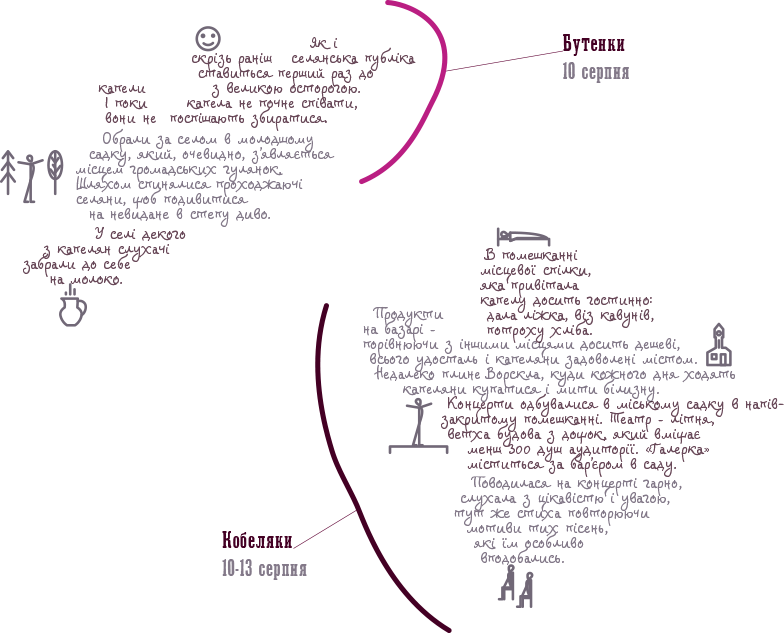
The village Butenky is located on the left bank of Vovcha river on the place, where its flows into the river Kobeliachka. Highways and railway station Kobeliaky pass through the village. Actually, capella singers were staying on this station. They settled there for giving concerts.
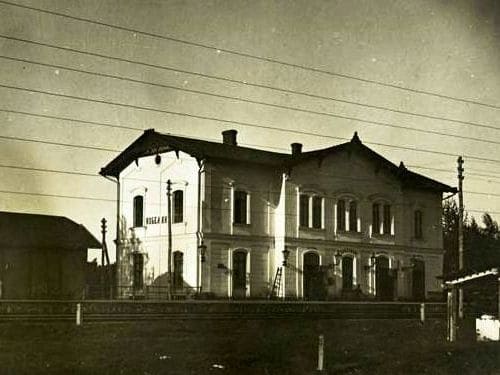
The passenger’s building of Kobeliaky Station, beginning of XX c. Public property
Travelling Capella and city Kobeliaky
Сity Kobeliaky is located on the bank of Vorskla river (mostly on the right bank) in the place, where river Kobeliachky debouch into it, and in distance of 13 km from railway station Kobeliaky. The name of the city probably came from river Kobeliachky or was calque of the name of Right-bank’s Kobyliaky (now the village of Zvenyhoroda district in Cherkasy region). This location was firstly checkmark on the Kornelii Dankert’s map, in 1620-1636 and Frederick de Wit’s, in 1632.
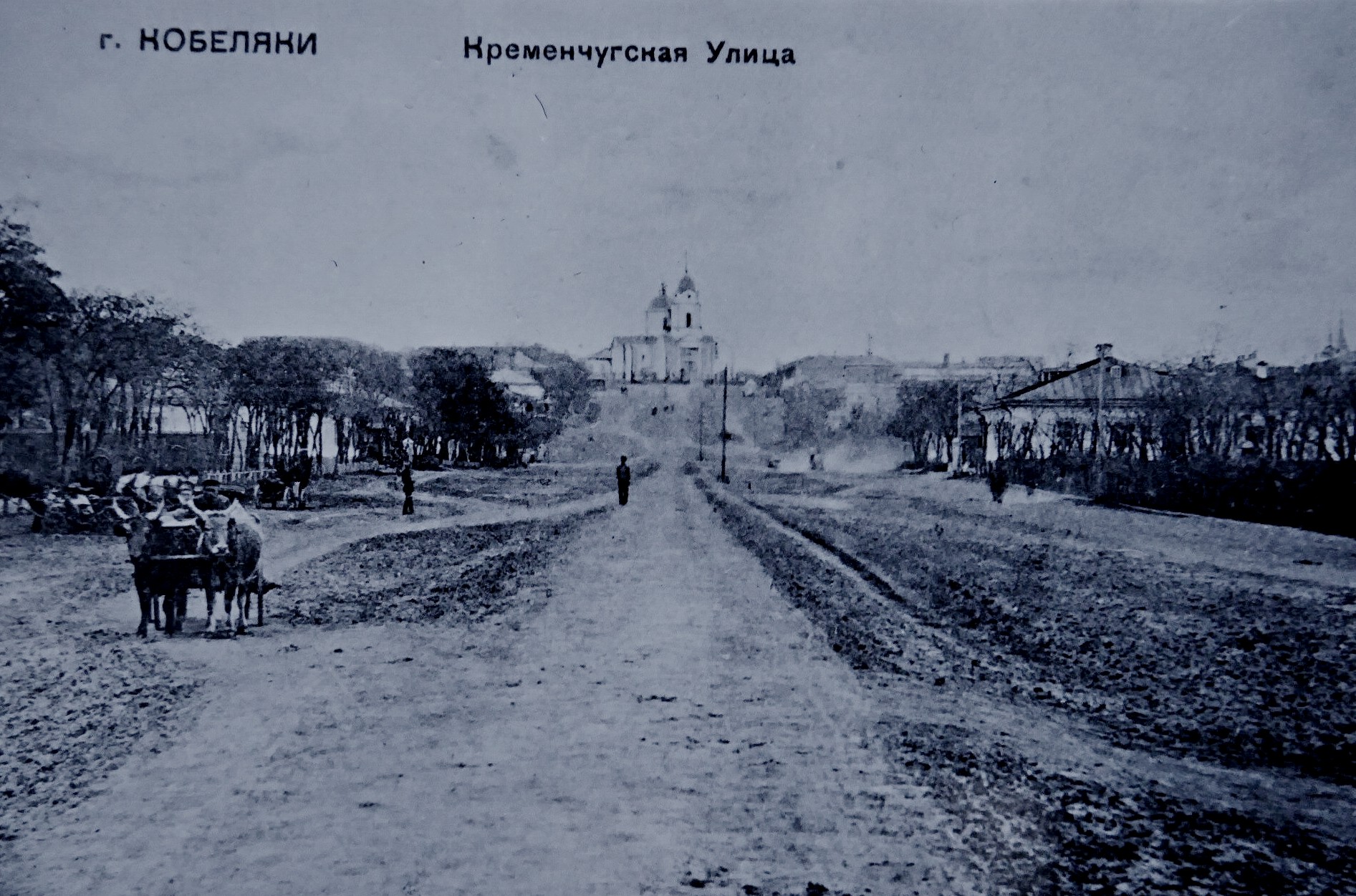
Ancient Kobeliaky. From archive of The museum of local history in Kobeliaky
The village was a part of Ukrainian People’s Republic (UPR) since 1917. Bilshovyky annexed Poltava province with Kobeliaky in 1920, after movement away of the allies and many defeats of Ukrainian army. In January 1919 anti-ukrainian Bilshovyky’s party-organization of the district, which consisted of 60 members and made a riot against Ukrainian People’s Republic, was created. On 22 of January, 1919 Kobeliaky was conquered by Horse Regiment of UPR Army named after Petro Bolbochan, which was renamed later on Horse Regiment of Black Zaporozhtsi to crackdown a riot.
Travelling around Left-banked Ukraine was quite dangerous and nervous for capella’s people. Stepan Vasylchenko noticed more than once in his diary about sieges and fugleman Mahno.
Citizen of Kobeliaky Matviy Boboshko during 1917-1921 was writing “Diary of counterman”.
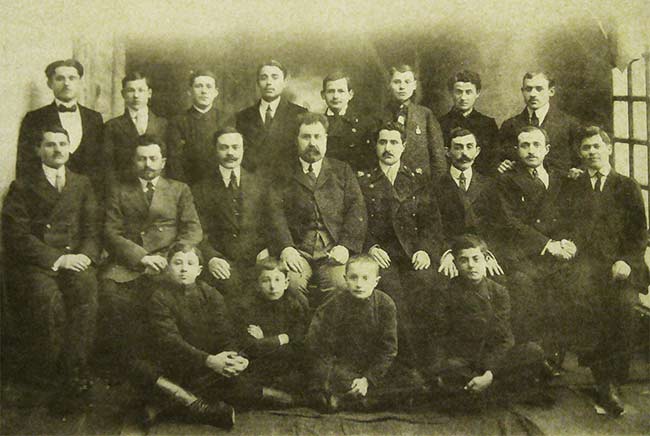
Matviy Boboshko (leftmost in 2 line) group photo with shop workers in 1917. From archive of the museum of local history in Kobeliaky
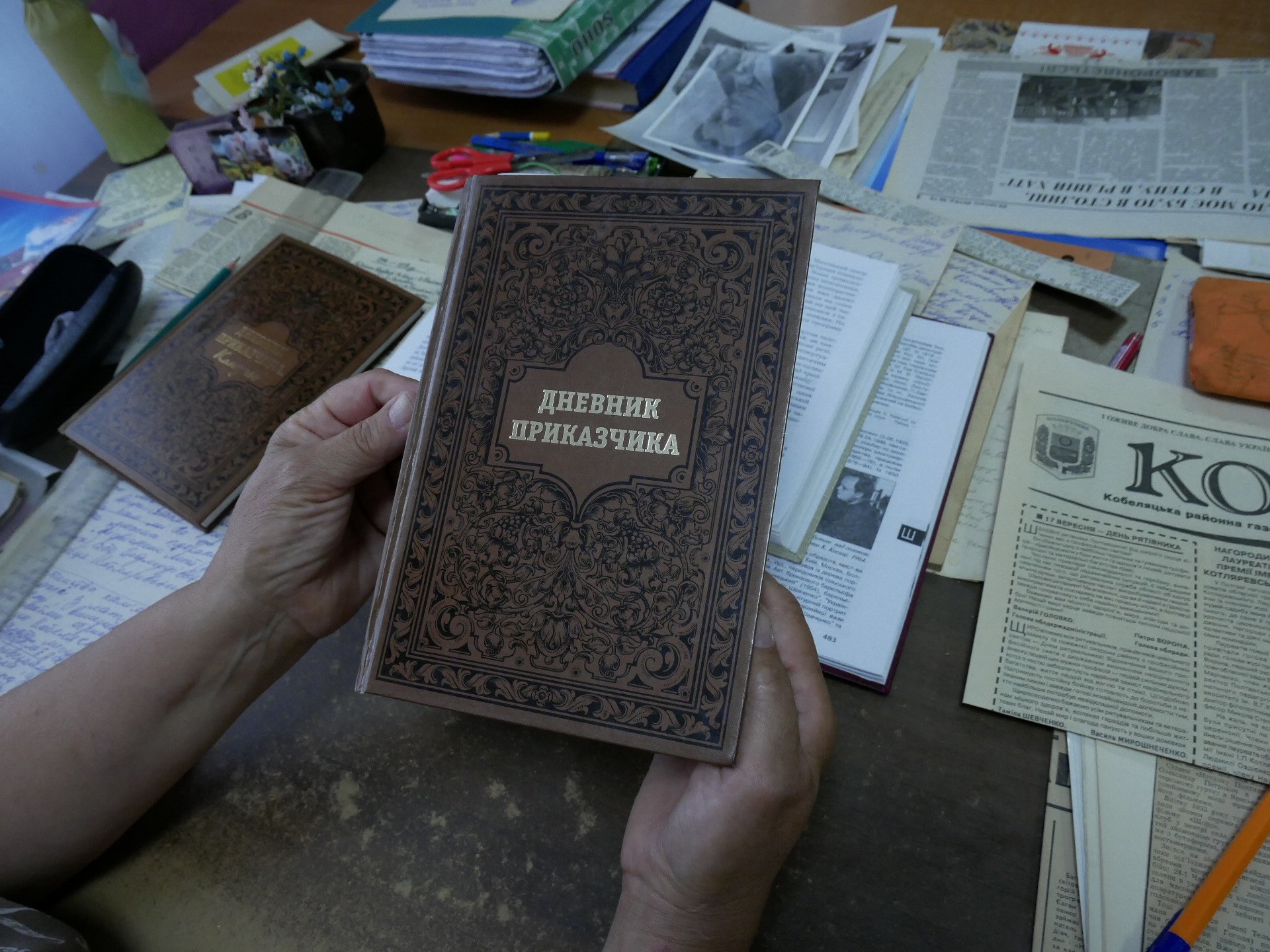
Diary of Matviy Boboshko. From archive of the museum of local history in Kobeliaky
He noticed interesting supervisions about contest of Ukrainian anarchists in current events: “New anarchists’ battle with everyone has begun: with white, with red, with Ukrainian army, and generally with all kinds of authorities”. It should be mentioned, that M. Boboshko noticed anarchists in his notes for the first time, and permissive to make two important conclusions. Firstly, anarchists’ ideology filled noticeable place after partly absorption of Ukrainian insurgents, which were confronting to white army in protest movement, that had continued battle against “dictatorship of the proletariat”, before red army. Secondly, local insurgents, that has joined Mahno in autumn, 1919, to some extent shared this ideology. So, it’s not strange, that in January, 1920, on “old” New Year, counterman from Kobeliaky has written next conclusions about Mahno’s people: “Betweet Bilshovyky, especially, between Ukrainians, cleavage has begun: Mahno, previous supporter of Soviet Authority, has announced new position of things, that is: anarchy. Authorities – go away! Let there be Ukrainian Anarchists Federation! The highest right is the right of rebellion!”
On 26-30 of July, 1920, M. Boboshko has written in his diary again: “Anxiety all the time; rumors say, that lots of insurgents are around the city… Life stopped in the town”.
(More info here: http://shron1.chtyvo.org.ua/Arkhireiskyi_Dmytro/Schodennyk_prykazhchyka_iak_dzherelo_z_istorii_selianskoho_povstanskoho_rukhu_u_1917-1921_rr_na_pivd.pdf)
But despite of riots and pressure, people of capella continued to perform and to give concerts in Kobeliaky, by gifting Ukrainian songs, and to raise the spirit of citizens.
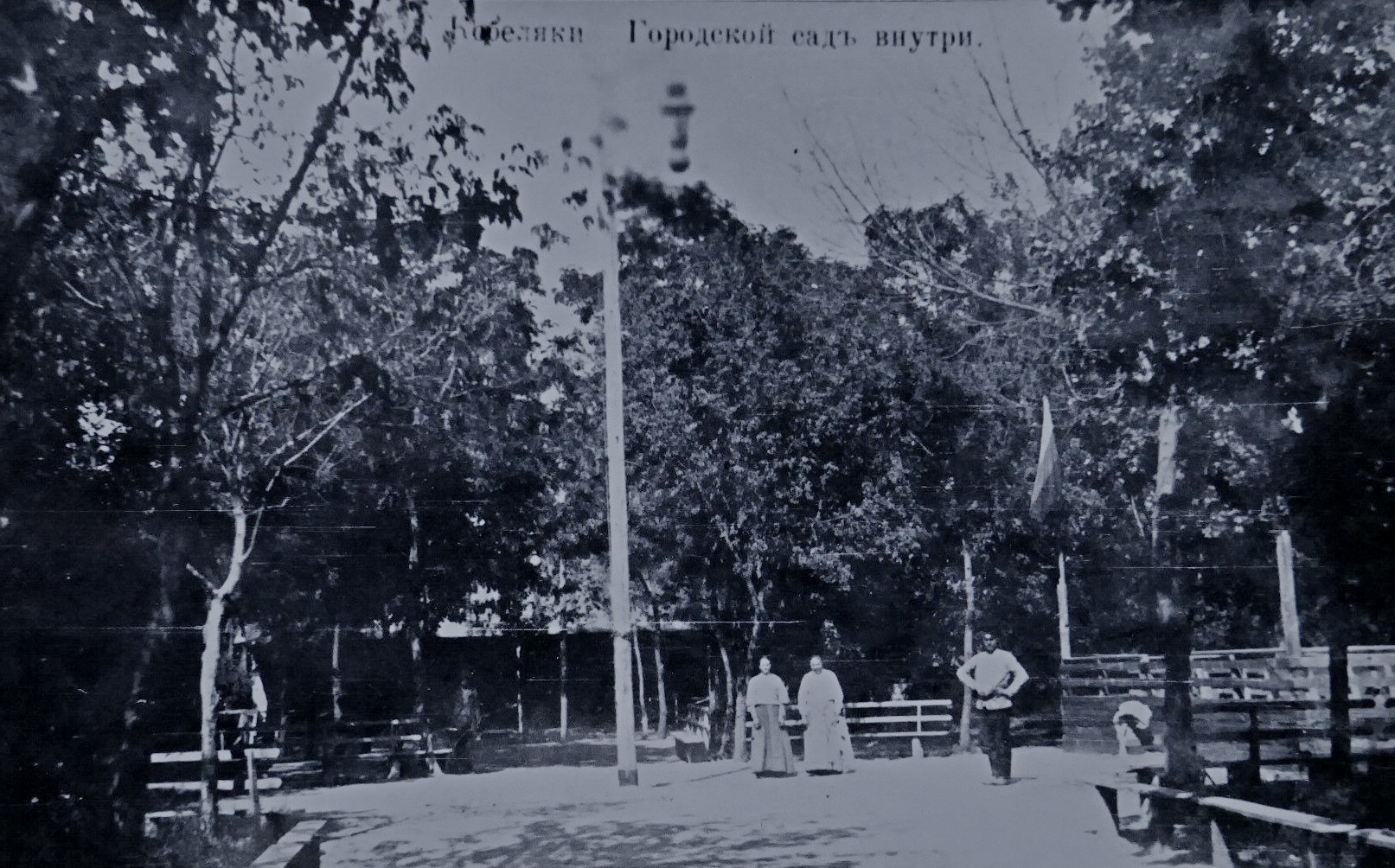
Garden of the city, beginning of XX c. From archive of the museum of local history in Kobeliaky
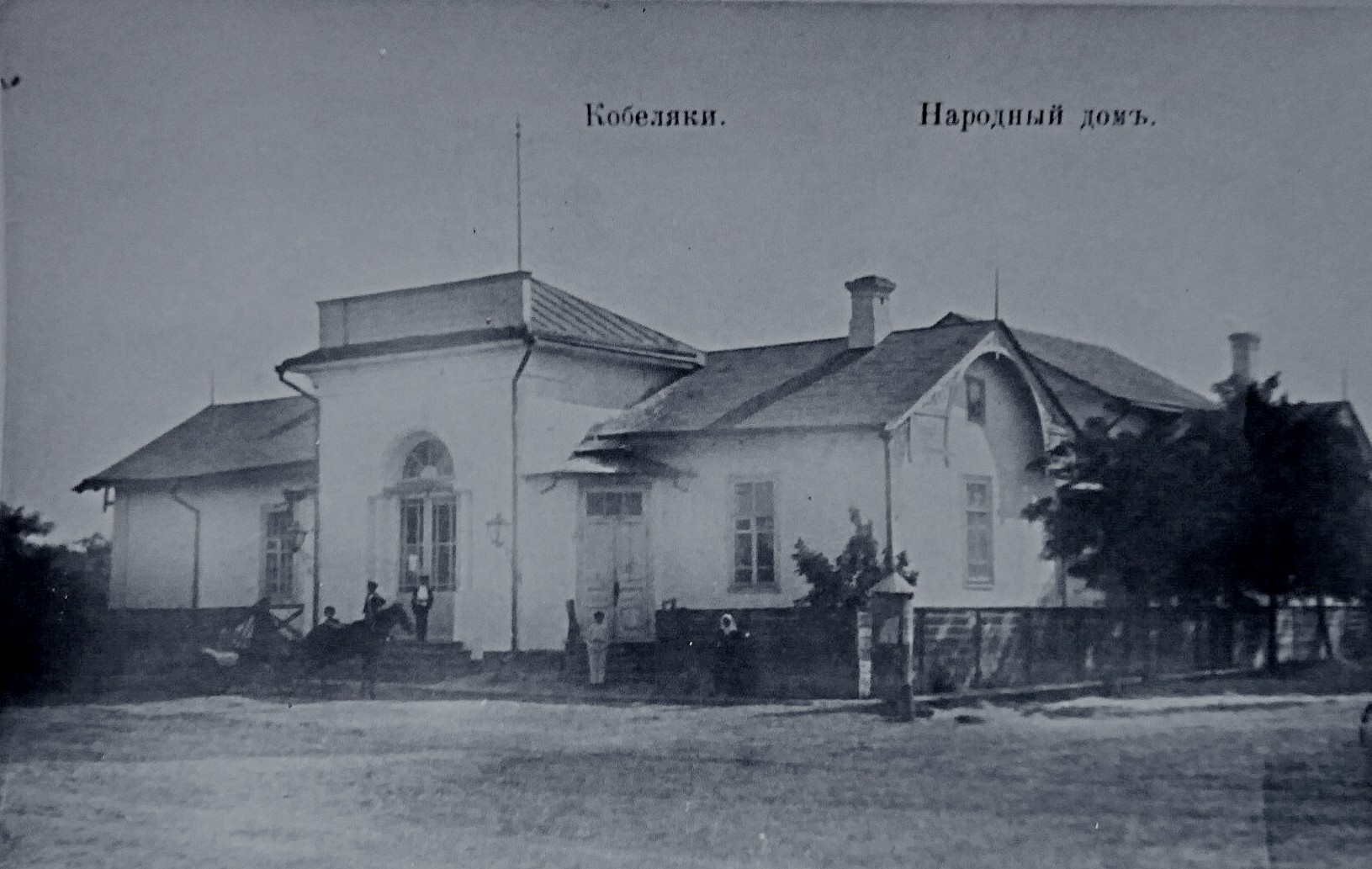
People’s house, beginning of XX c. From archive of the museum of local history in Kobeliaky

Kremenchuk is the city in Poltava region. It has two mini-districts: Avtozavodskyi and Kriukivskyi. City located on Dnipro river (larger side lies on the left bank and smaller side lies on the right bank). Official date of founding is 1571 year. Most of scientists claim that the name came from Turkic word “kermenchyk” and means “small tower”. Other suggest versions about Turkic word “ker” (“kyr”), which means “hill”; or from the name of Cossack Kremen’.
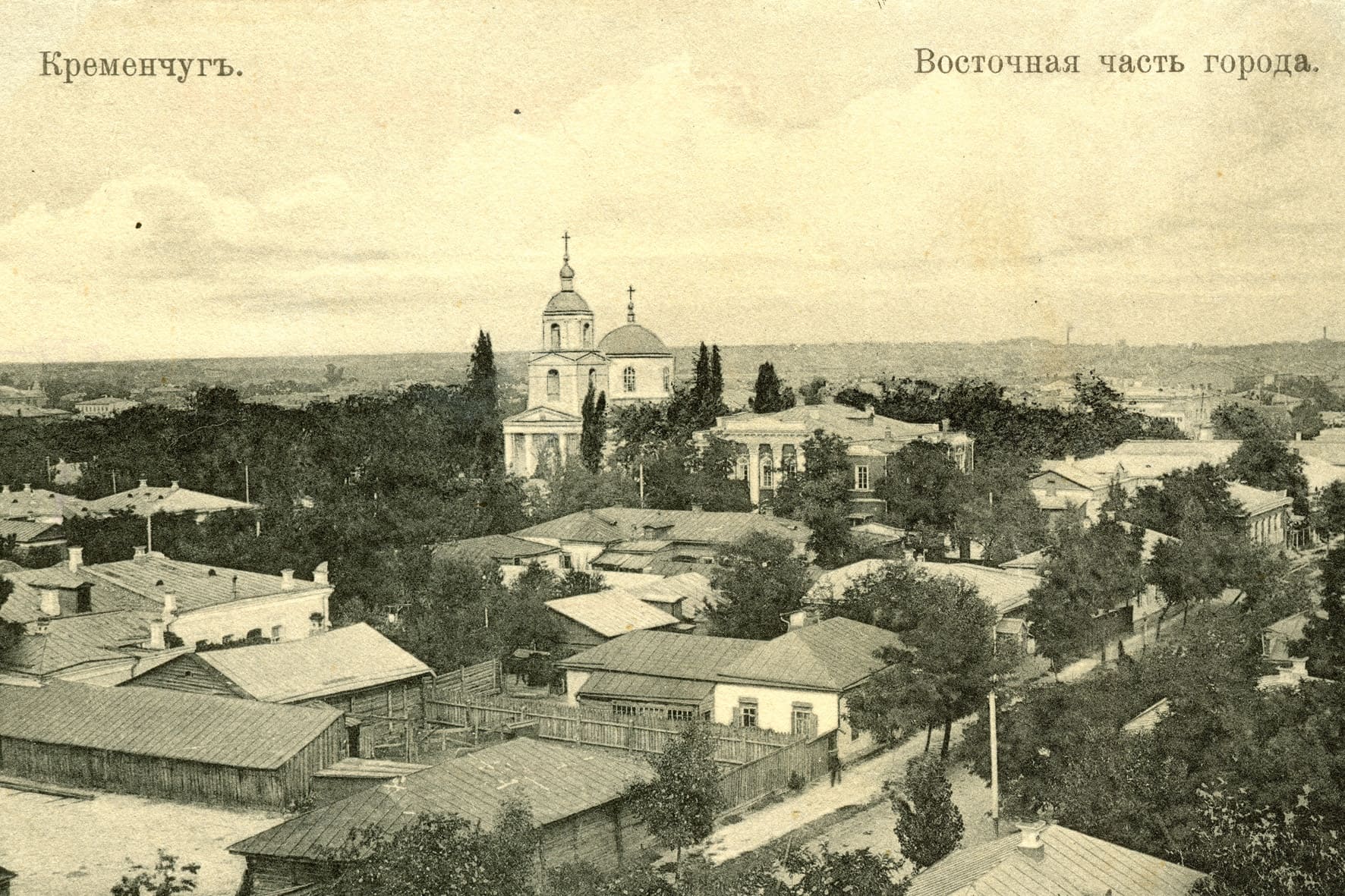
Old Kremenchuk. From archive of The museum of local history in Kremenchuk
Travelling capella performed in Kremenchuk and in the town Kriukiv. Buildings, where concerts took place, didn’t keep, but some interesting facts about them still exists.
“Korso” – electricbiographer (cinema) had opened in December, 1913, inside the theatre’s “Korso” building in the town Kriukiv (other sources suggest 1909 year).
The name “Korso” came from Italian title of local entertaining out-of-town trains and also from simple evening walks in horse-carriages per main streets of the city. So “Korso” is an entertaining place, where different events happened, not only for watching movies.
Capella of “Dniprosoiuz” in 1920 has visited exactly this cinema “Korso” in Kriukiv, and it was only one. Nowadays only elevation of cinema “Korso” has left.
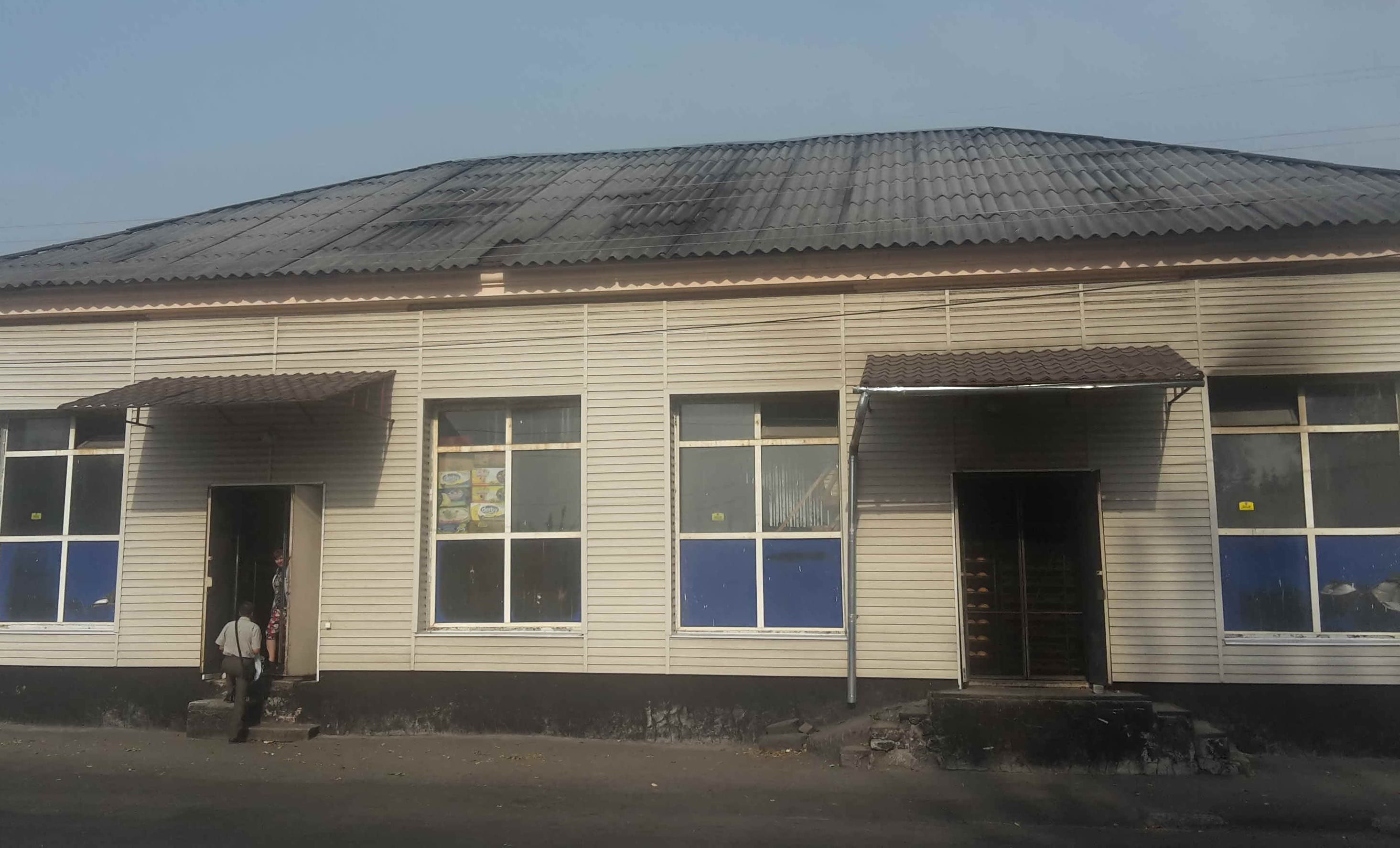
Elevation of old cinema. Public property
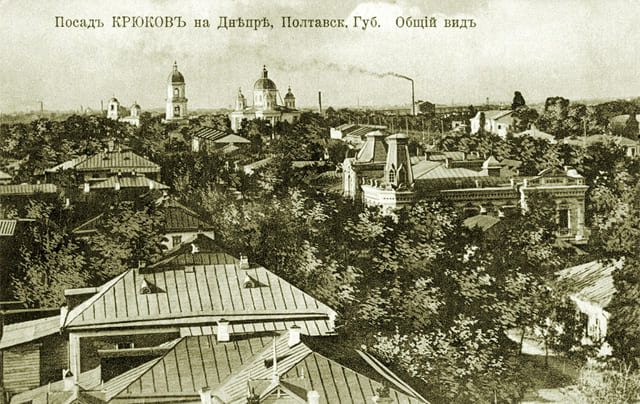
Old Kriukiv. From archive of The museum of local history in Kremenchuk
People's audience of Pushkin was a place of culture and entertainment, that has appeared in the town at the end of XIX c., and was named after O.S. Pushkin in honour of centenaries from his birthday (1899). It was double-decker brick building on high foundation wall. It was located at the corner of streets Gorodova and Mishchanska (now there is modern sewing factory).
In people’s audience were a big hall and city people’s library. Theatre performances (touring and amateur’s) happened here. Despite of the theatre, there was touring concerts, performances of famous people from that period: D. Yavornytskyi, writer V. Solohub, I. Sievierianin, A. Rubinshtein, S. Rakhmaninov and many others.
Just educative events as “The white flower’s day”, action, that was dedicated to struggle with tuberculosis (1913), often happened. On this occasion in people’s audience house was removable educative exhibition. Mrs Aisshtetten, wife of Kremenchuk’s polizeimeister A. I. de Aisshtetten, was head of the committee of conducting “The white flower’s day”.
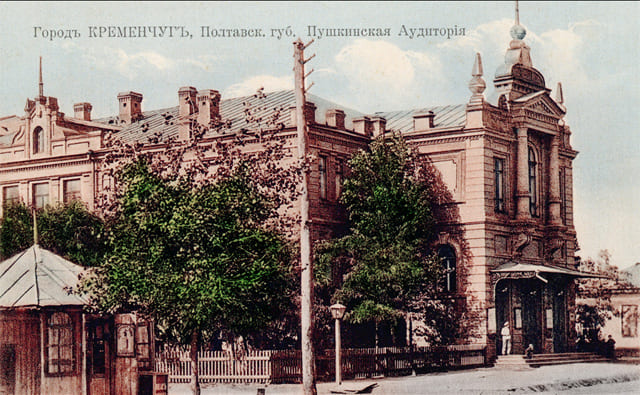
People’s audience. XX c. Public property
At this time, it was difficult to appreciate Ukrainian language and folk songs, because new system affected citizens. But, generally, Kremenchuk was customizable for Ukrainian musical style. According to researcher of Kremenchuk’s museum of local history, Mrs Viktoriya, Kremenchuk’s capella named after M.V. Lysenko for guidance of Prokopii Sapsai from 1918.
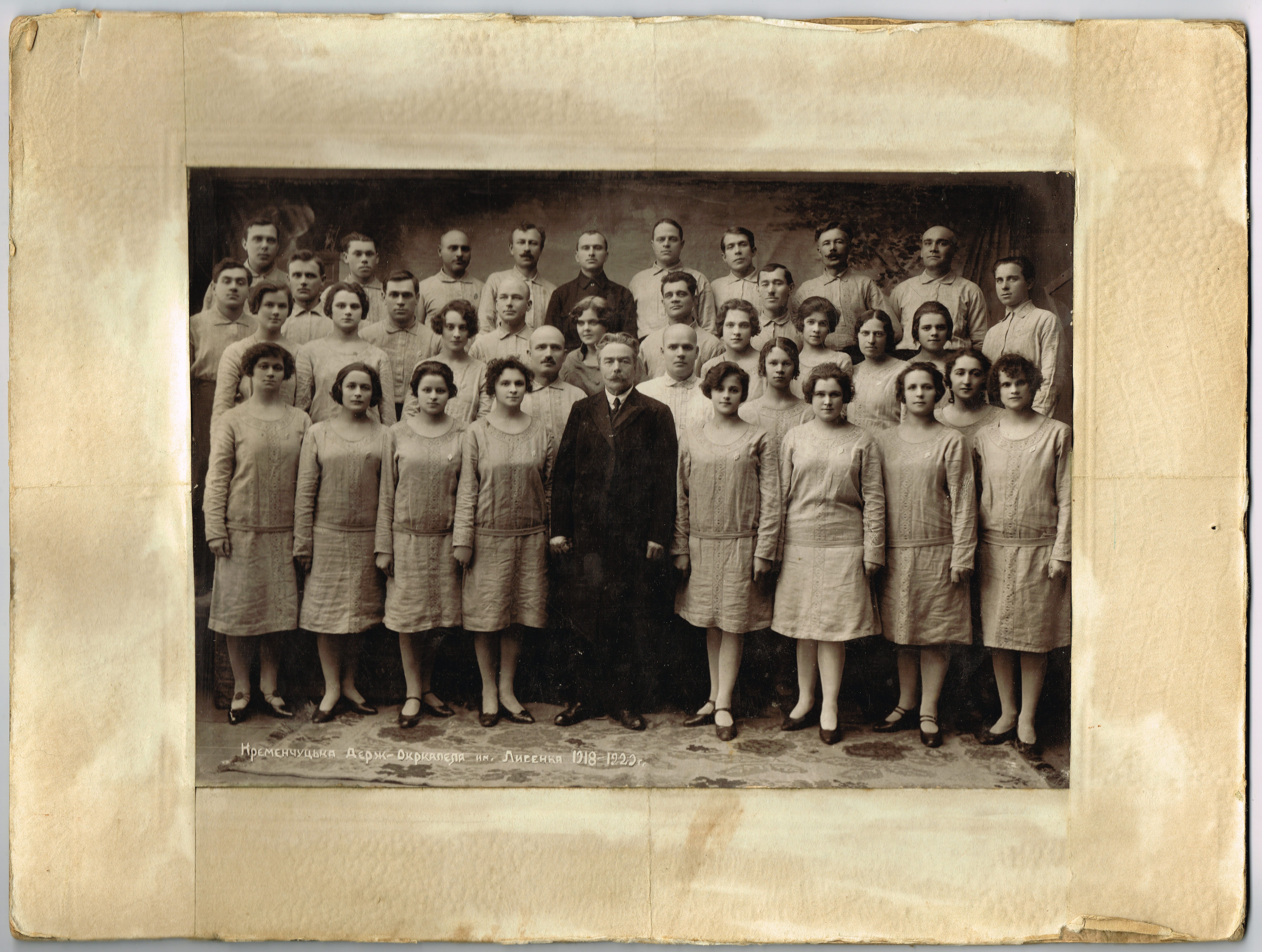
Kremenchuk’s capella, conductor Prokopii Sapsai. From archive of Kremenchuk’s museum of local history
Prokopii Sapsai was a famous composer, conductor, film director and actor. Capella’s repertoire was difficult and diverse, there were Ukrainian folk songs, choral compositions of Ukrainian composers, and also classical works of Russian and foreign authors.
In 1920 around Kremenchuk’s capella was created art council. The most talented participants were addressed to take education in National Kyiv’s Conservatory. Kremenchuk’s singers Nesterenko and Babenko then came to Travelling capella of “Dniprosoiuz”.
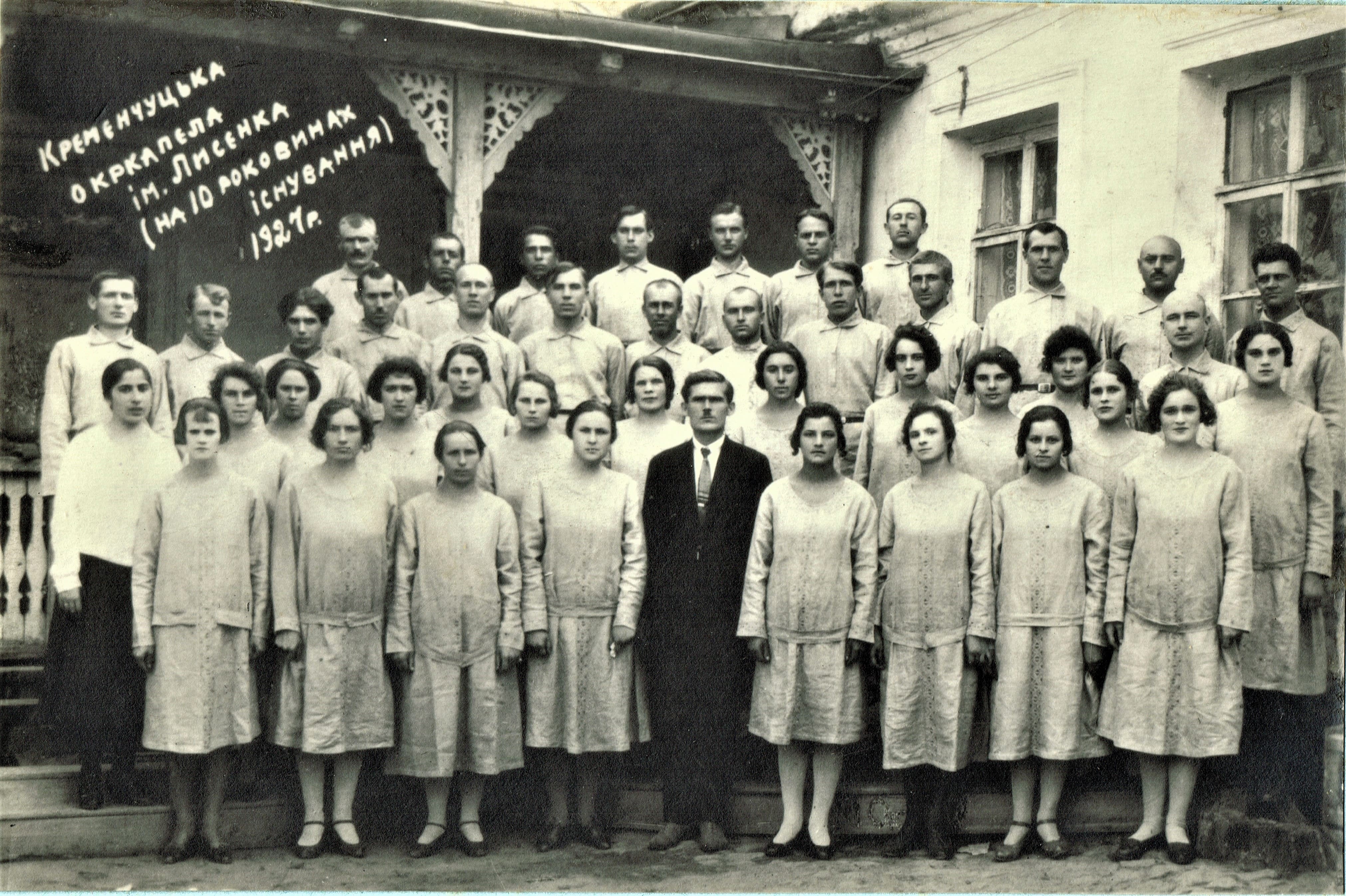
Kremenchuk’s capella. Kremenchuk’s museum of local history
Unfortunately, beautiful building of People’s audience was partly destructed during World War II. Ruins kept safe until 60s XX c. Then, it was destroyed, and on this place was constructed ruck concrete building of Kremenchuk’s sewing factory.
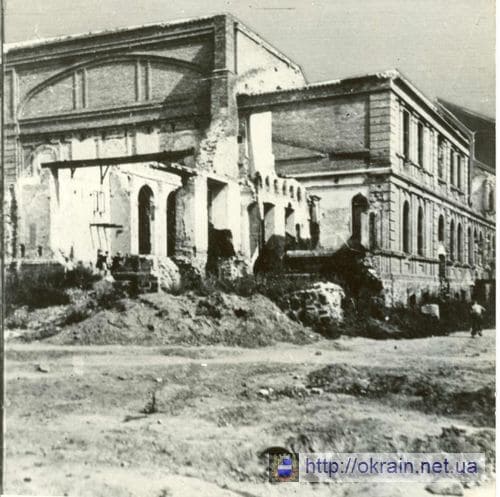
Destroyed people’s audience. Public property
In 2019 cultural life continued in Kremenchuk. Folk ensemble «Slavutych» was created in 1975 and is one of the biggest of independent collectives in town. Ensemble blends three genres: vocal, choreographic and instrumental. Every group has its own repertoire, which complete general conception of “Slavutych”.
For more than four decades of its existence, “Slavutych” has educated eight generations of artists, which not for once has performed on national and foreign scenes.
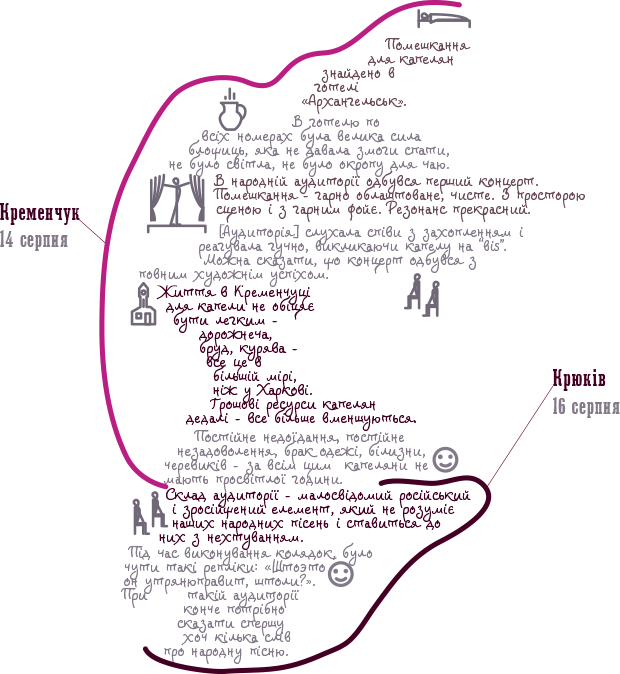
Nestor Horodovenko and choral capella “Dniprosoiuz”
Capella got in Lokhvytsia to perform by no coincidence. It was very important for band-master Nestor Horodovenko to visit homeland. Nestor Feofanovych was born in Venslavy within Poltava region (now Lokhvytsia district in Poltava region).
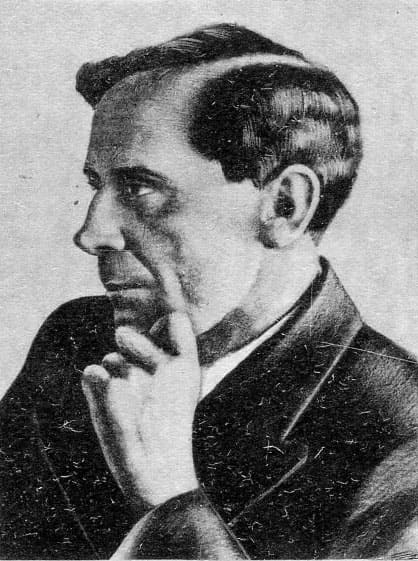
Nestor Horodovenko. Public property
He graduated from Teacher’s college of Hlukhiv in 1907, worked in academies of Lokhvytsia and Pereiaslav, where he professed singing and curated choirs.
Horodovenko has begun his big career and road-concerts trips with choral capella of “Dniprosoiuz” in 1920.
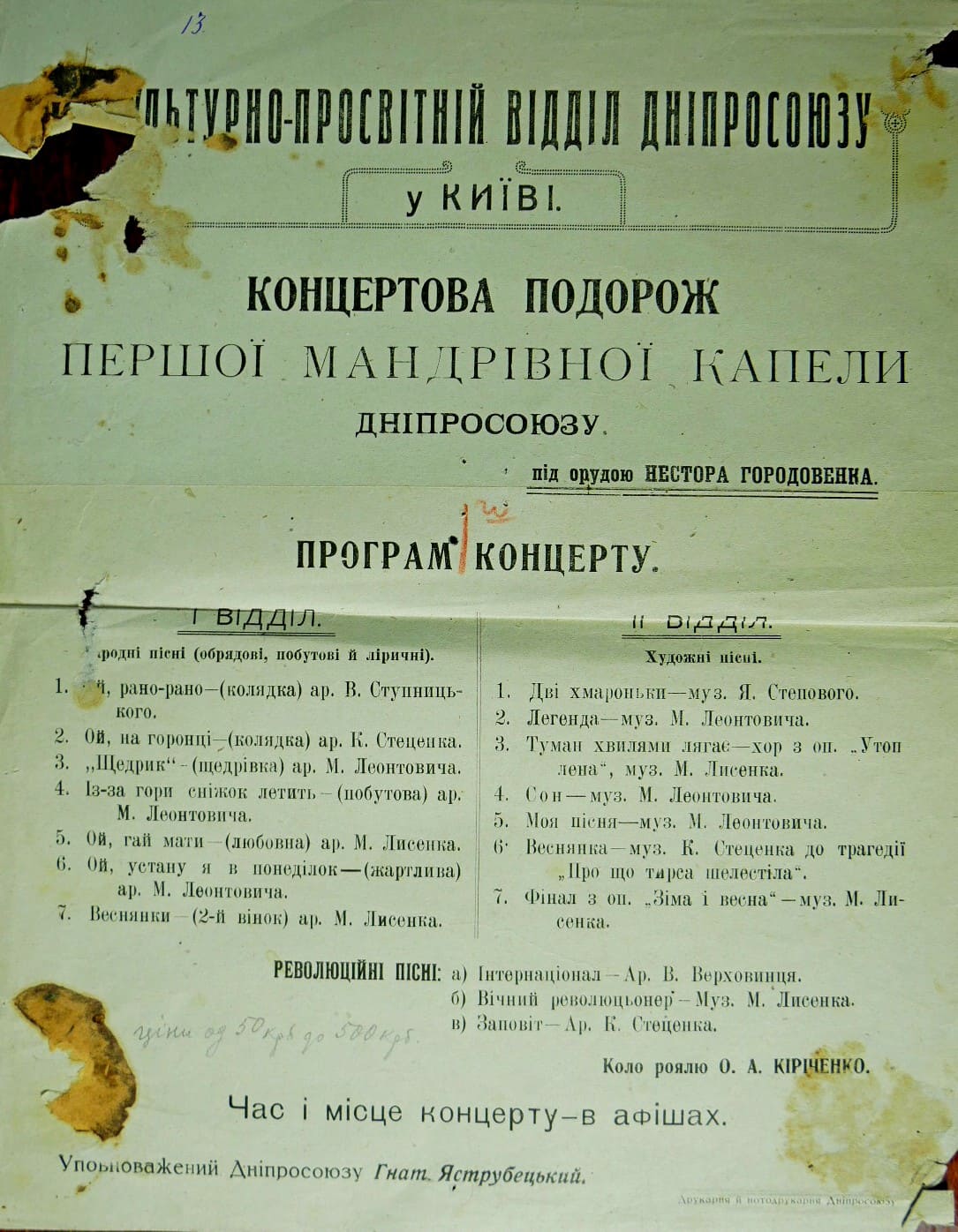
Programme of First travelling choral capella of “Dniprosoiuz”. From archive in Museum of local history in Lokhvytsia
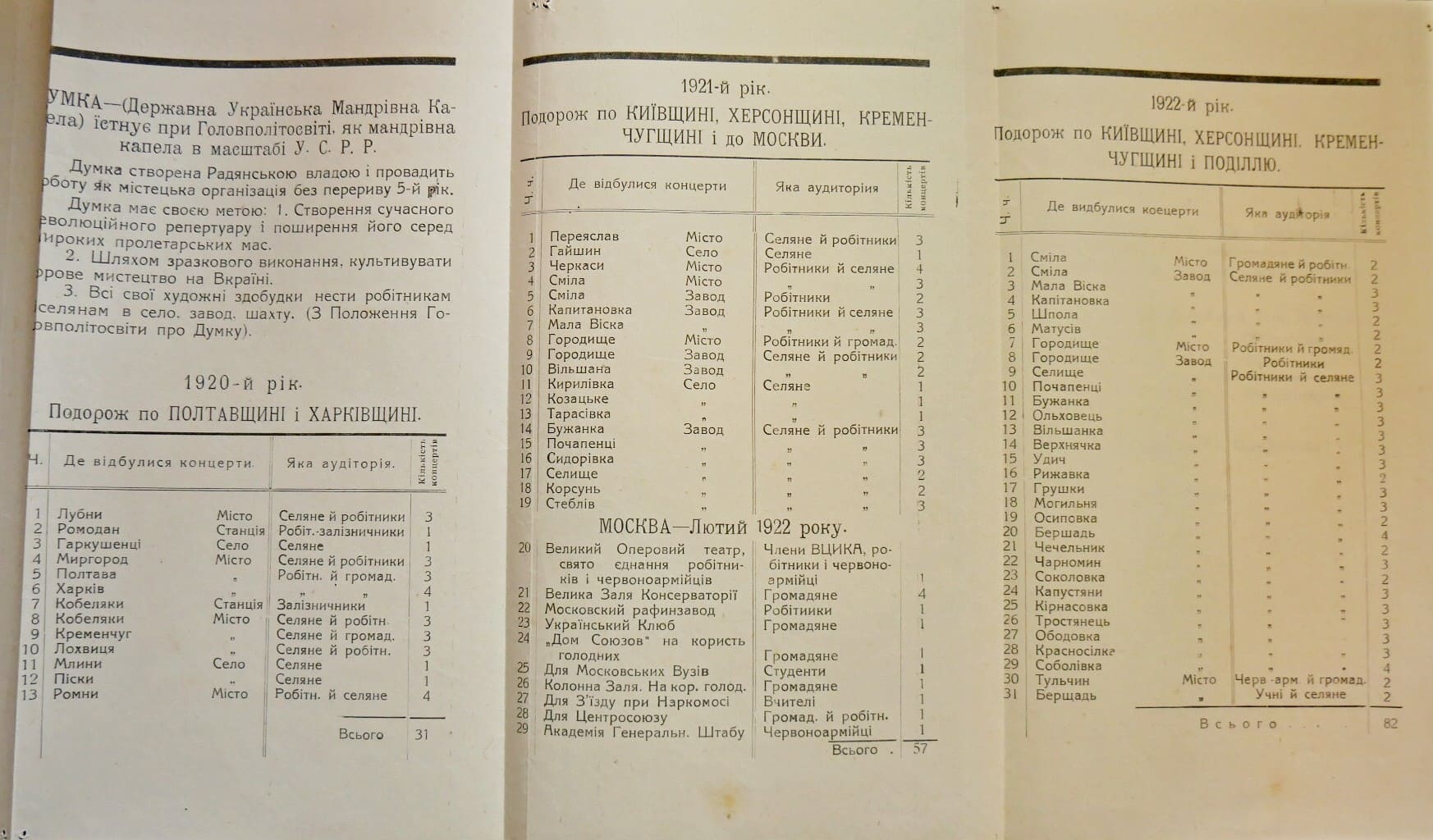
Program of First travelling choral capella of “Dniprosoiuz”. From archive in Lokhvytsia’s museum of local history
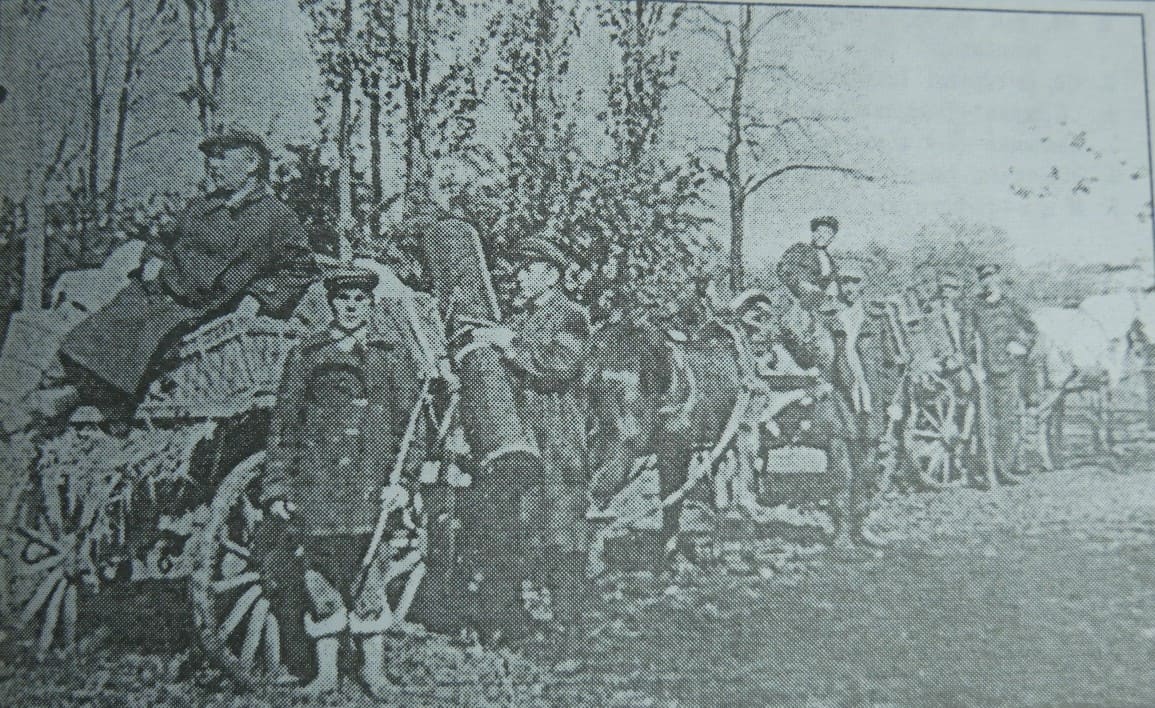
Capella of “Dniprosoiuz” during first errantries. From archive in Lokhvytsia’s museum of local history
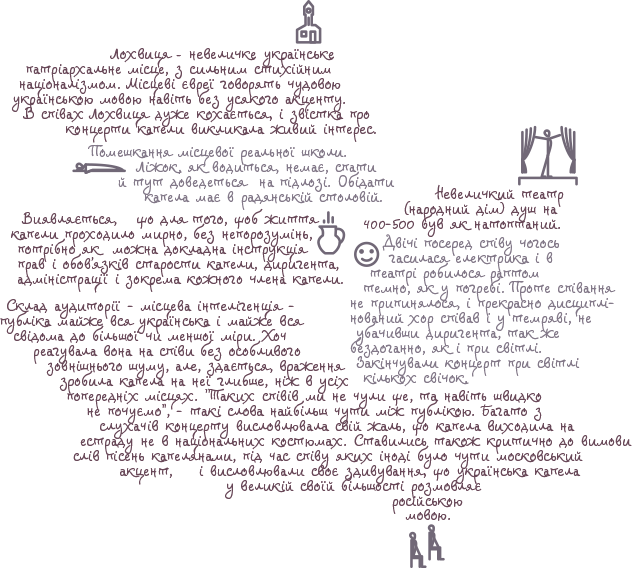
This fact is evidential about tension of conductor’s work: during first three years of its existence, capella gave almost 400 concerts. N. Horodovenko settled creative co-work with famous composers and singers: M. Verykivskyi, L. Revutskyi, B. Lyatoshynskyi, I. Kozlovskyi, etc. Activity of “Dniprosoiuz” has represented dynamics of next artisticly-aesthetic transformations of Ukrainian choral culture under this period of time.
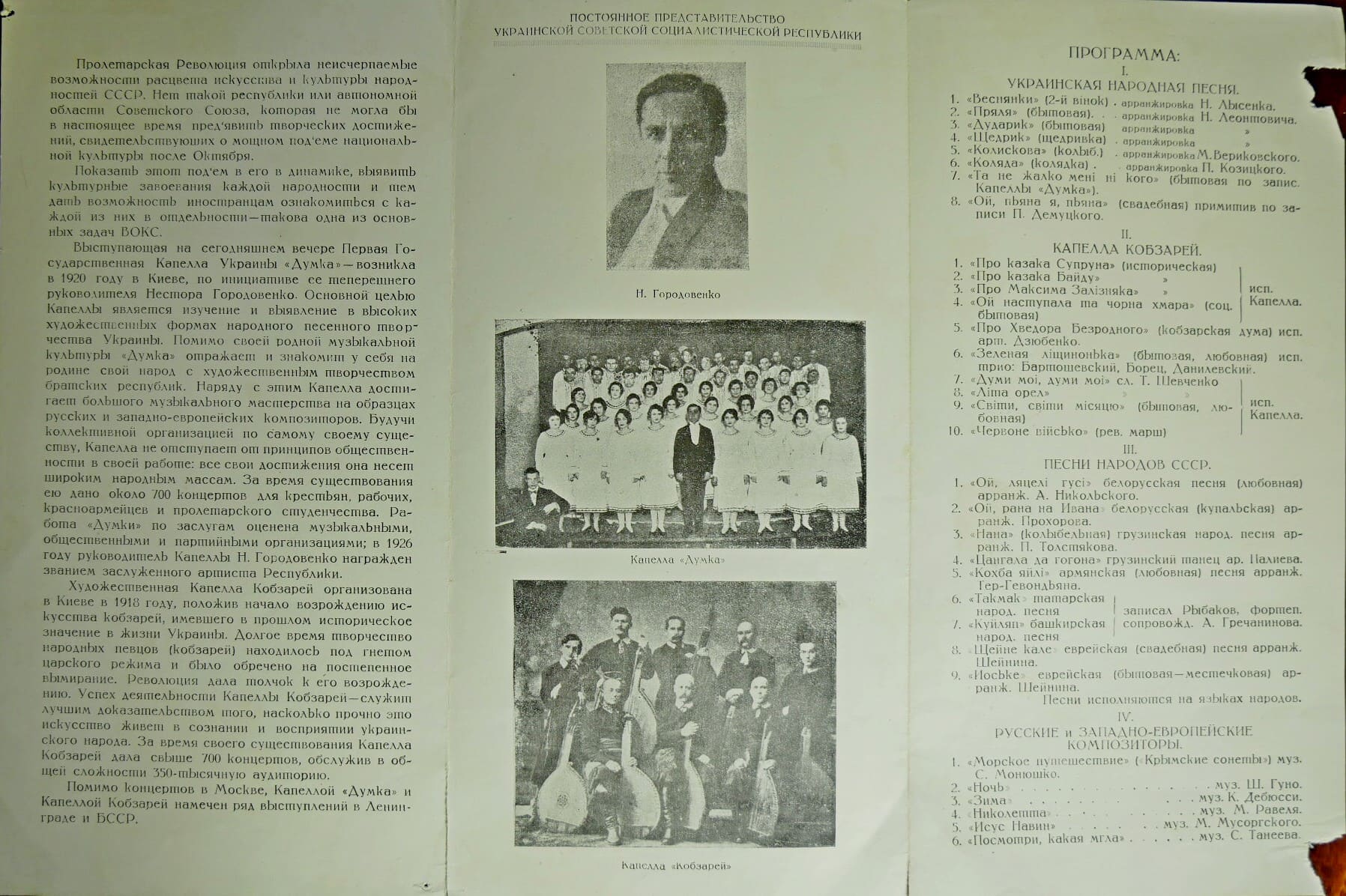
Program of capella of “Dniprosoiuz”. From archive in Lokhvytsia’s museum of local history
A dot work started over the formation and enrichment of repertoire. Programs of concerts were soaked of national-singing spirit. Firstly, they consisted only of folk songs, but sooner were prepared thematic cycles based on works of M. Lysenko, M. Leontovych; of calendar and ceremonies (folk songs of Halychyna, where were shown works of S. Ludkevych, N. Nyzhankivskyi, H. Topolnytskyi and others); songs of the revolution, music of USSR’s people in the middle of 20s, Russian, and then foreign music (from monumental oratorio Season of the Year by Haydn to impressionists’ works of M. Ravel, C. Debussy), which hasn’t been performed in Ukraine before.
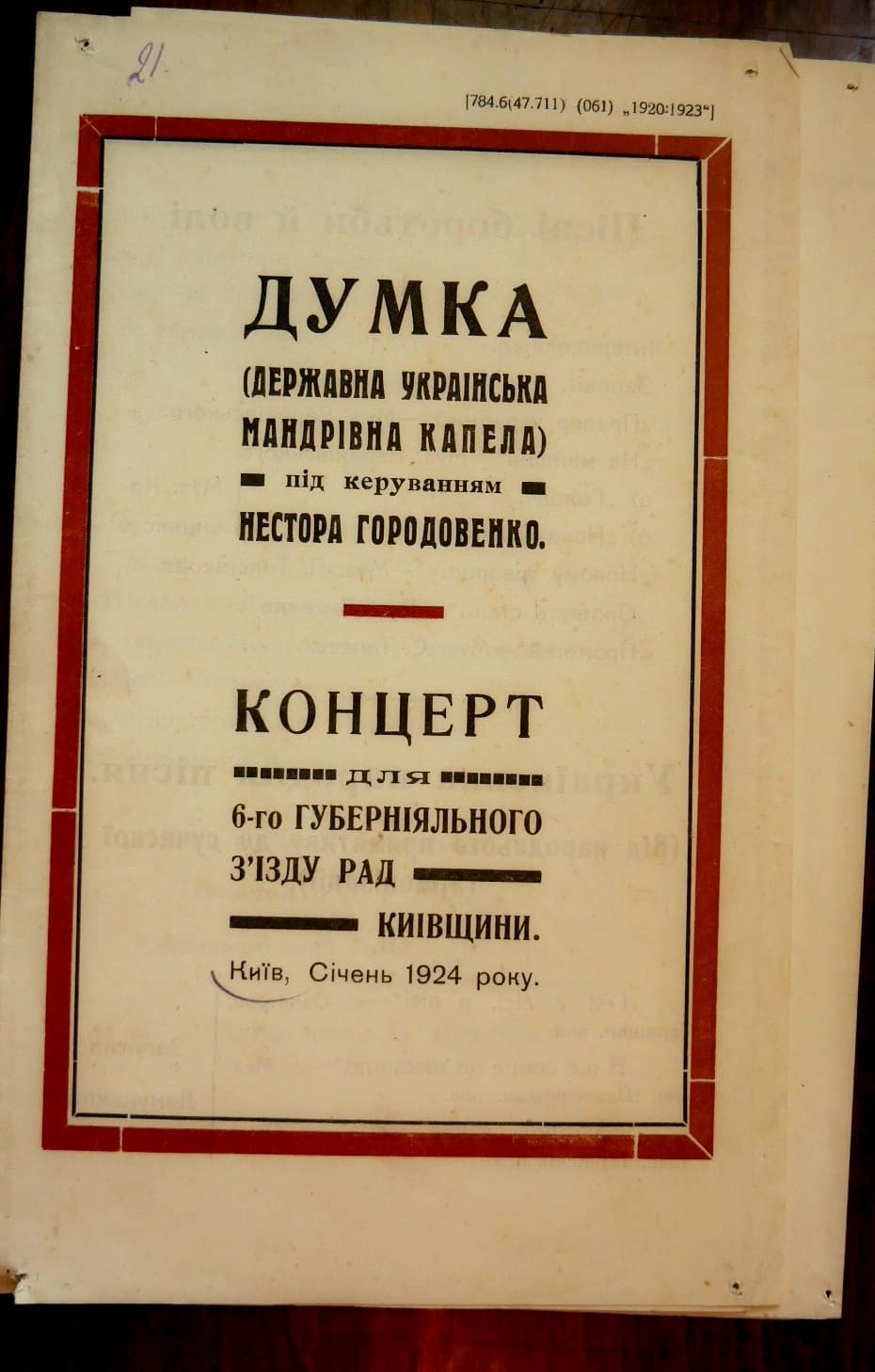
Program of capella of “Dniprosoiuz”. From archive in Lokhvytsia’s museum of local history
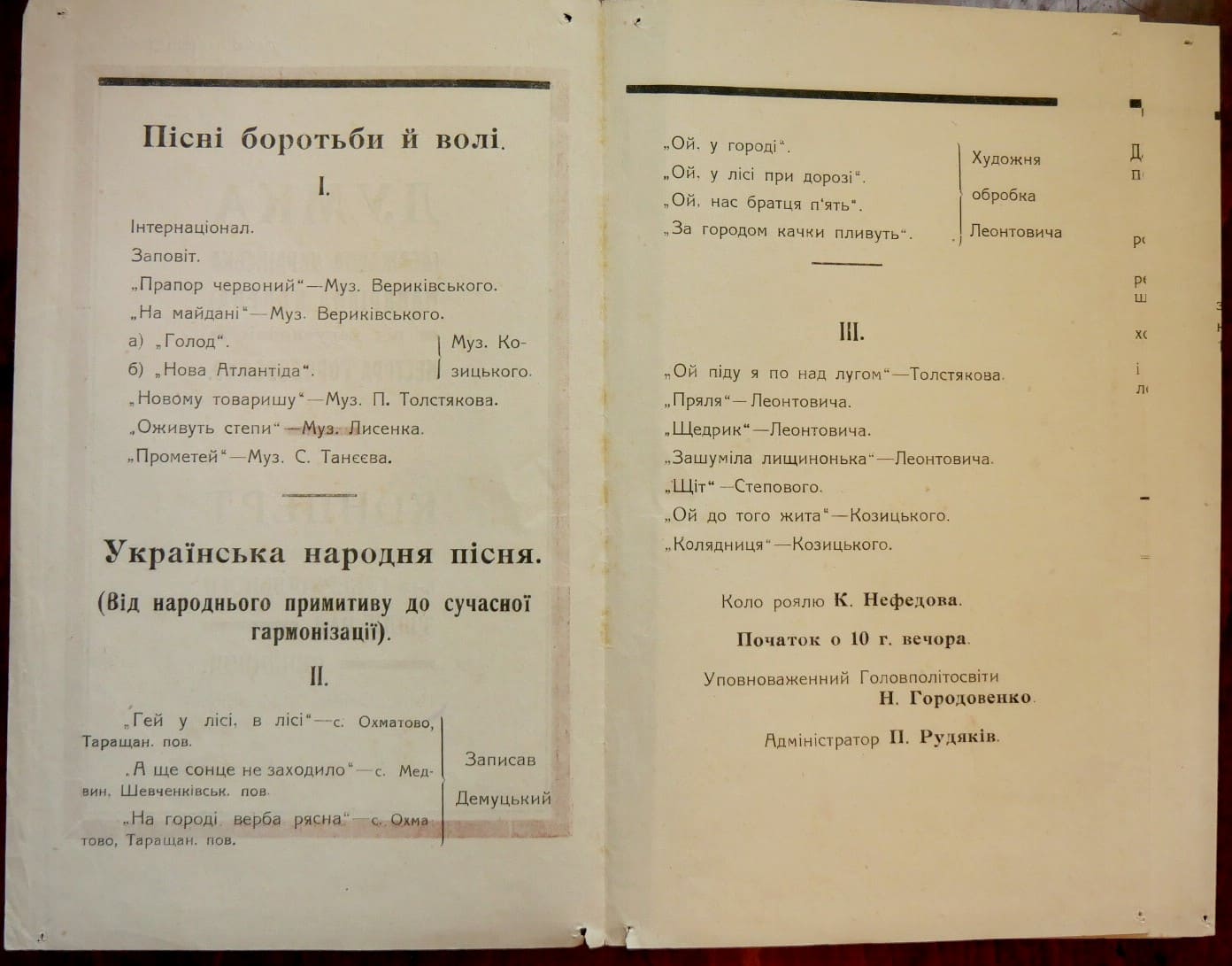
Program of capella of “Dniprosoiuz”. From archive in Lokhvytsia’s museum of local history
Frontal attack on choral music, that was associated with churches, started in 30s; cleaning of chorists and choir-masters with doubtful social origin begun, tested concerts’ programs were prohibited, classical works and repertoire of 20s years were replaced with “actual” percussion odes. This not only exhausted participants of choral movement, but also has brought to massive elimination of professional and amateurs capellas. “Dumka” was also turned off into propaganda’s channel, though N. Horodovenko wished to safe capella. According to him, collective had yet “an opportunity to cherish, to protect, and to share Ukrainian folk songs” in uneasy Bilshovyk’s reality.
In 1934 capella performed D. Verdi’s Requiem for the first time. So, N. Horodovenko was the pilgrim of first reading of many world classical works and lifting choirs to European level of that time. Sooner choir refers to cantata oratorial compositions of Ukrainian composers. Setting on wide specter of styles of performed compositions required skillful hold of all arsenal of expressive means.
After triumphal performance of “Dumka” on the first Decade of Ukrainian art in Moscow in 1936, where was Stalin, N. Horodovenko was quited from capella. Famous conductor dared to complain to “Host” on that it’s prohibited to sing spiritual works for capella. Stalin answered with irony: “Sing them without words”. N. Horodovenko was quited and doomed to exile in ominous 1937, capella was also “repressed” by withdrawal from its repertoire national choral classic. During the war N. Horodovenko has created Ukrainian national capella from old singers of “Dumka” and from other choral collectives, that has left in Kyiv; its farewell concert was on opera theatre’s stage in August, 1943.
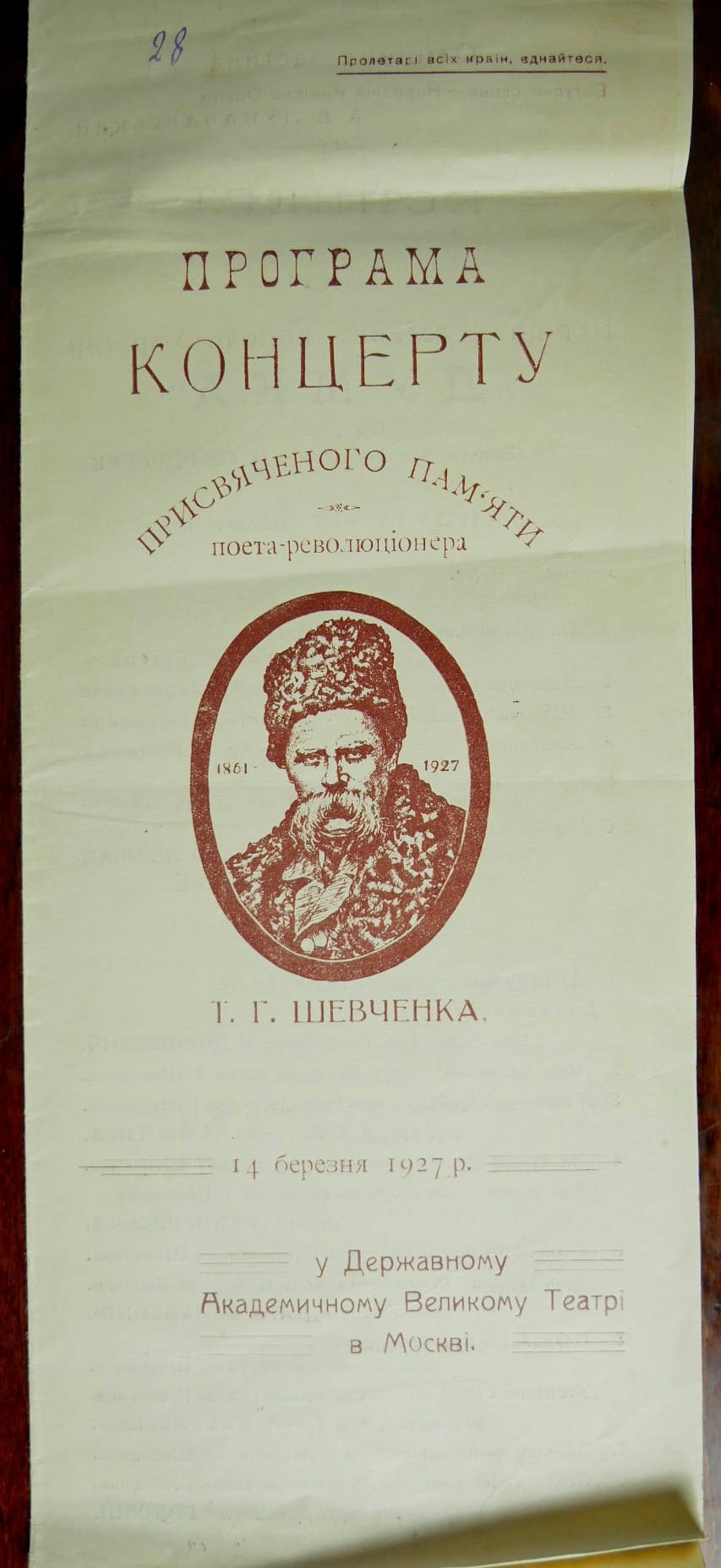
Program of capella of “Dniprosoiuz”. From archive in Lokhvytsia’s museum of local history
In 1944 he arrived in Germany, where in 1945 he has organized choir “Ukraine”. From 1949 he was living in Canada (Montreal), where he was conducting choir “Ukraine”.
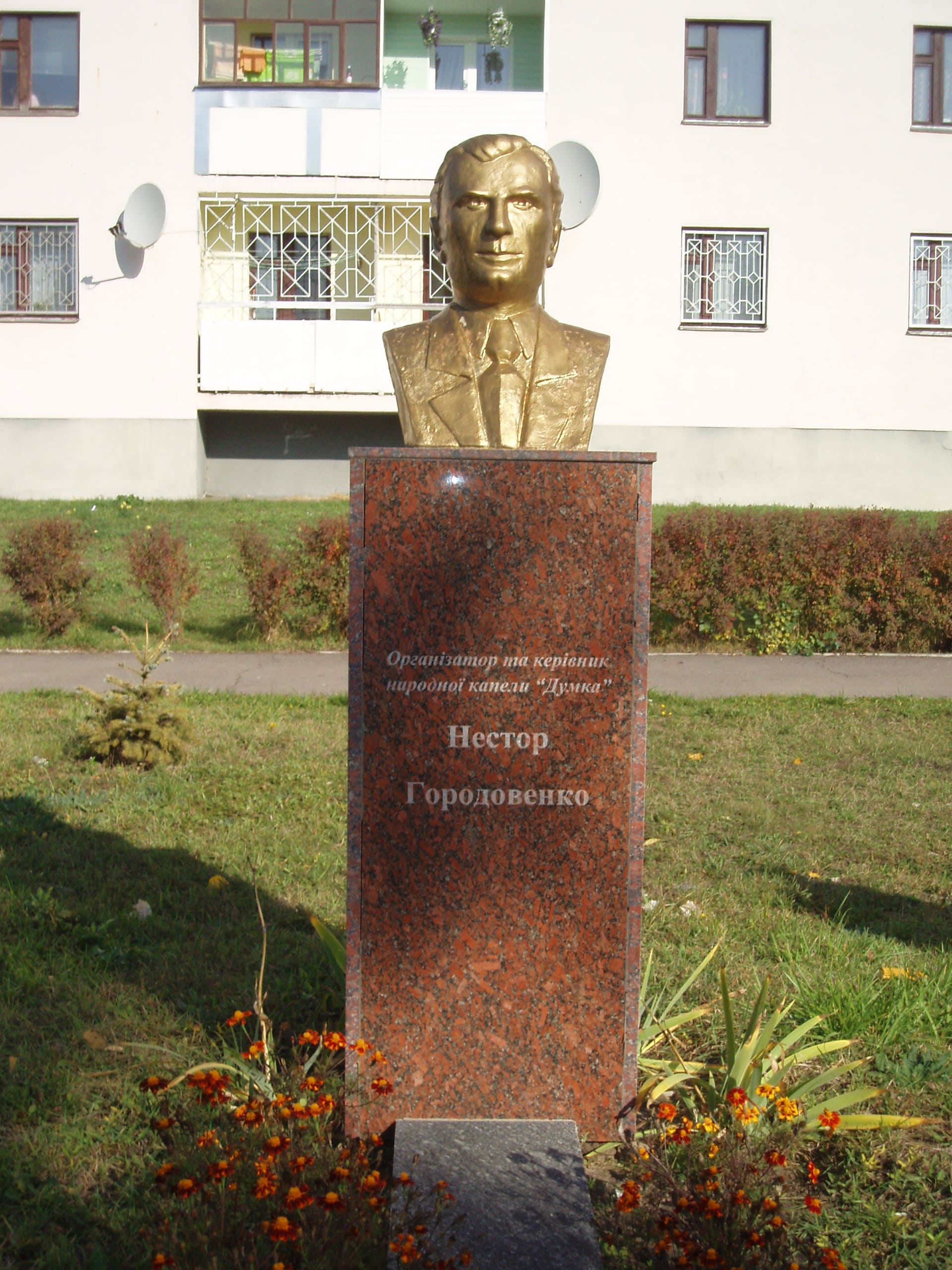
Nestor Horodovenko’s bust in Lokhvytsia. Public property
More about choral movement: http://194.44.152.155/elib/local.pdf

Mlyny is the Ukrainian village in Lokhvytsia district in Poltava region that was founded not beyond the beginning of XVII century.
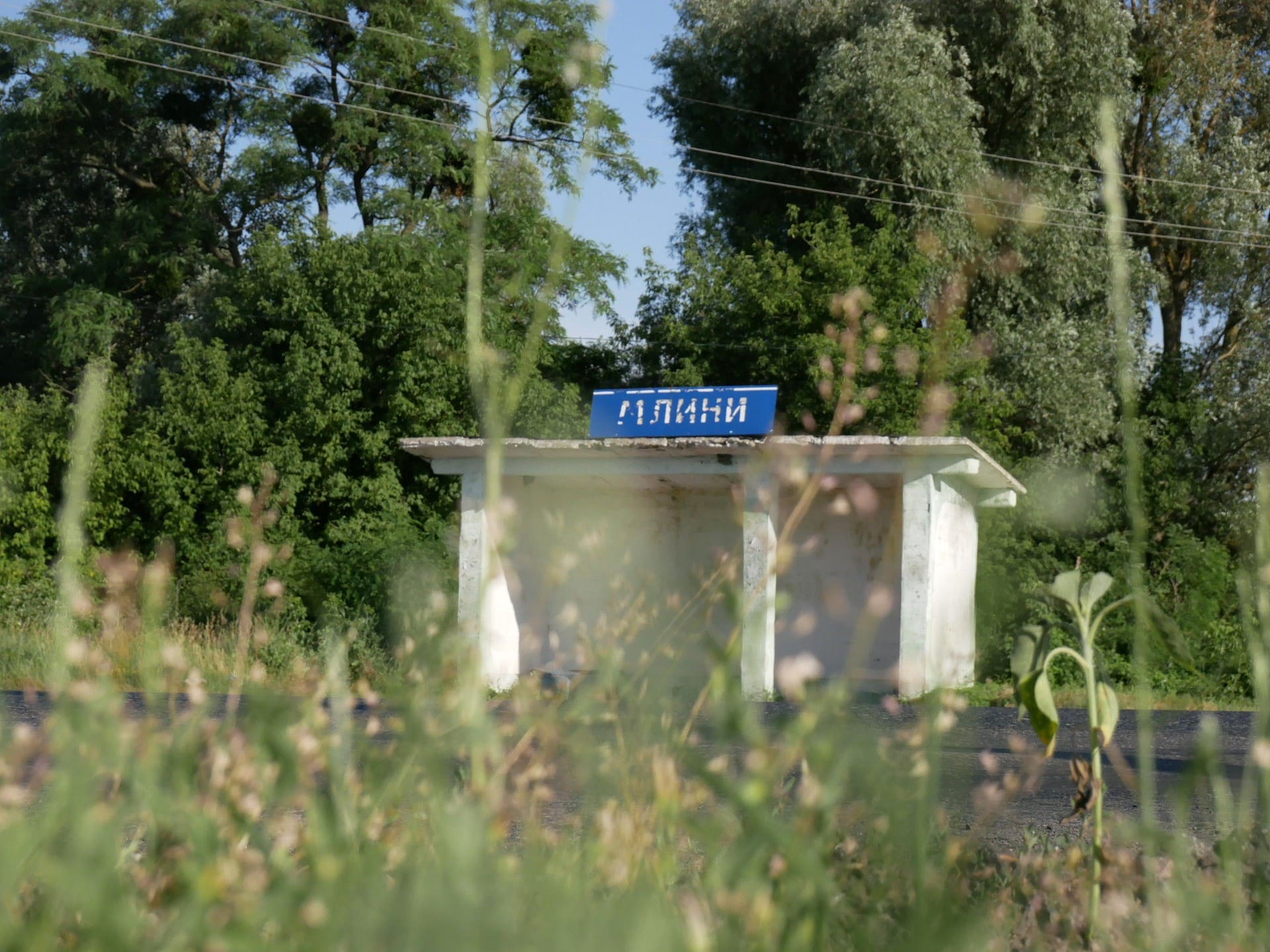
Bus station in Mlyny
The village Mlyny is situated on the left bank of the river Sula, while Lokhvytsia is located on opposite side. The river is winding there by forming estuaries and swampy lakes. Freeway lies along the village. In 1912 double-complex territorial school was built in Mlyny according to Opanas Slastion’s project. In 1920 near this school first travelling choral capella of Dniprosoiuz was waiting for dray to go to the closest countryside Pisky.
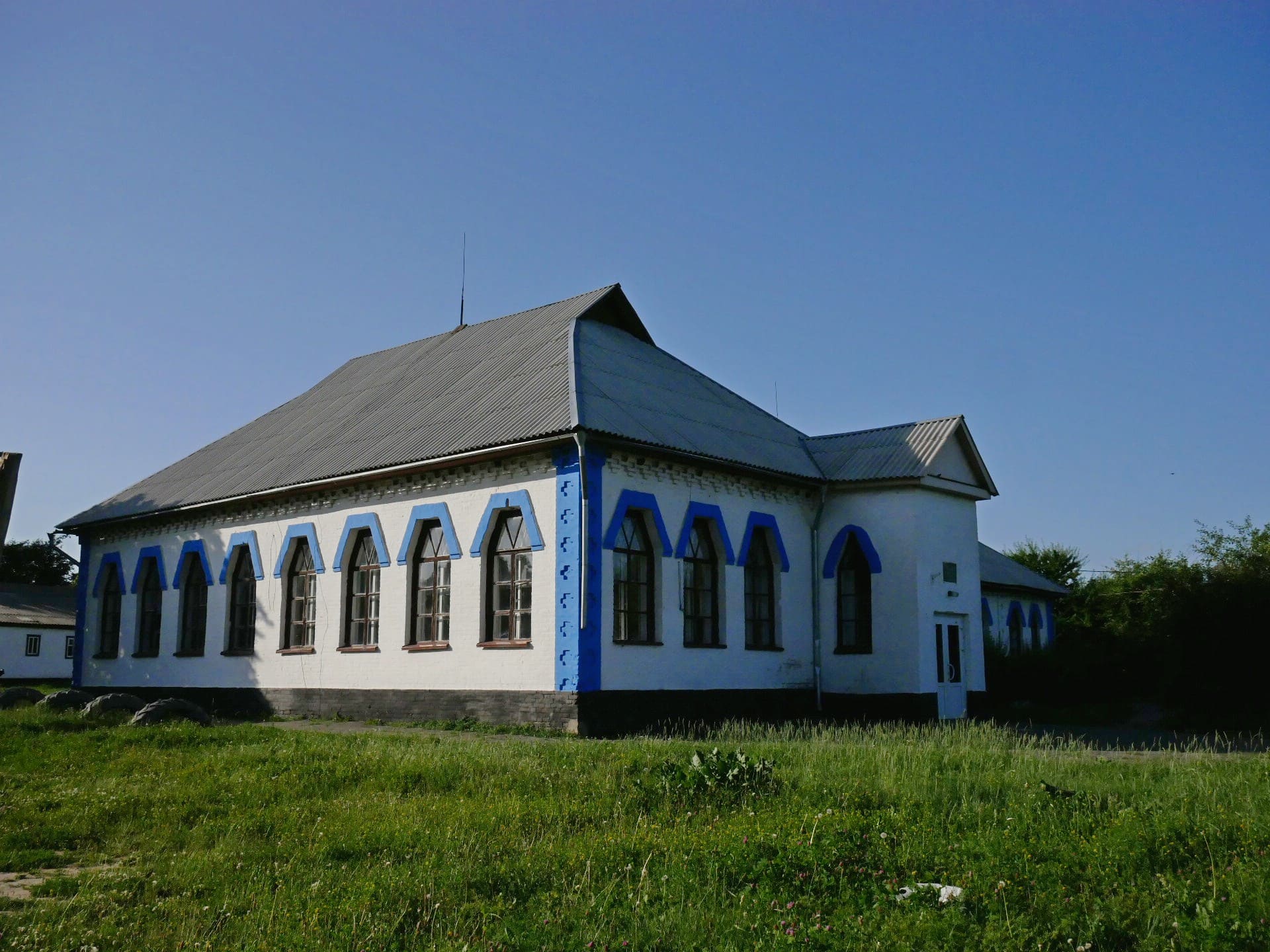
The School at Mlyny
Pisky is the Ukrainian village in Lokhvytsia district, Poltava region. The first mention about the village was in 1092 with the name Pesochen. Modern name has existed since 1600 year.
The village Pisky is located in Poltava region, in north-eastern part of Ukraine, on north east of Lokhvytsia district in forest-steppe zone. There were seven factories and one Orthodox Uspenska church (1818), that was built of stone.
Panas Myrnyi wroted about life in Pisky of 1870s in his novel “Do oxen roar, when manger is full?” (Хіба ревуть воли, як ясла повні?).
In 1867-1879 railway line Kremenchuk-Bakhmach was tracked across the village. There was a folk school. In 1910 Pisky was in the centrum of district and had 772 yards, 4347 citizens, 25 windmills, 6 forges, 2 brickworks, 31 groceries store, folk school and church’s school.
On January, 1918, Bolsheviks captured the village. During the fighting with Denikin, in 1919, underground staff of the guerrillas has existed in the country. In 1920 committee of poor folks was created. Revolutionaries events affected on cultural life of the village. In 1921 seven years’ plan started and all kids begun to study. Education was in two alterations. School located in a few educational corps. Junior classes had lessons in old provincial school, then there was a pharmacy. Pupils of high school were learning in count Galagan’s building of savings.
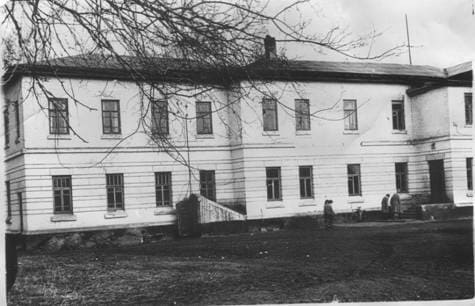
County of Galagan. Public property
In 2019 only a tumbledown cellar left from county, you can find here bricks with Galagan’s sign.
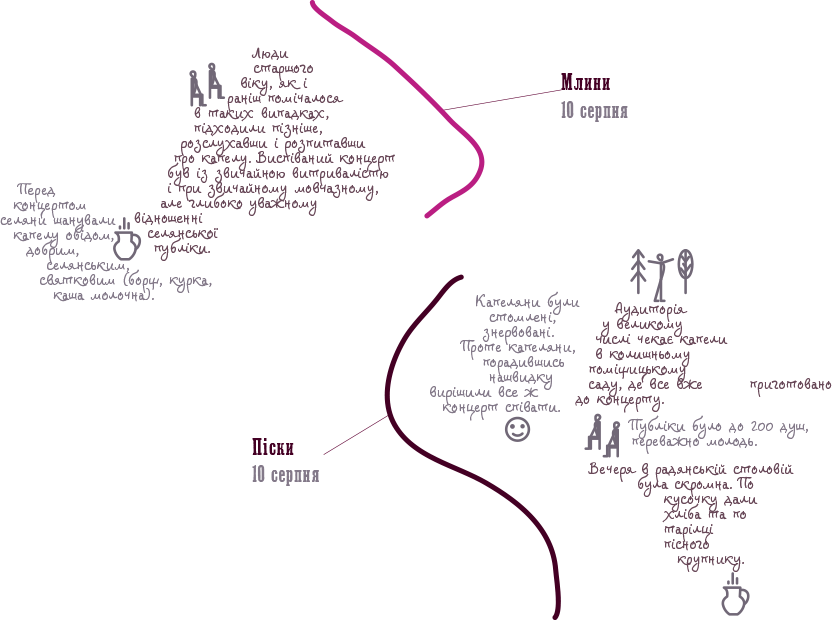

Cultural life in Romny at the beginning of XX c.
Opening of the city garden was on May, 1918, in which local musical collectives and members of Kyiv’s soiuz of orchestrators have participated. A symphony orchestra under the direction of M.H. Svet and H.I. Suharenko always played in the garden.
In April, 1919, musical and dramatic school was opened.
History of Romny’s folk choir has started from choral capella, that was founded in 1920. Songs of kobzars Ivan Zaporozhchenko, Musiy Oleksienko sounded at that time. Debut of future national artist of USSR, Iryna Ivanivna Volykivska, was on Romny’s scene.
Cinema appeared in the town at this period. In cities garden first cinema with name bioskop was opened. Here are some names of the films, that were showed there: “Poison Damned”, “Life is homeless, life is lonely”, “Days of mourning and sorrow in Moscow”, “Princess of daydreams”.
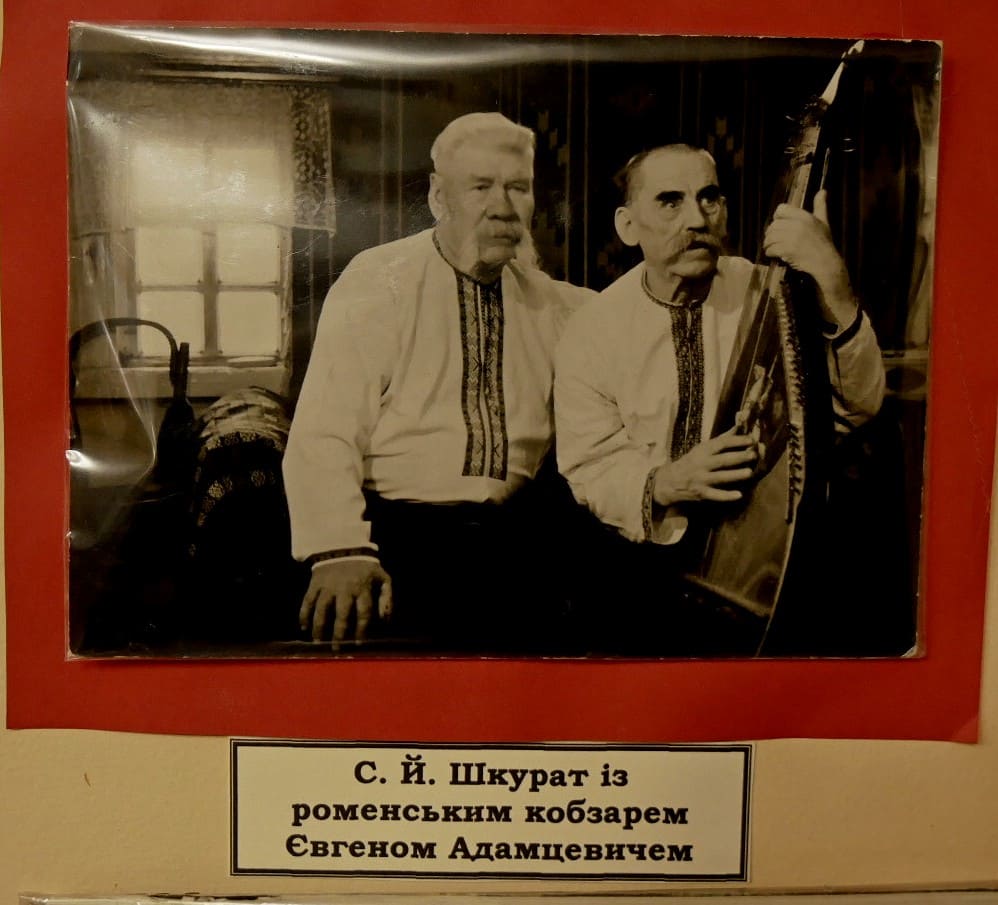
Romny’s actor of theatre and cinema Stepan Shkurat. From archive in Romny’s museum of local history
At this period Romny became peculiar cultural centre of the region. This is evidenced by stormy theatralic life of that time. From 1882 in Romny was amateurish theatre. Exactly on its stage was debut of coryphaeus of Ukrainian scene Hanna Petrivna Zatyrkevych-Karpynska.
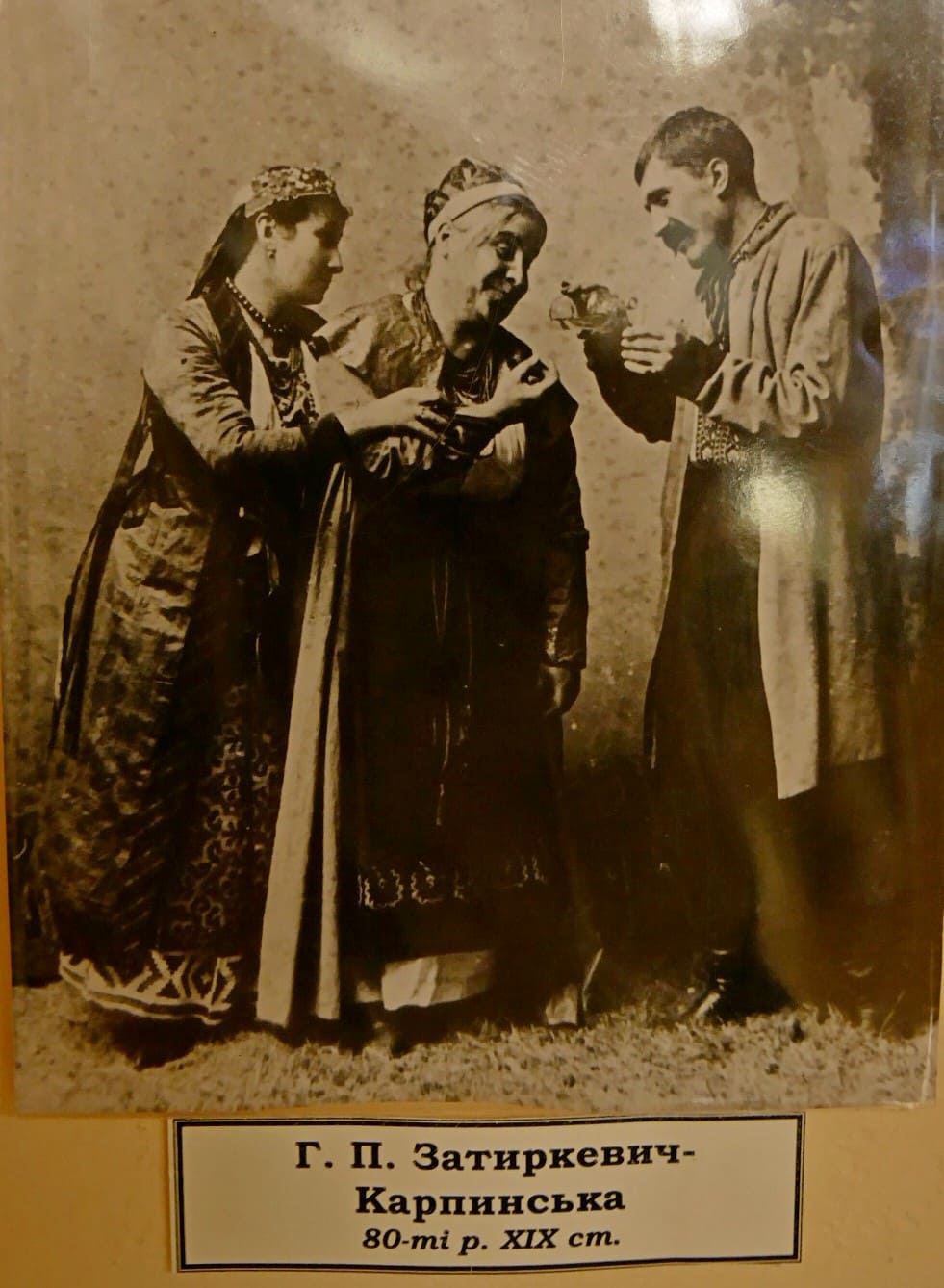
Ukrainian actress Hanna Zatyrkevych-Karpynska (in the middle). From Romny’s museum of local history
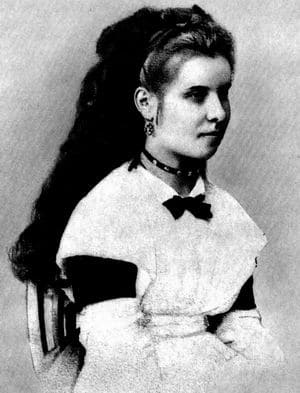
Hanna Zatyrkevych-Karpynska. Public property
Maybe, exactly, she invited to our city on spring, 1918, her colleagues, Kyiv’s actors from group of M. Sadovskyi. Mykyta Mishenko’s publication in the newspaper “People’s word” was about this: “Romny’s association “Prosvita” has invited actors and actresses from M. Sadovskyi’s theater company for all summer season. S. Stadnyk, L. Kovalevska and Nizhynska, O. Korolchuk, I. Ovdienko, I. Kovalevskyi agreed and came to Romny. On Saturday, 25th of May, historically beloved in Ukraine I. Kotlyarevskyi’s play “Natalka Poltavka” opened the theatre. In Ukraine old and young knows this strange pearl, so how much and where it will be showed, walls are cracking, especially, when decent artists are playing. We, Romny’s citizens, are lucky to see “Natalka Poltavka” in adaptation of honoured in Ukraine artist Oleksandr Ivanovych Korolchuk from Mykola Sadovskyi’s theatre. For long time different Russian-small-russian companies stumbled to Romny and fed audience with hopak and horilka, and it seemed there will be no end and land to this. But this year fortune smiled to us, and we have happiness to grate honest artists. Impressions from the play are the best. Finally, people of Romny could see their demos not ridiculed, not as blind people, or a drunk-loser, but as an extraordinary artist, that creates beauty, special art and will be equal among other nations of the world”.
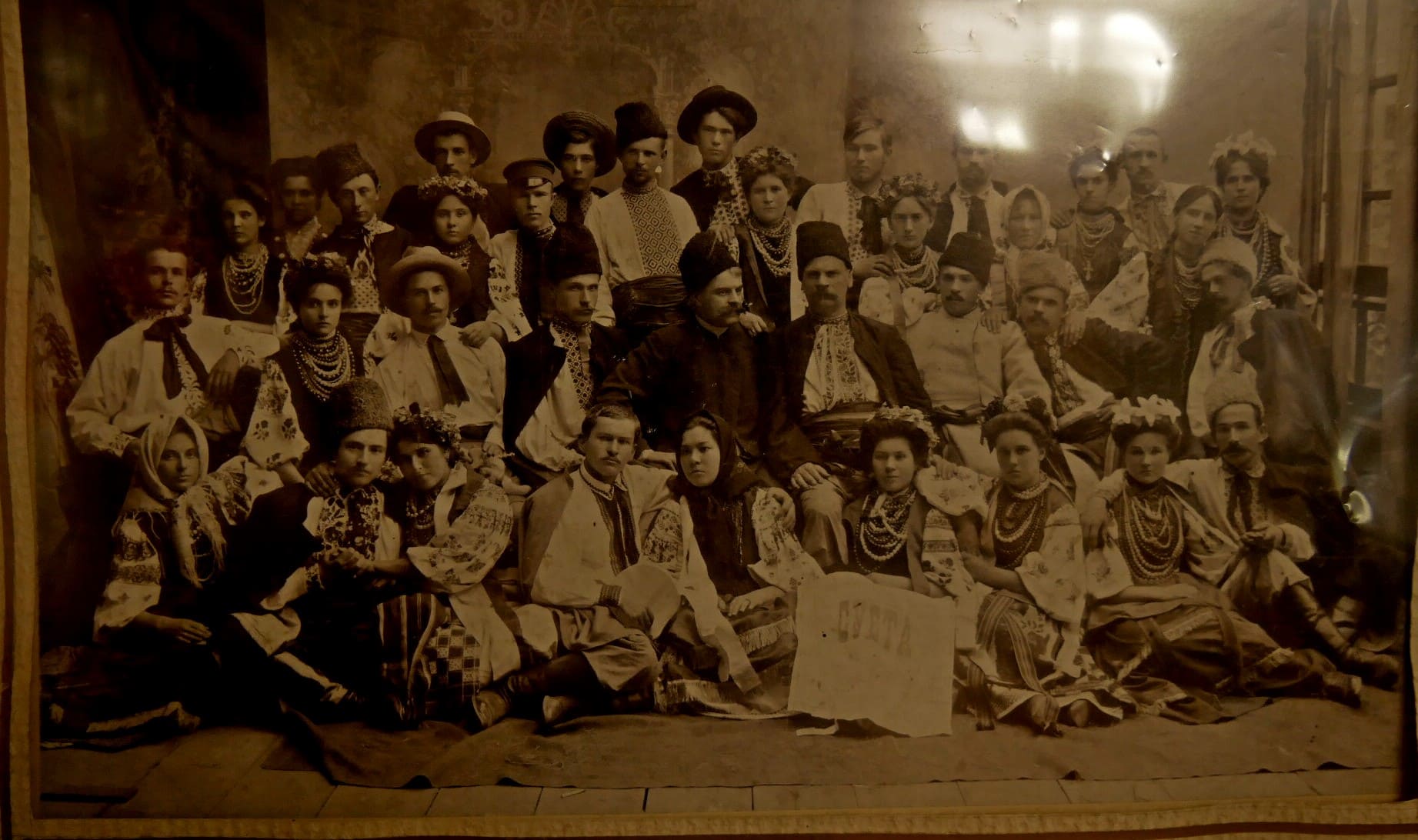
Romny’s theater company. From archive in Romny’s museum of local history
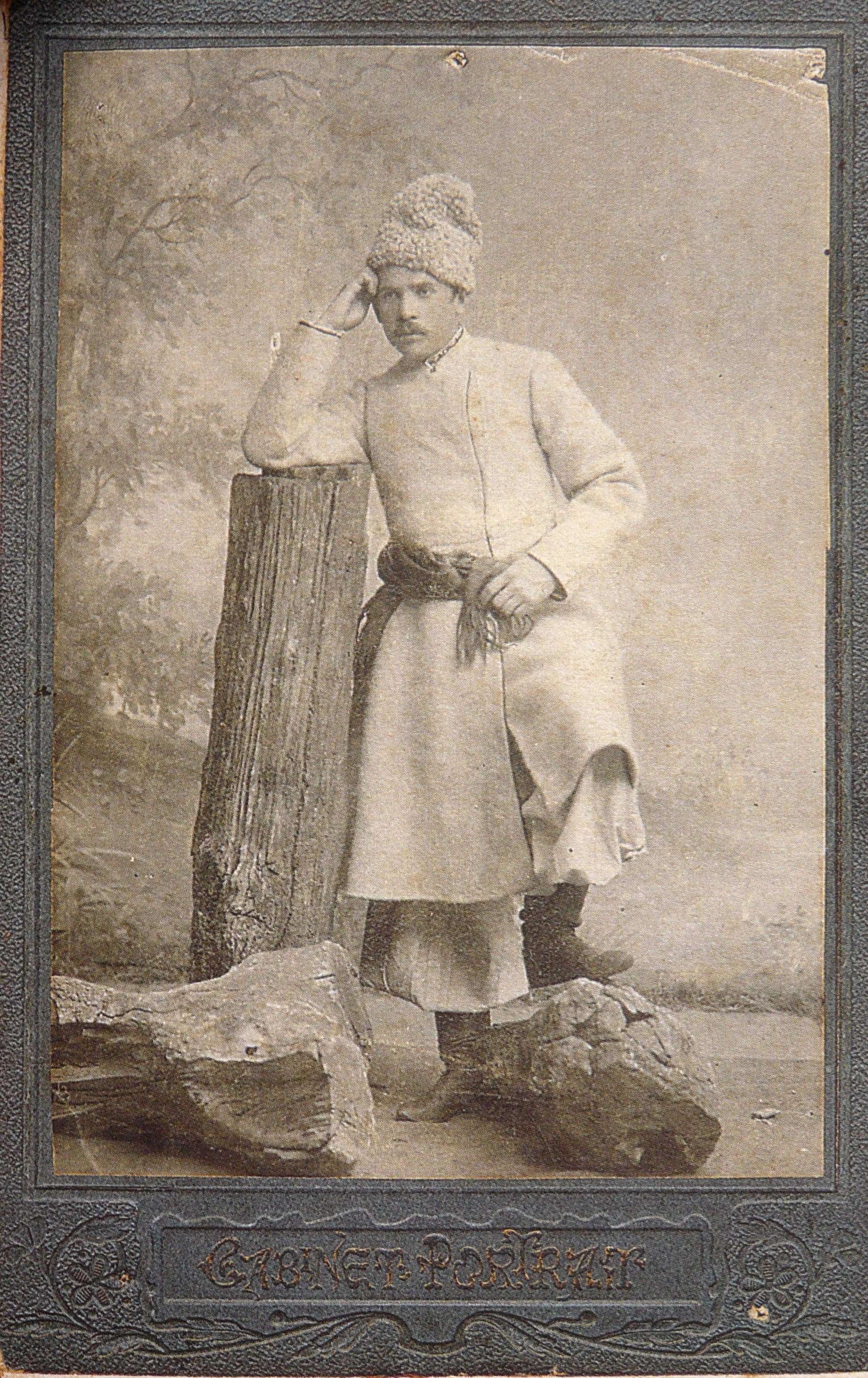
Director of Romny’s dramatic choir in the local national outfit. 1920s. Public property
With installation of Soviet government at the end of January, 1919, theatre in the city didn’t end its existence, because it was popular between population, so authority obviously didn’t want to lose this instrument of influence on masses, that’s why didn’t undertake the elimination of “nationalist” association “Prosvita”. Change of “political weather” firstly reflected only on the name of theatre’s collective: “Ukrainian soviet theatre company at “Prosvita””. And from June, 1920, has already indicated institution of bilshovyk’s government, that took care of artistic institutions at this period (as also in Romny) – “Department of public education” – directly before the name of company, and then the name of the theatre. As we know from posters (they are stored in the department of funds of the State historical and cultural reserve "Posulia" in Romny), Ivan Kavaleridze staged performances at the Romny Professional Theater such as: “The last sheaf” of L. Starytska-Chernyakhivska (premiere was on 20th of June, 1919), “Clever and fool”of I. Tobilevych (premiere was on 18th of July, 1919), “Forest song” of Lesya Ukrainka (premiere was on 4th of August, 1919). I. Kavaleridze’s debut as director was with performance “At the first lump” of S. Vasylchenko on 6th of November, 1918, for which he also created decorations.
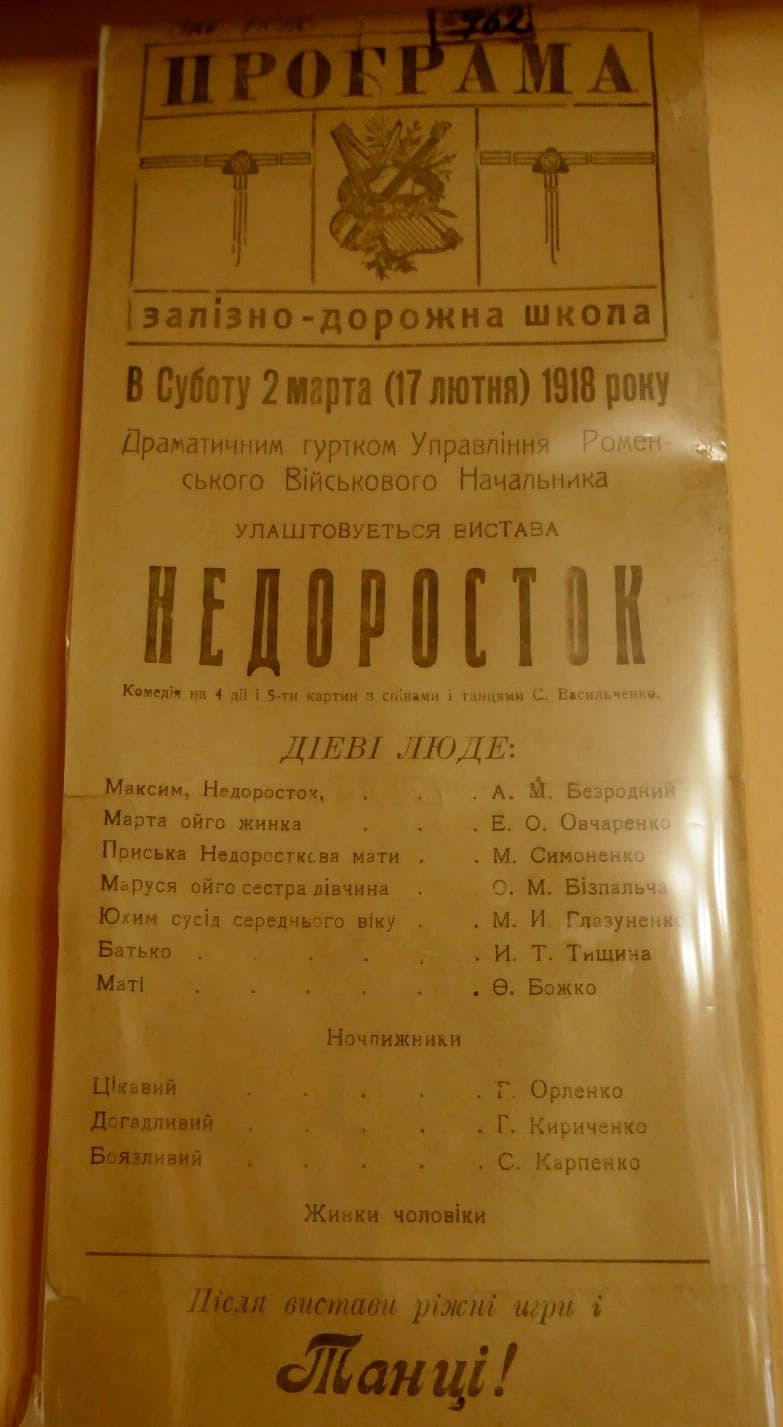
Poster. From archive in Romny’s museum of local history
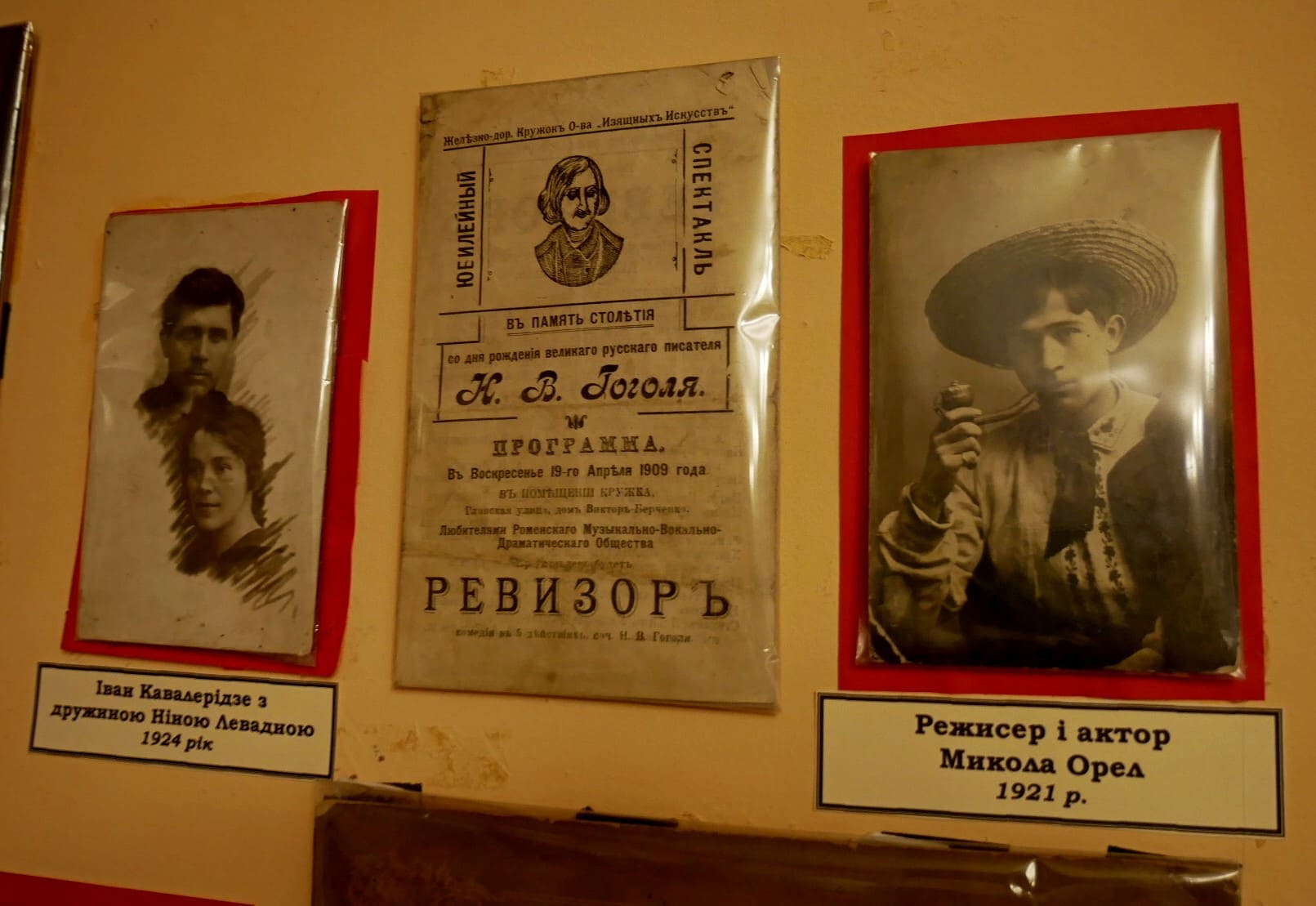
Posters. From archive in Romny’s museum of local history
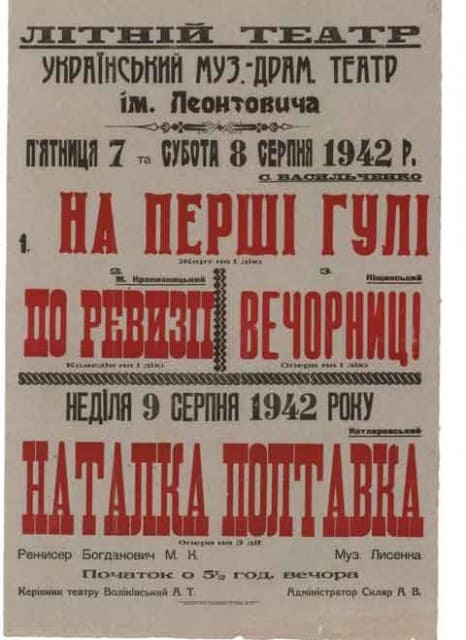
Poster. From archive in Romny’s museum of local history
Especially valuable are evidences from newspapers of this time, that were published in the city. Publications such as “People’s word”, “Bulletin of the Romny Military Revolutionary Committee” (exactly from it started the story of our local newspaper “News of Romny district”), which lately has celebrated its centenary), “News of the Executive Committee of the Romny Council of Workers and Deputies”, “Voice of the villager” and others.
For example, in the newspaper “Voice of the villager” was mentioned about arrival of capella with Stepan Vasylchenko to Romny.
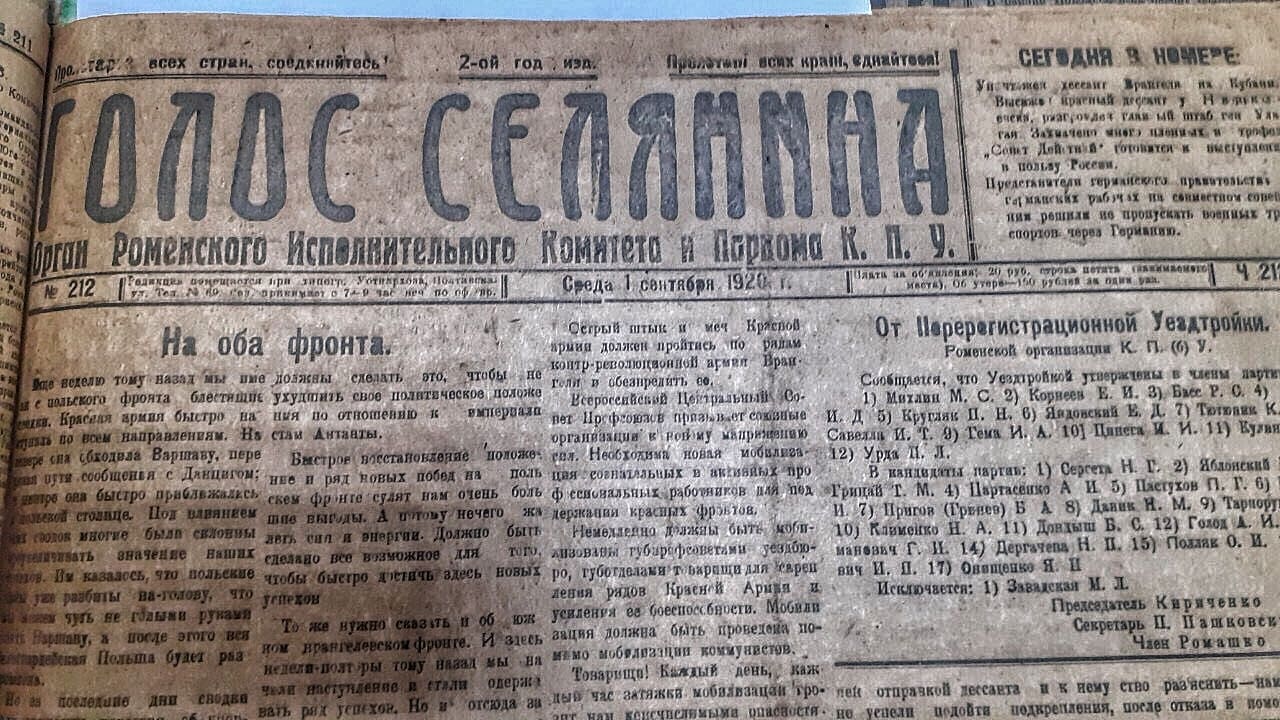
Voice of the villager. From archive in Romny’s museum of local history
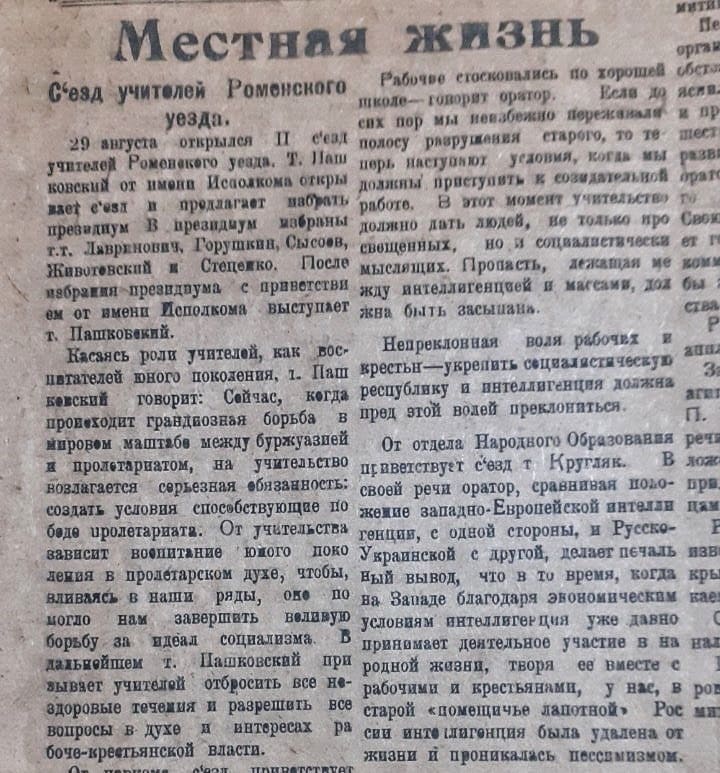
Newspaper “Voice of the villager”. From archive in Romny’s museum of local history
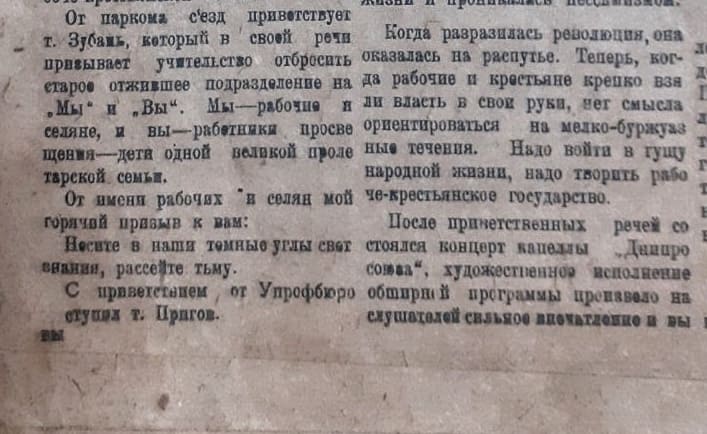
Newspaper “Voice of the villager”. From archive in Romny’s museum of local history
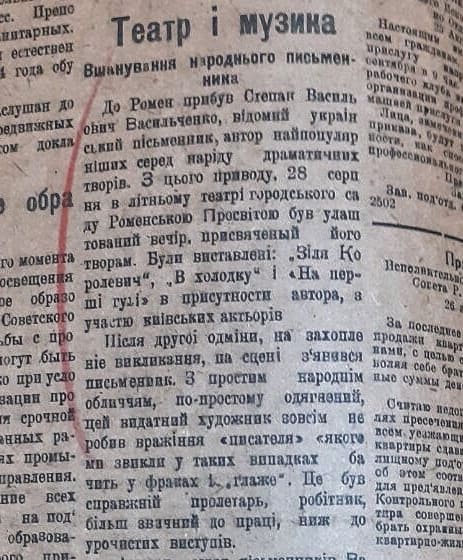
Newspaper “Voice of the villager”. From archive in Romny’s museum of local history
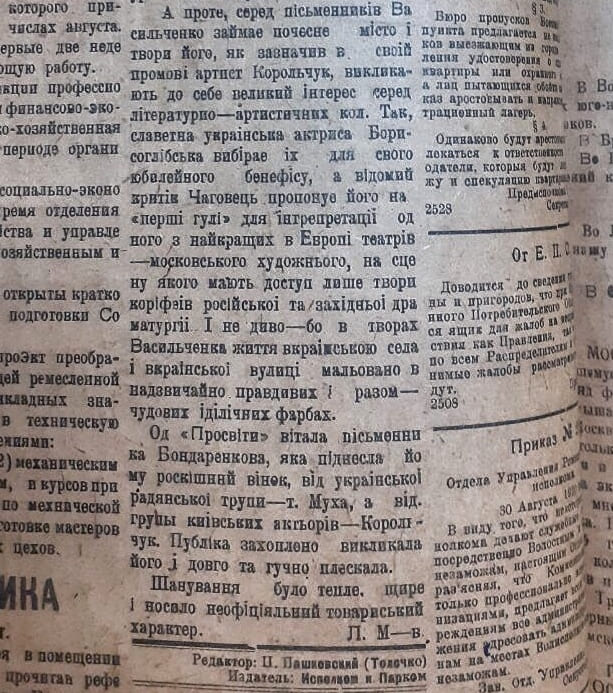
Newspaper “Voice of the villager”. From archive in Romny’s museum of local history
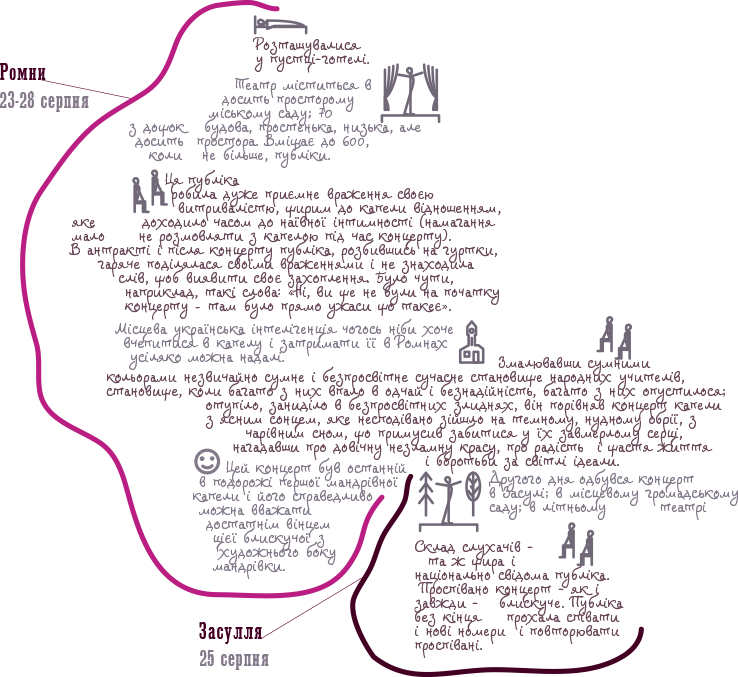
Also people of capella gave concerts in Zasullya, that is located on other part of the city Romny.
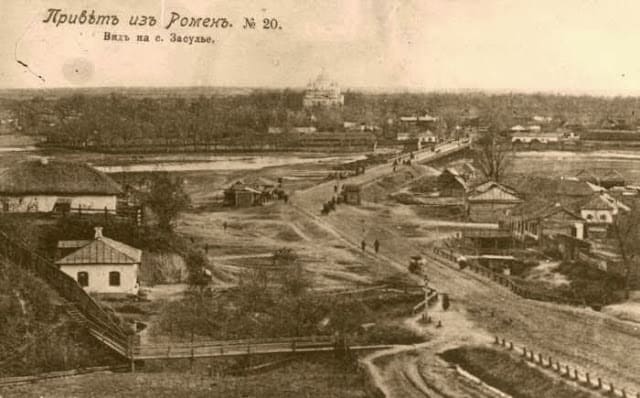
View on Zasullya. From archive in Romny’s museum of local history
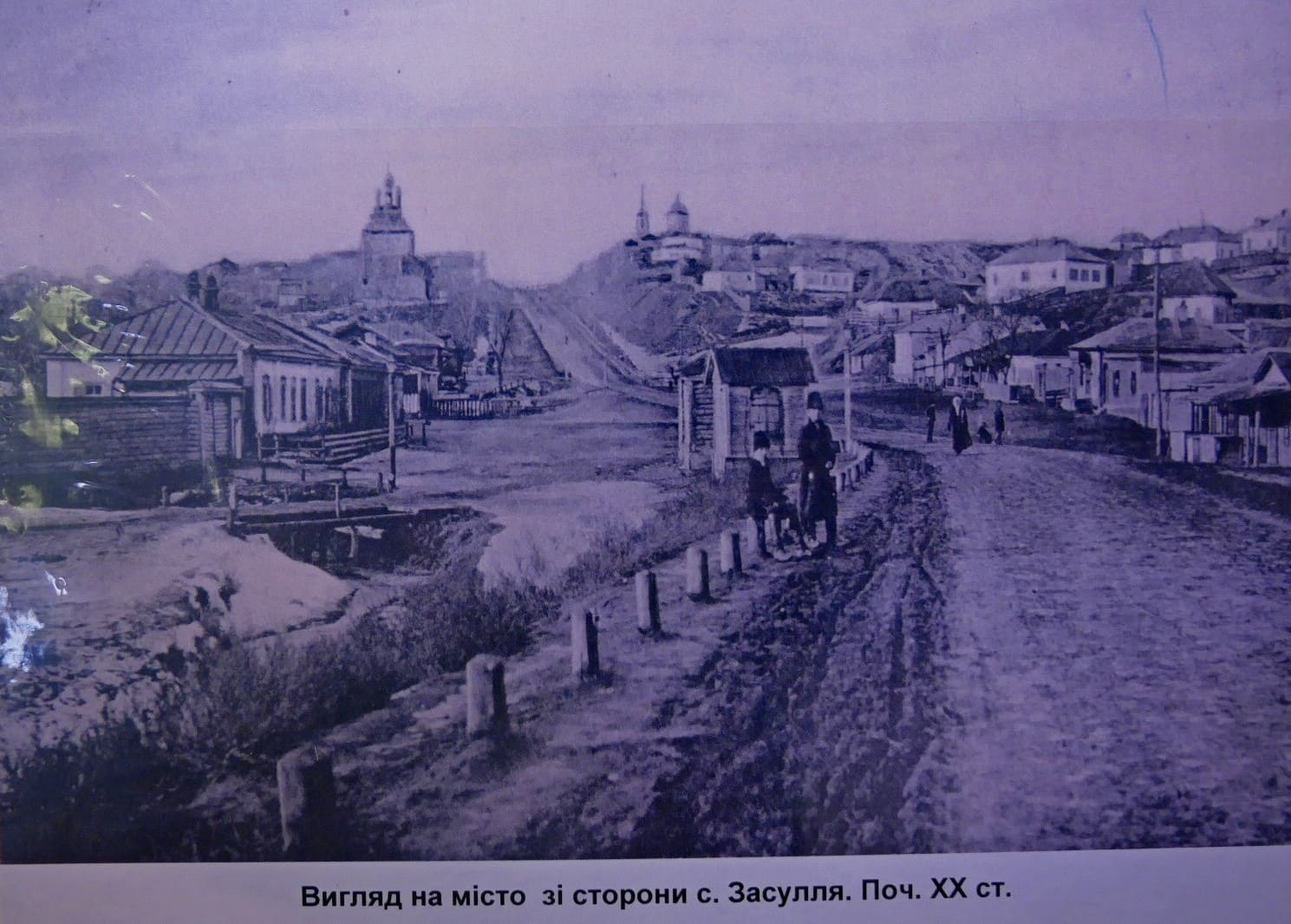
View on Zasullya. From archive in Romny’s museum of local history
City Bakhmach came as a working class village in 60s-70s of XIX century near old countryside Bakhmach during construction of Kursko–Kyivska and Libavo-Romenska railways.
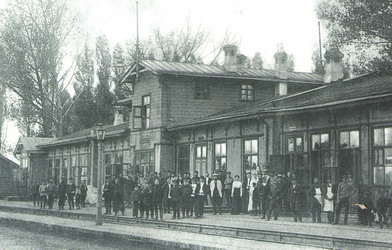
Bakhmach, beginning of XX c. Public property
Bakhmach, beginning of XX c. Public property
“Word Bakhmach belongs to a group of ancient Turkic words, that were used in Ukraine before the Tatars’ irruption. “Bakhmach” means “bashtan”, and argues about the fact that Dukes of Kyiv and Chernihiv settled captive Pechenegs or other revenants from Turkic hordes, who have given the name to their settlement at the end of the first millennium CE”.
Pavlo Skoropadskyi became the hetman of Ukraine on 28-29 of April. One of the hetman’s regiments has located in Bakhmach. Head-quarters of hetman’s regiment located in the school of the village Bakhmach. Hetman’s Cossacks were lodged at the expense of proprietaries of local counties: two Cossacks on garden.
Total mobilization into hetman’s army was announced. But this mobilization went supinely: people were tired of the war and the revolution, that’s why young boys deserted from the army.
In summer 1918 massive disposition of food from Ukraine begun. If earlier Bilshovyky had robbed Ukrainian country folks, now cattle were bunched and fowls were brought from the nearest villages to station Bakhmach to send it alive and for provision according to interests of German alliance. Places, where cattle were killed, had located on stations Bakhmach-Kyivskyi and Bakhmach-Gomelskyi.
On 19 th of July was strike of Bakhmach’s rail men.
Russian troops begun new intervention into Ukraine in the second part of November. On January 20 th in 1919 Bakhmach was occupied by Bilshovyky again. Horrible times of misery, terror, destruction of churches and deportation of people took place.